Start with the sentence, not the tool
What kills most short ads is not image quality or font choice. Far more often, the viewer did not understand in the first second why any of this mattered to them, so they swiped.
Before you open any tool, write three lines on paper:
- Who exactly is the buyer? Not "everyone," but "a woman running a home bakery who wants packaging that looks professional."
- What pain do they feel before they ever hear of you? Write it in their words, not in marketing words.
- What is the offer in one sentence? The product, the result, the next step.
Those three lines are the ad. Everything after them is execution. And if the offer is weak or pointed at the wrong audience, AI will just build you a good looking ad that sells nothing, only faster.
Pick the ad format before you write a word
Two formats work well in vertical video, and each has its place:
Talking face ads (UGC style). A person looks into the camera and talks about the product the way a real customer would recommend it. Good for anything that needs trust: skincare, services, apps, anything where the buyer is quietly asking "has anyone actually tried this?" The face is the persuasion.
Visual scene ads with voiceover. No face. Moving shots, a voice narrating and explaining, on screen text. Good for explaining an idea, running a comparison, showing a before and after, or a product that is understood by looking rather than by listening.
Rule of thumb: if your customer's objection is "I don't trust this," go with the face. If it is "I don't get it," go with the visuals.
The technical shape is basically fixed: vertical 9:16, and short. The viewer gives you seconds to make the case, and an ad that says one thing clearly beats an ad that says five things quickly.
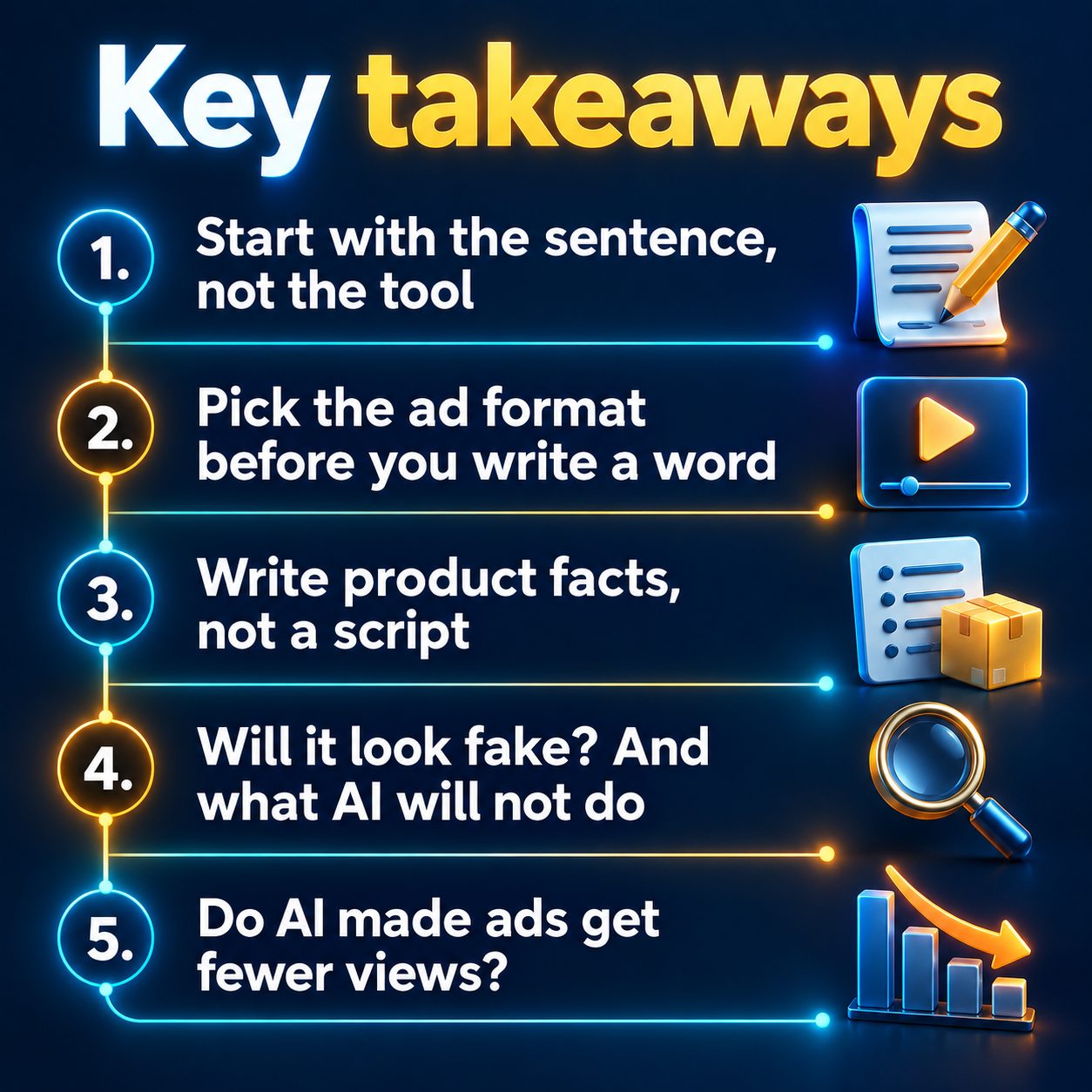
Write product facts, not a script
This is the step most people skip, and then they complain the output feels "generic and cold."
Do not ask the AI to "write me an ad." Give it precise raw material instead: the product name, who it is for, three real selling points (not slogans), the offer if there is one, and the call to action. The more specific that material is, the closer the copy lands to your voice and the further it gets from canned filler.
In MaqtAi, for example, the presenter ad is built from the product facts you enter yourself, on a fixed six scene structure, and it claims nothing beyond what you wrote. You can also upload up to six product images that fill the screen while the presenter keeps talking, as long as the hook stays at the start and the call to action stays on their face at the end. Your images appear exactly as you uploaded them, with no redraw. And if you want a video that talks about the topic with no sales tone at all, leave the product fields deliberately empty and it turns into a talk about the idea rather than an ad.
Spend five minutes writing those facts. It saves you an hour of regenerating.
Will it look fake? And what AI will not do
Let's be straight about this, because it is the question keeping you from starting.
Voice clones and generated faces have improved a lot, but they are not perfect. Mouth and hand movement is the hardest part of the problem, and voice and face cloning tools are still getting better. If you clone your own face, a clear front facing photo with good lighting and a calm audio recording in a quiet room make the single biggest difference to the result.
There are practical limits worth knowing up front rather than after: the presenter ad runs on the standard presenter engine and needs a paid plan, you pick a length of 30, 60 or 120 seconds but no motion level or quality tier, and once it renders you can only edit the music and the on screen text, because changing the words or the voice would break lip sync. For the same reason, you currently cannot generate another language version of a video with a talking face in it.
Most important: AI will not fix a weak offer, it will not know your audience for you, and it does not carry responsibility for what you claim about your product. Reviewing before you publish stays your job, especially in sensitive spaces like health or money.
Do AI made ads get fewer views?
No. Platforms do not downrank a video just because AI made it. TikTok, Instagram, YouTube, and Facebook rank short video on viewer behavior: watch time, completion rate, likes, shares. How it was produced is not a ranking signal.
Three things actually hurt you: spam patterns (the same file across many accounts, or repeated near identical posting), a weak first few seconds, and ignoring the disclosure rules for realistic synthetic content. The disclosure itself does not reduce reach, but ignoring it can get the video taken down.
And about the quiet worry: yes, some people will notice it is AI. A few of them will say so in the comments. But the buyer who actually needs your product will ask about price and shipping, not about your editing tool.
Don't make one ad, make three
This is the line between people who try it once and people who build something.
A single ad tells you nothing. If it flops, you will not know whether the problem was the first line, the offer, or the audience. So lock the product and the offer, and change only the hook: one version that opens with a question, one that opens with the problem, one that opens with the result. Post all three and watch which one holds viewers to the end.
Then repeat what worked instead of starting from zero every time. And if part of your customer base speaks another language, visual scene ads can be regenerated on a paid plan with a voiceover and subtitles in a second language while the images stay exactly the same. That is the cheapest way to talk to an extra market.
Keep the files you download, too. A published video stays on your account, but you are better off building your own archive.
The small step that ends the stalling
Every week you spend weighing a professional shoot against postponing the idea is a week your account learns nothing about its audience, and you learn nothing about which sentence makes people stop. Your competitor posting a simple ad every few days does not have better taste than you. They have more data.
A shoot costs you time, gear, and maybe an actor, all before you know whether the idea works at all. The alternative is to write your product facts tonight, generate one ad, and post it tomorrow.
A new account on MaqtAi gets 450 free credits after email verification, no card required, which is three or four watermarked videos on the still frame Express tier, enough to see with your own eyes how your ad comes out before you pay anything. If you want to see the whole path first, how it works in three steps explains it in a minute.
Doing this by hand is the part most people quit at. MaqtAi writes the script, narrates it, generates the visuals and captions, and assembles the faceless short for you. Verify your email and you get 450 free credits: about 3 videos on the still-frame tier, or one with AI motion. Free renders carry a watermark.
Try it on your niche freeFrequently asked questions
Do I need editing experience to make an AI ad? No. You write your product facts and pick the format and the voice, and the rest is assembled automatically into a vertical video, watermarked until you are on a paid plan. The longest part is shaping the offer and the first line, not the tools.
Can I use these ads commercially and on client accounts? The videos you generate are yours. You can post them, monetize them, and use them commercially on your channels. Just follow the platform rules on disclosing realistic synthetic content.
How long does the first ad take to put together? If your product facts are ready, it is usually a one evening job, and the render itself takes a few minutes. Generating three versions to test hooks fits in the same session.
Can I use my own face instead of a stock presenter? Yes, on a paid plan, by cloning your voice from a short recording and adding a clear front facing photo, with explicit consent. The feature is still in Beta, so the quality of your photo and recording is what decides the result.
Results vary from business to business, and nothing in this article is a promise of sales or income.