
Yes, but not as an income stream at first
The question hiding under "is it worth it" is usually "will this pay me". Honest answer: not quickly, and not much per view. Shorts share ad revenue from a pool, and the rate per view sits far below what a regular long-form video earns. If your plan is rent money from Shorts by autumn, you will be disappointed.
Here is the frame that holds up instead. Shorts are the cheapest distribution available to somebody with zero audience. The Shorts feed does not care how many subscribers you have. It shows a video to a small group of people, watches what they do with it, and decides from there. That is a lottery ticket you get to buy every single day for free. Long-form does not behave that way. A brand new channel dropping a ten minute video into the void mostly gets silence.
So Shorts are worth it, as the thing that builds the audience your other work needs.
What Shorts actually pay, and the door that matters
There are two ways into the YouTube Partner Program, and knowing which one you are walking toward changes everything. You can qualify with 1,000 subscribers plus 4,000 valid public watch hours in 12 months, or 1,000 subscribers plus 10 million valid public Shorts views in 90 days, according to YouTube's own eligibility page.
Read those two again. The Shorts door is brutal. The watch hours door is reachable for an ordinary person making decent videos. That is the whole strategic insight most "are Shorts worth it" arguments miss: Shorts are not the destination, they are the on-ramp. They earn attention and subscribers, then a regular horizontal video earns the watch hours and the better ad rate.
If you never want to make long-form, Shorts are still worth doing, just not primarily for ad revenue. They are worth it for audience, for a portfolio, for affiliate or product traffic, for proving to yourself you can hold a schedule. Treat ad money as the last thing that arrives, not the first.
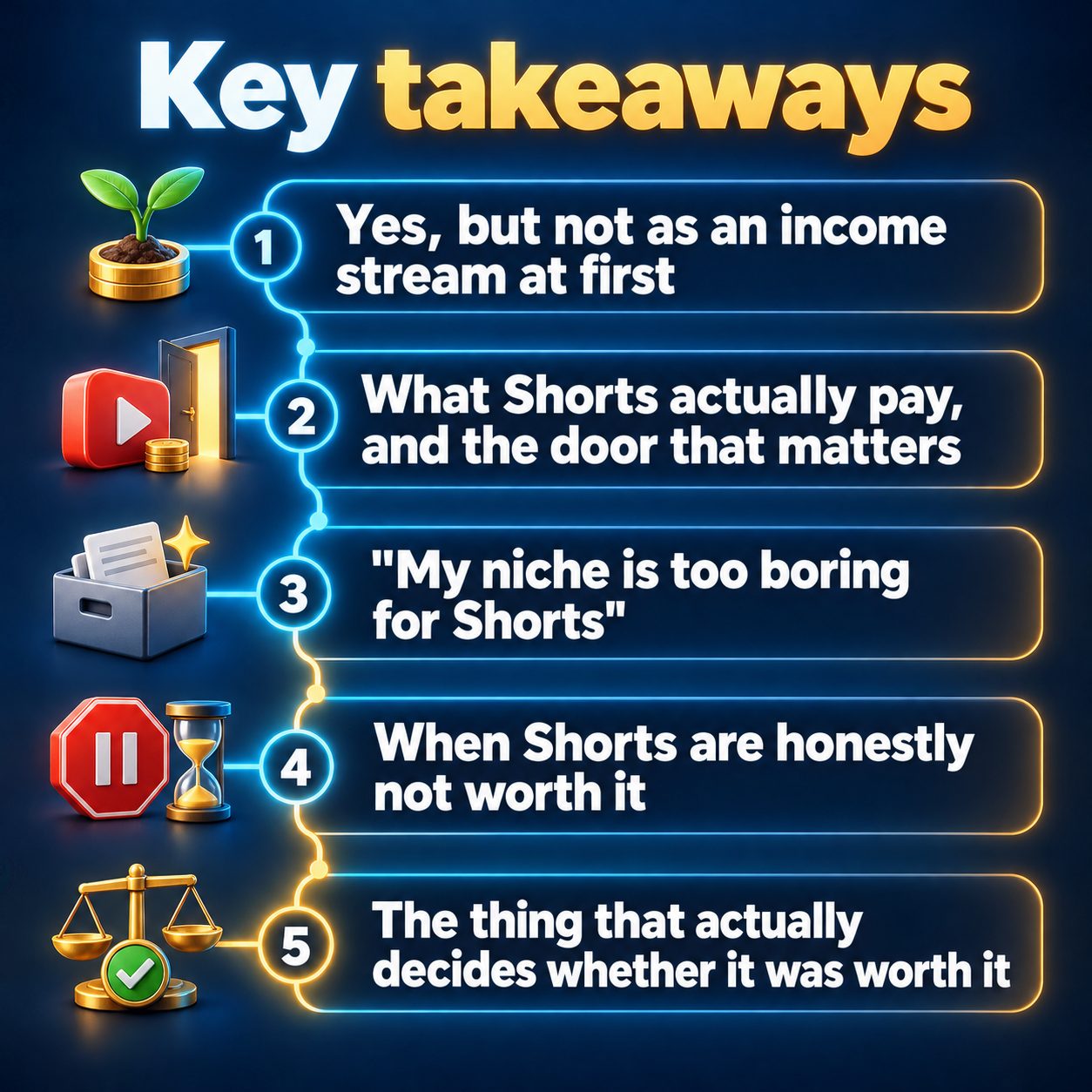
"My niche is too boring for Shorts"
This one comes up constantly, and it is almost never true. What is true is that some niches need a different hook.
Entertainment niches hook with spectacle. Everything else hooks with tension. A history channel does not open with "today we are talking about the Roman navy". It opens with the thing that makes you need the next sentence. A finance channel does not open with a definition. It opens with the mistake the viewer is probably making right now. A local business does not open with its logo. It opens with the question its customers ask on the phone.
So before you decide your subject is unwatchable, test whether you have actually tried a hook-first structure, or whether you have been writing intros. Those are different crafts. Boring topics with a sharp first line beat exciting topics with a slow one, every time.
And yes, faceless works. Nobody in the feed is checking whether a face appears. They are checking whether the next three seconds are worth staying for. If you want to see which subjects hold up without filming, the use cases page walks through the formats that suit voiceover and visuals rather than a camera.
When Shorts are honestly not worth it
I would rather you skip Shorts than waste four months, so here are the cases where I would say no.
If you can only post once a week or less, Shorts are a poor bet. The format runs on volume of attempts because each video is a small test. Weekly posting on long-form can work. Weekly posting on Shorts mostly starves.
If you need income this quarter, Shorts are the wrong lever. Client work pays faster. Shorts pay later, if at all.
If your plan is to reupload other people's clips or spin out near-identical videos in bulk, do not bother. YouTube's monetization policies on inauthentic content target mass-produced and repetitious material, and channels built that way tend to hit a wall right where they were expecting a payout. Making videos with AI tools is fine. Making the same video over and over is not.
And if you are hoping the platform quietly punishes AI production, it does not. Feeds rank on viewer behavior, not on how a file was made. What you do owe viewers is disclosure when content is realistic and synthetic, which YouTube requires creators to flag when uploading. The label does not hurt distribution. Skipping it can.
The thing that actually decides whether it was worth it
Cadence. Not talent, not gear, not your niche.
Most channels that "tried Shorts and it did not work" made a handful of videos over a few weeks, got quiet numbers, and stopped before the algorithm had enough data to know who to show them to. A couple of dozen videos in a consistent niche is roughly where patterns start to show. Before that you are reading noise.
So the practical plan looks like this. Pick one niche and stay in it for a full month, because switching resets the signal. Write hook first and cut everything before the tension. Keep videos short and end on a beat rather than a fade. Batch your work, so a bad Tuesday does not break the streak. Then, once you have a shape that holds attention, start putting a horizontal version of your best subjects on the same channel and start collecting watch hours toward the reachable monetization door.
The honest failure point in that plan is week three, when the novelty is gone and the numbers are still small. That is exactly why removing production friction matters more than people think. MaqtAi takes a niche and a topic and produces the finished vertical video, script, AI voiceover, moving visuals and animated captions, then posts it to your connected accounts on the cadence you set, which turns "I need three hours tonight" into a decision you already made on Sunday. The features page covers the scheduling and Autopilot side if that is the part you are worried about.
What waiting actually costs
Nothing dramatic happens if you wait another month. That is the problem. The channel just does not exist, the algorithm collects no data about who your videos suit, and somebody with a worse idea and a working schedule builds the audience you wanted, one video at a time.
The fastest way to end the debate is to stop evaluating and make one. One video tells you more about whether Shorts fit your life than a week of reading opinions like this one. New accounts get free credits after email verification, no card, which is enough to make your first few videos and see the format with your own topic in it. Check the pricing page for how credits work once you are past that.
One video today. Then decide.
Doing this by hand is the part most people quit at. MaqtAi writes the script, narrates it, generates the visuals and captions, and assembles the faceless short for you. Verify your email and you get 450 free credits: about 3 videos on the still-frame tier, or one with AI motion. Free renders carry a watermark.
Try it on your niche freeFrequently asked questions
Do Shorts hurt my long-form views? No. Shorts and long-form are recommended through different surfaces, so a Short doing well does not take views from your regular videos. What it can do is bring in subscribers who have never watched a long video from you, which is why pairing the two works better than either alone.
Can a channel get monetized on Shorts alone? Technically yes, through the Shorts view route to the Partner Program, but the long-form path of 1,000 subscribers and 4,000 watch hours is far more reachable for most creators. Use Shorts to build the audience, then let horizontal videos carry the watch time.
Am I too late to start Shorts? No, because the feed serves videos to people who do not follow you. Unlike a subscriber-driven platform, a new account is not structurally disadvantaged. Being late only matters if you are copying what is already saturated instead of picking an angle you can hold.
How long before I know if it is working? Give it a month of consistent posting in one niche before you judge anything. Watch retention and completion rather than views early on, since those tell you whether your hooks and pacing land, and they move before the view counts do.
Results vary, and nothing here is a guarantee of income.