
It is not the algorithm. It is your first two seconds.
The instinct when a Short gets 12 views is to blame the platform. But YouTube Shorts, TikTok, and Instagram Reels all work the same way: they show your video to a small test audience first. If those people swipe away in the opening second or two, the platform stops pushing it. Your video did not get suppressed. It got tested and lost.
This is actually good news. It means the fix is inside the video, not some mystery setting you missed. The single biggest thing separating Shorts that reach thousands from Shorts that reach twelve is the opening hook.
A hook is the first sentence or visual that stops the scroll. "Three things you should never say to a narcissist." "This abandoned hospital has been hiding a secret since 1987." "Most people get this wrong about compound interest." The pattern: curiosity, specificity, an open loop the viewer needs to close.
If your first two seconds sound like an introduction ("Hey guys, welcome back, today we are going to talk about..."), the viewer is already gone.
Five things quietly killing your view count
Beyond the hook, here is what else tends to go wrong:
1. Pacing is too slow. Short-form video rewards density. If you take 8 seconds to say what could take 3, viewers leave. Every sentence should either deliver a payoff or build tension toward one.
2. You are posting once a week or less. Shorts are a volume format. The algorithm needs data points to learn who your audience is. Posting one Short every few days does not give it enough signal. Daily posting, or close to it, is how most small channels break through.
3. Your topics are too broad. "Productivity tips" competes with everyone. "Productivity tips for night shift nurses" competes with almost nobody. Niche down until you feel slightly uncomfortable. That is probably the right level.
4. No captions. A significant portion of viewers watch with sound off. Animated captions are not optional anymore. They keep eyes on your video even in silent scroll mode.
5. You are obsessing over thumbnails. Unlike long-form YouTube, Shorts autoplay in the feed. Nobody clicks a thumbnail to find your Short. Your hook IS your thumbnail. Spend your energy there.
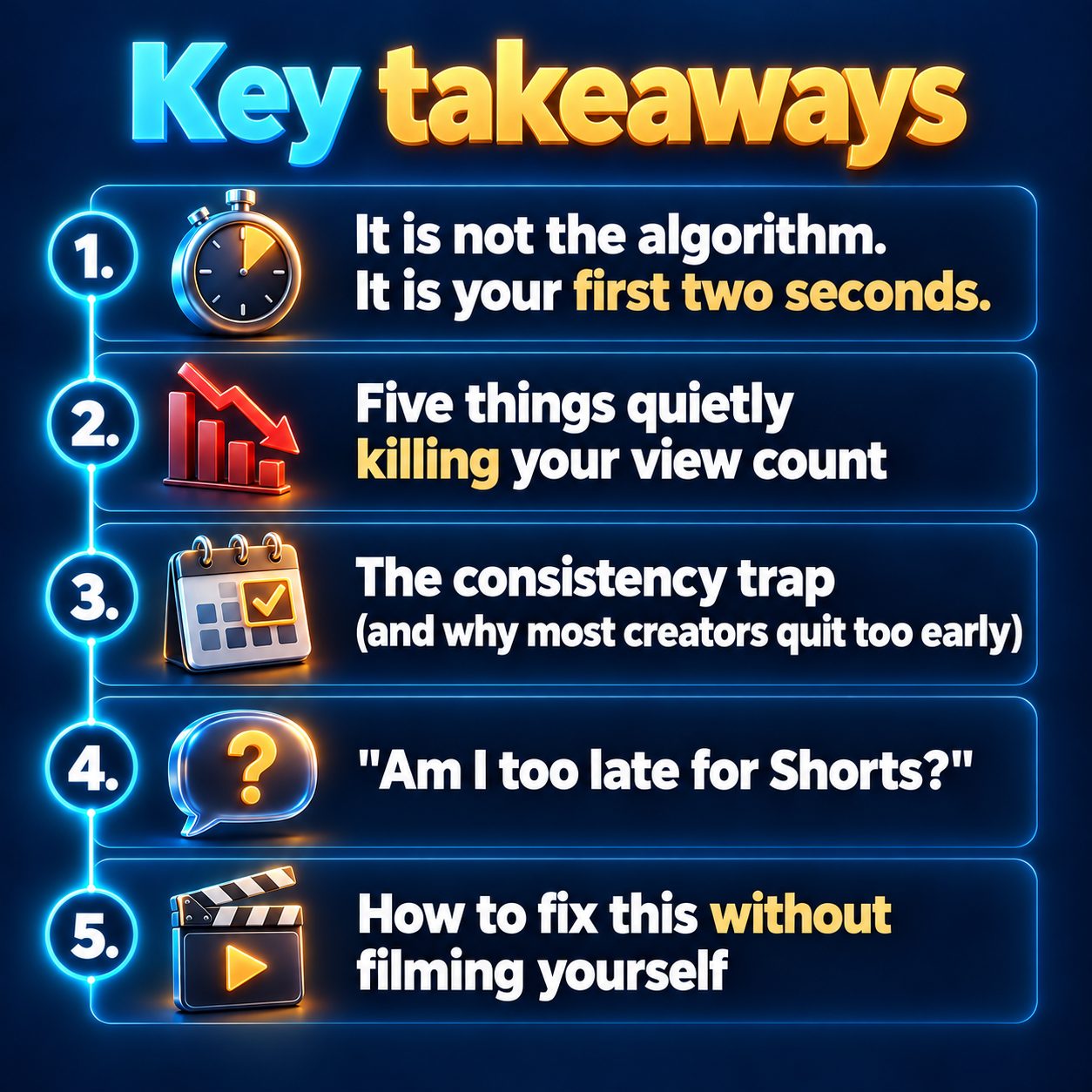
The consistency trap (and why most creators quit too early)
Here is what nobody tells you: your first 30 to 50 Shorts are mostly for the algorithm, not for viewers. The platform is learning what your channel is about, who responds to it, and how to categorize you. During that phase, view counts will be low and erratic. That is normal.
The creators who break through are rarely more talented than the ones who quit. They just kept posting through the ugly phase. The ones who stopped usually gave up around video 15 and concluded "this doesn't work."
If you are posting daily and seeing zero traction after 50 videos, then change your approach: different niche, different hook style, different pacing. But if you have posted 10 Shorts over the last two months, you have not actually tested anything yet. You have just dipped a toe in.
"Am I too late for Shorts?"
No. YouTube Shorts crossed over 70 billion daily views and YouTube keeps expanding how Shorts are surfaced through dedicated shelves, search results, and suggestions. The format is still growing.
What IS true: the bar for quality rises every year. A slideshow with a robotic voice worked in 2022. Today, viewers expect real motion in the visuals, natural-sounding narration, and tight scripting. That does not mean you need a film crew. It means the production floor has risen, and meeting it matters.
No platform down-ranks a video just for being AI-made, either. TikTok, Instagram, YouTube, and Facebook rank Shorts by viewer behavior (watch time, completion, shares), not by production method. What DOES hurt reach: spam patterns like posting identical files across many accounts, weak opening seconds, or ignoring a platform's AI-disclosure rule for realistic synthetic media.
How to fix this without filming yourself
Here is a practical path if you want to post daily Shorts without being on camera:
Pick one niche and commit. Scary stories, personal finance, historical mysteries, motivation, true crime, dark psychology. Whatever pulls you in. One niche, one channel, at least 30 days before you judge results. Not sure which niche fits? Browse 19 faceless niches to find one that clicks.
Write hook-first scripts. Start every script with the most compelling sentence. Not context, not an intro. The hook.
Use real motion and captions. Static images with a voiceover feel dated. Animated visuals and animated captions are the baseline now.
Post every single day. Or as close to daily as your workflow allows.
This is where the production bottleneck usually hits. Writing, narrating, editing, captioning, and publishing one Short a day takes real time. If you are doing it all manually, you will burn out around week two. That burnout is the actual reason most faceless channels die, not a lack of talent.
MaqtAi exists specifically for this friction. You give it a niche and a topic. It writes a hook-first script, narrates it with a natural AI voice, generates animated visuals with real motion, adds animated captions, and assembles a vertical video in a few minutes. On a paid plan, connect your accounts once and it can auto-publish on a schedule, daily if you want. The entire point is removing the gap between "I know I should post today" and actually posting.
You can make your first few still-frame videos with the 450 credits you get for verifying your email, enough for about three or four on that tier, with a watermark on each. No card needed. That removes the last excuse.
The expensive choice is not a tool. It is another month of posting once a week while your channel collects dust and the algorithm learns nothing about who your audience should be. Every day without a video is a day without data.
Doing this by hand is the part most people quit at. MaqtAi writes the script, narrates it, generates the visuals and captions, and assembles the faceless short for you. Verify your email and you get 450 free credits: about 3 videos on the still-frame tier, or one with AI motion. Free renders carry a watermark.
Try it on your niche freeFrequently asked questions
Do YouTube Shorts get less reach if they are made with AI? No. YouTube ranks Shorts by viewer behavior like watch time, completion rate, and engagement, not by how the video was produced. What hurts reach is spammy duplication or mass-produced repetitive content, not AI tools used thoughtfully.
How many Shorts should I post before judging my results? Give it at least 30 to 50 videos posted on a consistent daily or near-daily cadence. The algorithm needs data to learn your audience. Judging after 5 or 10 videos is like judging a diet after one meal.
Should I post the same Short to TikTok and Instagram too? Yes, cross-posting is smart. Each platform has a separate audience and separate algorithm. Upload natively to each one rather than reposting with another platform's watermark.
Does posting time matter for Shorts? Somewhat, but less than you think. Consistency matters more than timing. Pick a time and stick with it. The algorithm adjusts around your schedule over time.
Results vary. Nothing in this article is a guarantee of views, subscribers, or income.