
What the criteria actually say
YouTube's Partner Program page puts the bar for full monetization at 1,000 subscribers plus one of two things: 4,000 valid public watch hours in the last 12 months, or 10 million valid public Shorts views in the last 90 days. You only need one of those paths, whichever you reach first.
Then there's the part people skim past:
- You live in a country where the program is available.
- Your Google account has 2-Step Verification turned on.
- You have no active Community Guidelines strikes.
- You have an AdSense account, or set one up, so you can get paid.
- Your channel follows YouTube's monetization policies, and a person reviews it.
One detail catches a lot of Shorts creators. Views from the Shorts feed don't add to your watch hours. If you only post Shorts, the views path is the one that applies to you. Subscribers work differently. Anyone who subscribes after watching a Short counts toward the subscriber number.
In many countries YouTube also has an earlier tier with fan features like memberships. Its bar is lower, but it doesn't share ad revenue. Think of it as a stepping stone toward the real thing.
"Ten million views is a fantasy for my channel"
That's a fair reaction. For a small channel it looks absurd. But look at what it really measures: momentum. Because the window rolls, a Short that takes off only counts for a while before it ages out. So you need a steady flow of views. One viral moment won't carry you.
That's why lots of creators run both formats. Shorts get you discovered. They put you in front of strangers and bring in subscribers. Longer videos are what build watch hours, because every view adds minutes. For a channel with a smaller, loyal audience, the watch-hour path is usually easier to reach. Regular videos also tend to earn more per view.
You don't have to pick a format today. Start with Shorts, see which topics bring in subscribers, then turn those topics into longer videos.
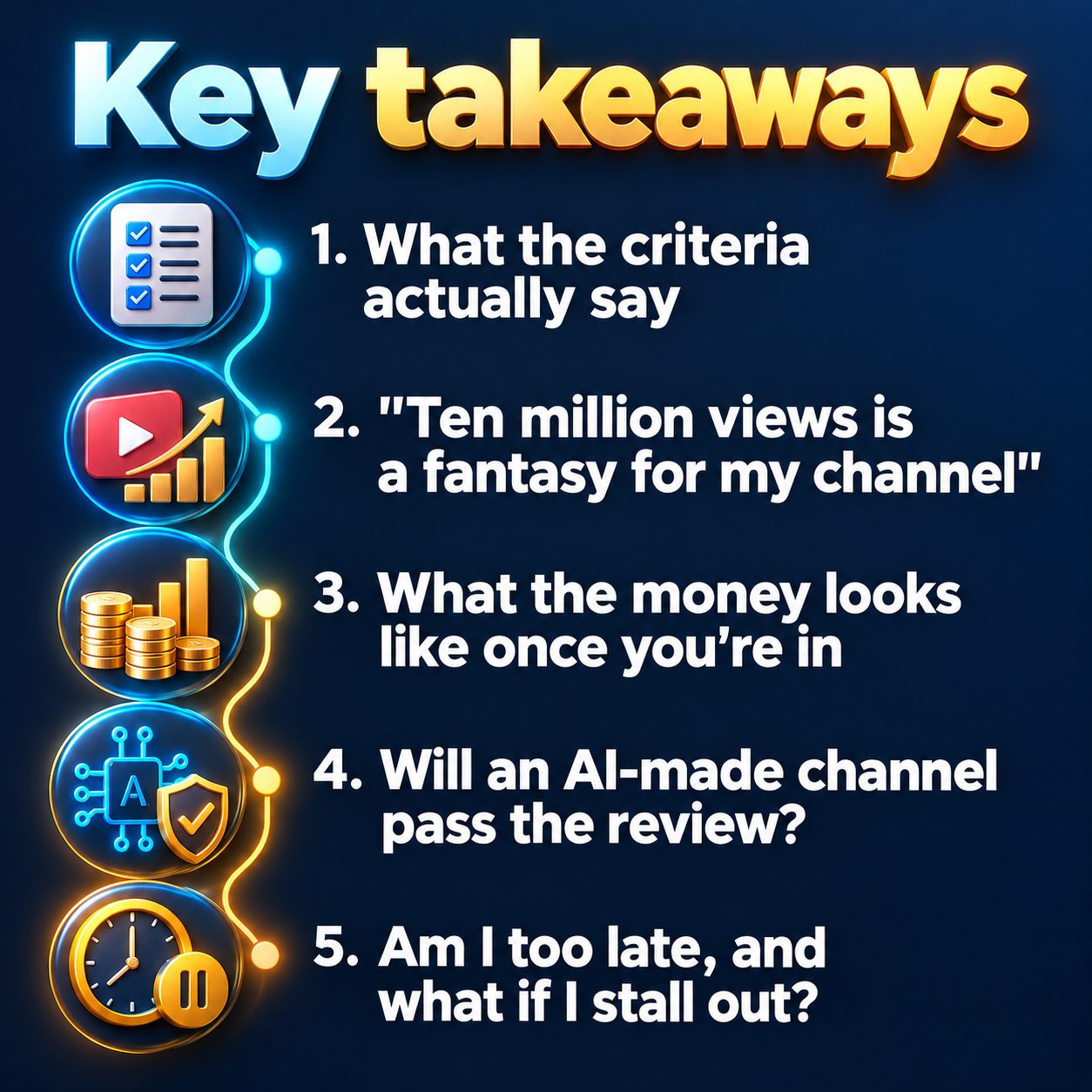
What the money looks like once you're in
Be honest with yourself here, because this is where the hype lives. Shorts don't pay the way long videos do. Under YouTube's Shorts monetization policies, money from ads shown between Shorts goes into a shared pool. YouTube splits that pool by each creator's share of eligible Shorts views, takes out a portion for music licensing when a Short uses music, and pays you a cut of what's left for you.
In practice, each view earns very little. It's real money, and it adds up on a busy channel. But very few people replace a salary with Shorts ad revenue alone. Most channels that earn well treat Shorts as the front door and make their money elsewhere: long videos, sponsors, products or a business behind the channel.
If a course promises you a Shorts salary within a month, close the tab.
Will an AI-made channel pass the review?
Most faceless creators wonder this and never ask it, so here's the answer. YouTube doesn't turn channels down for using AI tools. It turns down channels that look mass-produced. Its monetization policies cover inauthentic content (it used to be called repetitious content). That means uploads that follow a template so closely that each one is basically the last one with new words.
Reviewers want to see that each video adds something. That could be a clear point of view, a real story with a payoff, facts that hold up, or a channel people would recognize. A faceless channel with its own voice and a clear niche passes. A pile of interchangeable list videos made in bulk often fails, no matter who or what made them.
One more thing. If a video shows realistic synthetic people or events, turn on YouTube's AI disclosure when you upload. The label doesn't cut your reach. Skipping it is what puts the video at risk. The feed ranks Shorts on how viewers behave, not on how the video was made.
Am I too late, and what if I stall out?
You're not too late. Yes, Shorts is crowded. But the feed decides what to show based on how viewers react. Do they stop scrolling, watch to the end, rewatch, share? A new channel with a stronger opening beats an old channel with a lazy one.
The real risk isn't timing. It's quitting. Most channels don't die from bad videos. They die when the novelty wears off before the views show up. The rolling window also punishes gaps. Go quiet for a few weeks and the views that were counting start to drop off.
So pick a pace you can actually keep for months. Post once a day if you can sustain it, and a few times a week if you can't. A slower schedule you stick to beats a daily one you drop.
A realistic way to build toward the threshold
Here's the plan:
- Pick one niche and stay in it, so the algorithm learns who to show you to.
- Open every Short with a hook and end it with a payoff. How many people watch to the end is the signal that matters.
- Post on a fixed schedule, and track which topics bring in subscribers, not just views.
- Turn your best Shorts topics into longer videos to start building watch hours.
For most people, step three is where it breaks down, because there isn't time to film and edit every night. That's the problem MaqtAi is built for. You give it a niche and a topic. It writes the script, narrates it with an AI voice, animates the visuals and adds captions, and Autopilot can post on a schedule. It makes vertical Shorts and 16:9 videos, so one tool covers both paths. It won't pick your niche for you, guarantee YouTube approval, or make a repetitive channel look original. Those calls are still yours.
The cost of waiting
Every week you spend reading about the criteria is a week with no data. You don't learn which hooks hold people or which topics bring subscribers, and no views go into that 90-day window. Meanwhile, someone in your niche posted again today.
The smallest real step is to make one video and see whether the workflow suits you. Verify your email on MaqtAi and you get 450 free credits, no card needed. That covers a few videos in the default still-frame style or one with AI motion (details on pricing). Free renders carry a watermark, so treat them as a test drive, not your launch. If it clicks, you'll know tonight.
Doing this by hand is the part most people quit at. MaqtAi writes the script, narrates it, generates the visuals and captions, and assembles the faceless short for you. Verify your email and you get 450 free credits: about 3 videos on the still-frame tier, or one with AI motion. Free renders carry a watermark.
Try it on your niche freeFrequently asked questions
Do Shorts views count toward the 4,000 watch hours? No. According to YouTube's Partner Program page, views in the Shorts feed don't count as public watch hours. They count toward the separate Shorts views path.
Do I need both the watch hours and the Shorts views? No. You need the subscriber minimum plus either one, whichever you reach first.
Can a faceless or AI-voiced channel get monetized? Yes, as long as the content is original and each video adds something. YouTube's problem is mass-produced, repetitive uploads, not the tools you use.
How long does it take to get monetized with Shorts? There's no set timeline. It depends on your niche, your hooks and how often you post. Channels that post consistently for months give themselves the best chance, but nothing is guaranteed.
Results vary, and nothing here is a guarantee of income.