What YouTube means by "inauthentic content"
In mid-2025 YouTube renamed its old "repetitious content" rule to "inauthentic content" and sharpened the wording. You'll find it in the YouTube channel monetization policies, right next to reused content. The rule is simple. Content that's mass-produced or repetitive, built from a template with little variation, or easy to copy at scale can't earn money.
Look at what that sentence leaves out. It doesn't mention AI, faceless channels or synthetic voices. YouTube has said openly that creators can use AI tools. The rule cares about what the viewer gets. How you made the video doesn't come into it.
Look at where the rule sits, too. It's a monetization policy. It decides whether your channel can join or stay in the YouTube Partner Program. Community guidelines are a separate thing. Those decide whether a video can stay up at all.
AI isn't the problem. Sameness is
I run this test on my own channels. Pick a handful of uploads at random, mute them and read the scripts back to back. Do they feel like different videos, or like one video with the nouns swapped?
Channels that get hit tend to look alike. Every upload opens with the same line. The same flat voice reads a list pulled from somewhere else. The pacing never changes, and nothing in the middle is something only this channel would say. A reviewer spots it fast because there's nothing to find.
A channel that survives can still be made entirely with AI. The difference is that every video has a reason to exist. A scary story has its own twist. A history short makes one clear argument. A stoic idea gets applied to a real situation your viewer is dealing with this week. Your videos can share a format, because YouTube expects a series to look like a series. What they can't be is interchangeable.
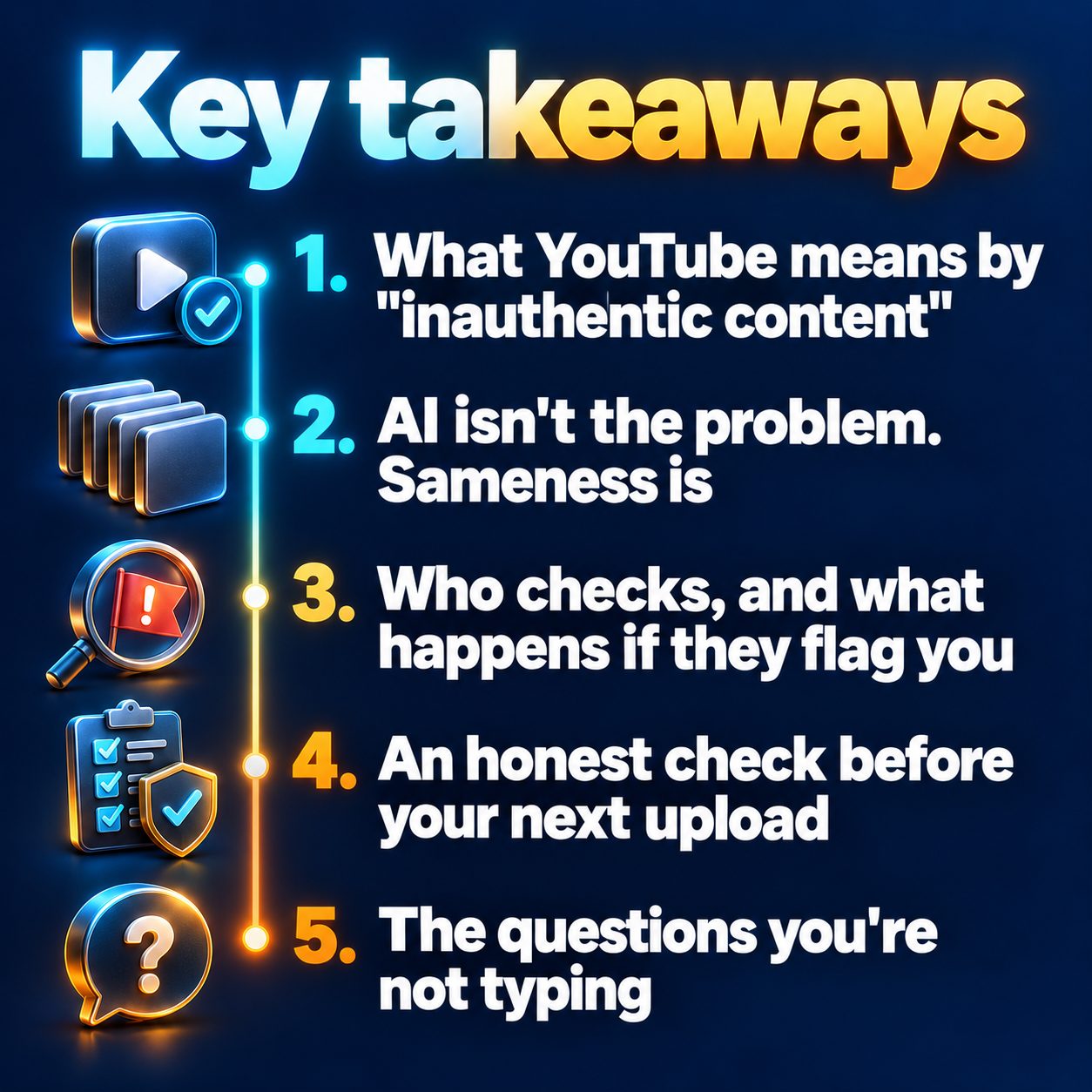
Who checks, and what happens if they flag you
The review covers your whole channel. When you apply to the Partner Program, reviewers look at the channel as a whole: its main theme, your most-watched videos, your newest uploads and the titles and descriptions around them. One weak video won't sink you on its own. A pattern of weak videos will.
If they decide the channel is inauthentic, it usually gets turned down for monetization, or loses monetization if it's already in. In most cases your videos stay up. You can fix the channel and apply again after a waiting period. Shorts don't get a separate pass, either. Shorts earnings have their own terms, but you still have to get into the program first.
An honest check before your next upload
Ask yourself these before you post again:
- Does the hook change with every video, or is it the same line with a new topic dropped in?
- Could a viewer tell your channel apart from the others in your niche?
- Does each video have a point of view, a takeaway or a story that you actually chose?
- Are you posting near-identical files across several channels? That's a spam pattern on its own.
- Are you uploading faster than you can pick good topics?
Here's the part nobody selling shortcuts will tell you. No tool can pass this review for you. Posting more often won't rescue a repetitive channel. More of the same just makes the pattern easier to see. And if your plan is to flood a niche with whatever the AI produces, this policy was written for you. Change the plan. A different tool won't help.
The questions you're not typing
"Will my old videos count against me?" Yes. Reviewers look at the channel, so a backlog of filler counts. Before they apply, plenty of creators make their weakest uploads private, which is a sensible cleanup.
"Will people judge me for using AI?" Viewers don't judge AI. They judge boring, and they show it by scrolling past. A sharp idea told well gets watched whether or not a camera was involved.
"Am I too late?" Tighter rules actually help you if you do this properly. They clear out the lazy channels you'd otherwise be competing with.
"What if I quit after two weeks?" Then this policy never mattered. Most faceless channels don't fail a review. They just stop posting.
Where a tool fits, and where it doesn't
A good tool takes away the filming and editing. That frees up your time for the part YouTube actually judges: topics and angles. That's how I'd use MaqtAi. By default each script follows the same structure: a hook in the first sentence, a problem set up and paid off in the middle, and one next step at the end. To be honest, that structure stays the same every time. That's fine. The content inside it is what has to change, and that's your job. You can edit any line before it renders or paste in your own script, which is used word for word. On the My brand page you can turn one topic into a few distinct angles and hooks before you make anything. If you schedule videos with Autopilot, every finished video waits for your one-tap approval unless you turn automatic publishing on.
Now for what waiting costs you. Every week you spend worrying about this policy is a week with no data on which hooks hold viewers. Meanwhile, someone in your niche is posting every day, learning from it and taking the audience you wanted. So take one small step today. Write a few topics that each make a different point, then make the first one for free. Verify your email and you get 450 free credits with no card. On the default still-frame tier that's roughly 3 to 4 videos, or one with AI motion (details here). Free renders carry a watermark, so treat them as a test of your angle. They aren't a launch.
Doing this by hand is the part most people quit at. MaqtAi writes the script, narrates it, generates the visuals and captions, and assembles the faceless short for you. Verify your email and you get 450 free credits: about 3 videos on the still-frame tier, or one with AI motion. Free renders carry a watermark.
Try it on your niche freeFrequently asked questions
Does YouTube demonetize AI-generated videos? Not for being AI-made. The inauthentic content policy goes after mass-produced, repetitive content with little variation, however it was produced.
Is inauthentic content the same as reused content? No. Reused content means repurposing someone else's material without adding meaningful value. Inauthentic content means repetitive, template-like videos, even when they're original. Both are monetization policies.
Can an inauthentic content decision get my videos removed? Usually not. It decides whether your channel can earn money. Removals happen under the community guidelines, which are a separate set of rules.
Do I need to label my AI videos? YouTube asks you to disclose realistic altered or synthetic content that viewers could mistake for real. The label itself doesn't limit reach, but skipping it when it's required can get a video removed.
Results vary, and nothing here guarantees monetization or income.