
First, figure out which finish line you're running toward
The YouTube Partner Program asks for 1,000 subscribers, plus either 4,000 valid public watch hours in the last 12 months or 10 million valid public Shorts views in the last 90 days. Open YouTube Studio, go to the Earn tab, and check where you stand on each one.
This is where a lot of stuck channels get a surprise. They've been posting Shorts and hoping, so without meaning to, they've been aiming at the Shorts views path. That path is brutal for a small channel. Views from the Shorts feed also don't count toward watch hours. So you can have Shorts that did fine and still be almost nowhere on the hours path.
For most small channels, the watch-hours route is the realistic one. One long video that holds people for several minutes adds more watch time than a whole stack of quick Shorts. Regular videos also tend to earn more ad revenue per view once you're in. Picking this path on purpose is the most useful thing you can do this week.
Why your channel stalled (it's probably not your niche)
It's natural to think "my niche is too small" or "YouTube just doesn't push channels like mine." Sometimes that's true. Much more often, the cause is one of these:
- Uneven posting. Three videos one week, then nothing for a month. Every time you go quiet, YouTube stops learning who to show your work to, and each comeback starts almost from zero.
- A weak first line. A viewer decides whether to stay in the first few seconds. "Hey guys, welcome back" gets skipped. Open with the payoff or the problem instead.
- No clear promise. A channel about everything gives YouTube nothing to match. People who subscribed for one topic don't stick around for the next one.
A narrow niche with a clear promise grows fine. A broad niche with no promise is what stalls.
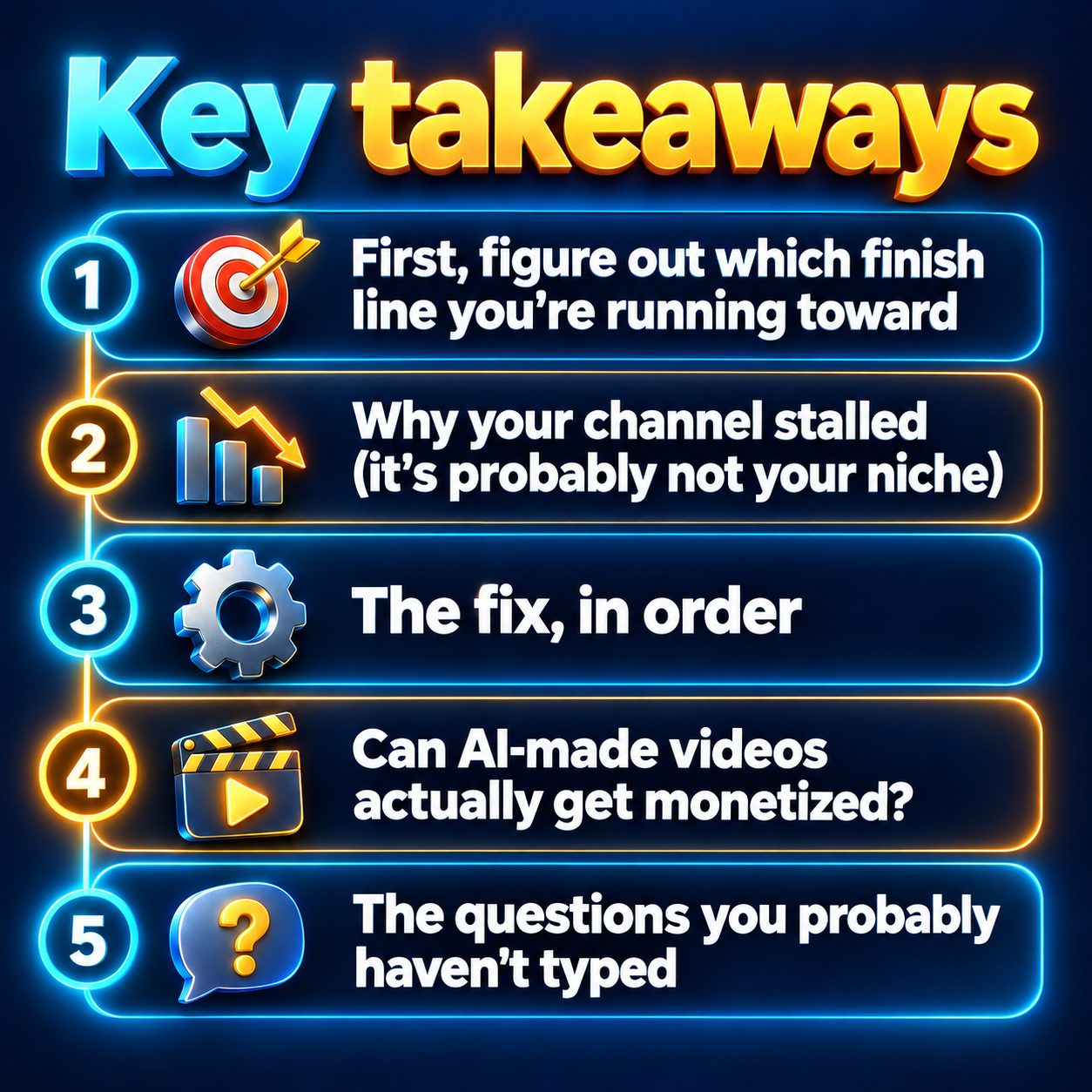
The fix, in order
- Commit to the watch-hours path. Make one long-form, horizontal (16:9) video a week, a few minutes long, with a simple shape: a hook, a few themed sections, a short recap.
- Treat Shorts as a way in. Make each Short stand on its own with a real payoff, and end it by telling viewers the full guide is on your channel. Links in Shorts aren't tappable, so say it out loud.
- Rewrite the first sentence of every video. That one sentence matters more than anything else in the script.
- Pick a schedule you can keep for months. One long video and a few Shorts every week, without fail, beats posting daily for a fortnight and then burning out.
- Read your retention graph every week. In Studio, look at where the line drops sharply. That's the exact moment you lost people. Fix that part in the next video.
- Write your channel's promise in one sentence. "Five-minute stories about how famous companies almost failed." If a video idea doesn't fit that sentence, skip it.
Can AI-made videos actually get monetized?
This is where your scam radar should switch on, and it should. No tool, course, or service can guarantee you'll get into the Partner Program. Anyone promising "guaranteed monetization" is selling something else.
The real line is YouTube's inauthentic content policy. It demonetizes mass-produced, repetitive videos, meaning the same template with the words swapped, over and over. The policy targets sameness and low effort, not the tool you used. No platform ranks a video lower just because AI made it. Ranking follows what viewers do: whether they keep watching, finish the video, like it, and share it. If your videos include realistic synthetic people or scenes, use the platform's AI disclosure label. The label doesn't cut your reach, but leaving it off can get the video removed.
So AI can take over the production work. It can't pick your niche, judge whether a hook is good, or stop you from posting near-copies. That part is still on you.
The questions you probably haven't typed
"Am I too late?" Someone is always just starting in your niche and someone is always quitting. What decides it is whether you're still posting a year from now, not whether you started early.
"Should I just quit?" Before you decide, try one honest experiment. Post on a steady schedule for a couple of months with better hooks and a clear promise. If the retention graph still doesn't move, you've learned something real. Quitting before that means quitting on a channel you never actually tested.
"Will people judge me for using AI?" Viewers judge whether a video was worth their time. A clear, well-paced faceless video that answers their question gets watched. Lazy, repetitive filler gets judged, whoever made it.
"What if I stop again after two weeks?" That's the real risk, and it's why your schedule has to be one you can actually keep.
Where the hours go, and how to get them back
For most people stuck at the one-year mark, the problem isn't knowing what to do. It's that a weekly long video plus a few Shorts takes more evenings than they have. That's the specific friction a tool like MaqtAi removes. You give it a niche and a topic, and it writes the script, narrates it with an AI voice, generates moving visuals, adds captions, and assembles the video. You never film or record anything. Choose 16:9 at two or five minutes and the script automatically follows the long-form shape from step one: hook, themed sections, recap. A finished video has a "Make a companion Short" button that creates a separate vertical video on the same topic, with its own payoff, ending with an invitation to the full guide.
To keep the schedule going when life gets busy, Autopilot renders from your own topic queue on a daily, three-times-a-week, or weekly cadence. By default, every video waits for your one-tap approval before anything gets published. You still choose the topics and check each video. You just stop losing evenings to editing.
Here's what waiting really costs. Your watch-hour count only looks back 12 months, so the hours you earned a year ago are dropping out of the total right now. Every week you don't post, your retention graph gets no new data, and somebody in your niche posts again. You don't need a new plan to start. You need one long video this week.
Make that first one without spending anything. Most new accounts get free credits once they verify their email, no card needed. That's enough to see whether this workflow actually fits your channel before you commit to anything.
Doing this by hand is the part most people quit at. MaqtAi writes the script, narrates it, generates the visuals and captions, and assembles the faceless short for you. Verify your email and you get 450 free credits: about 3 videos on the still-frame tier, or one with AI motion. Free renders carry a watermark.
Try it on your niche freeFrequently asked questions
Do Shorts views count toward watch hours for monetization? No. Views from the Shorts feed count toward the separate Shorts views path, not public watch hours. That's why long-form videos are usually the faster route for a small channel.
How long does it take to get monetized on YouTube? There's no honest fixed answer. It depends on your niche, how often you post, and how well your videos hold viewers. Steady posting with strong openings is what moves the numbers.
Can a faceless AI channel get accepted into the Partner Program? Yes, if the videos are original, useful, and not mass-produced repeats. YouTube's inauthentic content policy targets repetitive templated content, not AI as such.
Should I delete my channel and start over? Usually not. A new channel resets your subscribers and watch history. Fixing your schedule, hooks, and promise on the channel you already have is almost always the better move.
Results vary, and nothing here is a guarantee of monetization or income.