What "reused content" actually means to YouTube
Start with the notice in YouTube Studio under Earn, or the email you got. It names the policy, and that name matters.
YouTube's channel monetization policies describe reused content as material that isn't originally yours, used without significant original commentary, changes, or educational value. Think movie clips with a caption on top, compilations, other creators' Shorts uploaded again, or a narrator reading someone else's article over stock footage.
A related policy gets mixed up with it: inauthentic content. That one covers mass-produced or repetitive videos, like the same template with a few words swapped every day. The label is different but the result is much the same. Knowing which one you got tells you what to fix.
Here's the part that stings. The review looks at your channel as a whole, not one upload. Reviewers look at your main theme, your most-watched videos, your newest ones, and your titles and descriptions. So one lazy compilation can shape how your whole channel looks.
"But I edited it myself." Why hard work still gets flagged
Almost everyone says this, and it's fair. You spent hours cutting clips, adding music and picking the best moments. That's real work. It just isn't the kind the policy counts.
The test isn't effort. It's whether a viewer gets something from your video that the original didn't give them. Transitions, background music and zoom effects don't pass that test. Your opinion, your explanation, your research and the way you tell the story do.
Patterns that commonly get channels flagged:
- Reaction videos where the reaction is a few seconds of nodding.
- "Best moments" compilations with text on screen and nothing said.
- Your own footage that first showed up on someone else's channel, with nothing on your page showing it's yours.
- Voiceover videos where the script is a lightly reworded article or Reddit post.
If you see your channel in that list, that's actually good news. Now you know what's wrong, and you can fix it.
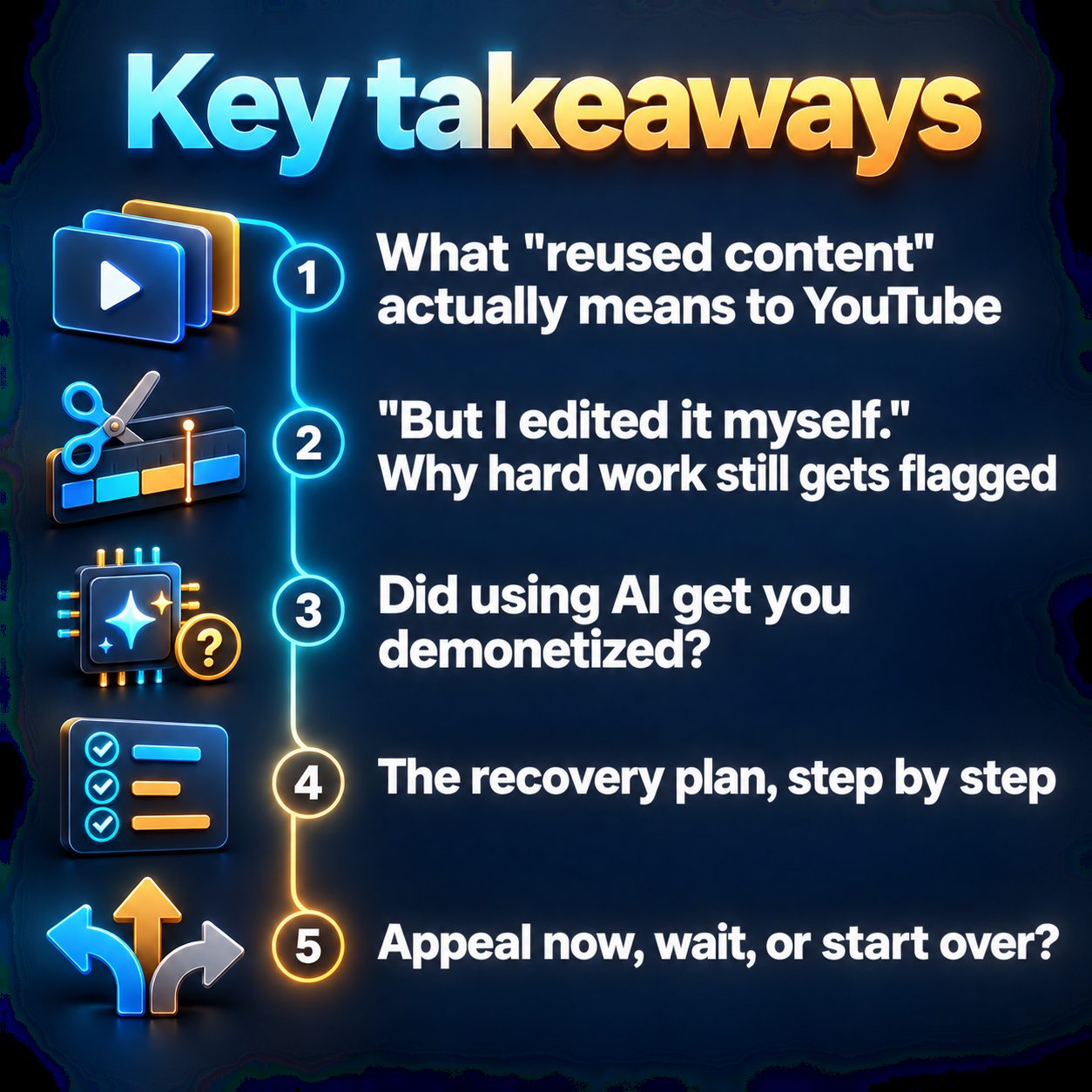
Did using AI get you demonetized?
Probably not on its own. YouTube doesn't pull monetization just because a tool helped make the video. It does act on the things AI makes easy: churning out near-identical videos on a schedule, or narrating material copied from somewhere else. The inauthentic content policy targets mass-produced, repetitive uploads, however they were made.
So don't ask "did I use AI?" Ask this instead: when someone scrolls my channel, do they see different, original videos, or the same video with different titles?
The recovery plan, step by step
1. Sort before you touch anything. Open your video list and sort by views. Put each video into one of three piles: clearly original, fixable, or mostly someone else's material. Be honest about that last pile.
2. Take the third pile off public view. Set those videos to private, or delete them if you never had the rights. Know the trade-off first. Private videos stop counting toward your public watch hours, and when you reapply, the YouTube Partner Program still asks for 1,000 subscribers, plus either 4,000 valid public watch hours in the last 12 months or 10 million valid public Shorts views in the last 90 days. A clean channel can cost you some numbers. It's still worth it.
3. Fix what can be fixed. Rewrite titles and descriptions that promise something the video doesn't deliver. If you own footage that also appears somewhere else, say so in the description.
4. Post a clear run of original videos. This is the step that actually changes the outcome. Each one needs your own script, your own angle and a real point the viewer takes away. After a couple of dozen of these, a reviewer opening your channel sees something very different.
5. Appeal or reapply with a plain explanation. When YouTube Studio gives you the option, explain what your channel is about, what's original in it and what you removed. The process may ask for a short unlisted video explaining your channel. Keep it honest and specific.
Appeal now, wait, or start over?
If you really believe the review got it wrong, appeal right away. That fits a channel full of your own commentary and original work. There's a time limit, and your notice tells you what it is.
If you recognize the problem in your own uploads, don't rush. Appealing without changing the channel will probably get you the same answer. Some decisions also make you wait before you can try again, and the notice tells you when. Clean up and post first.
Starting a new channel is the quiet thought everyone has. It only helps if your habits change too. The same content on a new channel gets the same review, and you lose the subscribers you already earned.
And no, the months weren't wasted. You keep your audience, your feel for which topics land and your posting rhythm.
Staying original without burning out
Here's the real reason channels slide into reused content: time. Clips are fast. Original videos need a script, narration and visuals. If you also have a job, the compilation shortcut starts to look sensible.
That's the specific problem a tool like MaqtAi solves. You give it a niche and a topic. It writes a fresh script, narrates it with an AI voice, and makes its own moving visuals and captions, so the video contains no borrowed footage. You can edit any line or paste your own script to use word for word, and that's where your angle comes in. The videos you make are yours to post and monetize.
Now the honest limits. It can't get your monetization back, because only YouTube's reviewers can. It can't turn a thin idea into an original one. And if you post the same template every day with a few words swapped, the inauthentic content policy can demonetize that too, AI or not. Change up your topics, give every script a real point, and pick a niche with depth. If yours is running dry, the use cases page lists niches to consider.
What waiting actually costs
Every week the channel sits unchanged, a reviewer sees exactly what got it flagged. Your watch hours keep dropping out of the rolling window. Your subscribers stop hearing from you. And someone in your niche is posting an original video today.
You don't need to rebuild everything this weekend. You need one original video that shows what this channel is supposed to be. If time has been the blocker, you can make that first one without a card. Verifying your email gives you 450 free credits (here's how credits work). Make one, watch it back, and ask yourself whether that's the channel you'd want YouTube to review.
Doing this by hand is the part most people quit at. MaqtAi writes the script, narrates it, generates the visuals and captions, and assembles the faceless short for you. Verify your email and you get 450 free credits: about 3 videos on the still-frame tier, or one with AI motion. Free renders carry a watermark.
Try it on your niche freeFrequently asked questions
Can I get monetization back after a reused content decision? It's possible, but not guaranteed. It depends on changing what reviewers see: remove borrowed material, post original work, then appeal or reapply when YouTube Studio lets you.
Does deleting old videos fix it right away? No. Removing problem videos helps, but reviewers also want to see what you post next. A cleaned-up channel with no new original uploads doesn't give them much to approve.
Are AI voiceover videos considered reused content? Not by default. Reused content means using material that isn't yours without meaningful changes, and an AI voice reading an original script over newly generated visuals isn't that. Mass-produced, repetitive uploads can fall under the inauthentic content policy instead.
Should I keep uploading while I wait? Yes, as long as the videos are original. New work is the strongest proof that your channel has changed.
Results vary, and nothing here guarantees monetization or income.