
The phrase is misleading, so here is what people actually mean
"Automation" makes it sound like money arrives while you sleep. It doesn't mean that. In creator circles it just means the channel runs without you being the on-screen talent.
A normal channel: you film yourself, you edit, you upload. An automated one: you choose a niche and a topic, a script gets written, a voice narrates it, visuals get assembled over the narration, captions get burned in, and the file gets posted. Your face is never in it. Your voice does not have to be either.
That's the whole model. The word "automation" is doing a lot of marketing work that the reality does not support. Plenty of people hear it and picture passive income. What it really buys you is the ability to publish often without a camera, a ring light, or the willingness to be perceived.
What you still have to do yourself
This is the part that gets skipped in the videos selling you courses. Even at full automation, three decisions stay yours, and they are the three that decide whether the channel works:
The niche. Not "motivation" but something a specific person would subscribe to. Scary stories. Roman history. Stoic philosophy. Startup failures. Bedtime and sleep content. Narrow beats broad early, because narrow gives the algorithm a clear signal about who to show you to.
The topics. Whatever tool or freelancer you use, someone has to feed it ideas. A queue of topics is the actual work of a faceless channel.
The first three seconds. Feeds autoplay. The opening line is what stops the scroll, and no amount of automation writes a hook that beats one you thought about for two minutes.
If you outsource all three, you get generic videos, and generic is the only thing the algorithm reliably punishes.
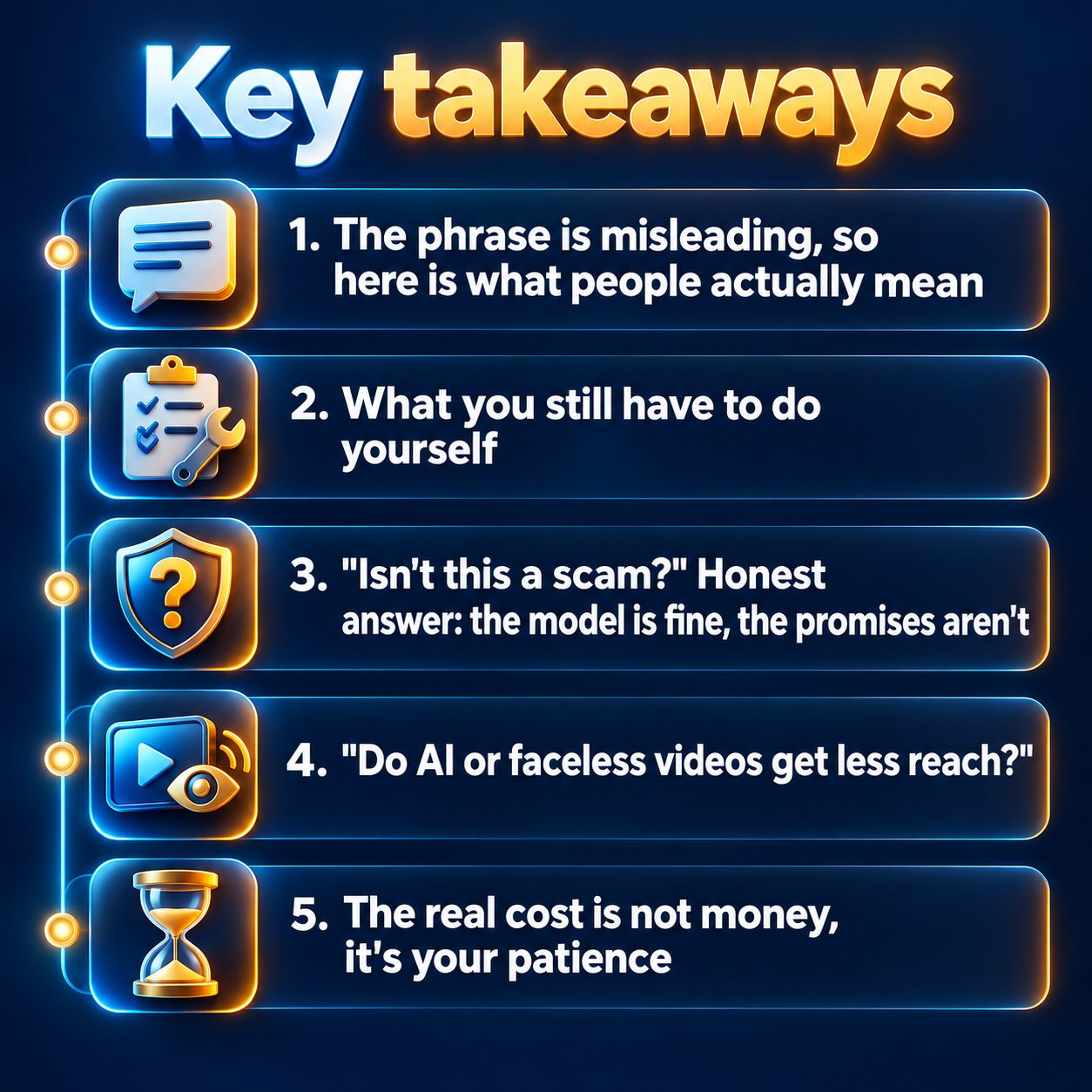
"Isn't this a scam?" Honest answer: the model is fine, the promises aren't
Faceless channels are ordinary. Compilation channels, narration channels, top-10 channels, sleep-story channels have existed for years. Nobody calls those scams. The scammy layer is the people selling "YouTube automation businesses" with income screenshots and done-for-you agencies charging thousands upfront.
A few things worth being blunt about:
- Monetizing takes real thresholds. YouTube's Partner Program asks for 1,000 subscribers plus 4,000 valid public watch hours in 12 months, or 1,000 subscribers plus 10 million valid public Shorts views in 90 days (YouTube's own requirements). The long-form path is far more reachable than the Shorts path for most people.
- YouTube's inauthentic content policy demonetizes mass-produced, repetitious content. Churning out near-identical videos is the failure mode, not the strategy.
- Nobody can promise you views. Anyone who does is selling something.
What is true: the videos you make are yours to post and monetize, and the barrier to publishing is now genuinely low. That's it. That's the honest version.
"Do AI or faceless videos get less reach?"
No. No platform down-ranks a video for being made without a camera. TikTok, Instagram, YouTube, and Facebook rank short video by viewer behavior: watch time, completion, likes, shares. Production method is not an input.
What does hurt you is spam patterns. Posting the same file to twelve accounts. Near-duplicate videos on a loop. Weak opening seconds. And if you use realistic synthetic media, follow the platform's AI disclosure rule, because the label itself doesn't reduce distribution but skipping it can get the video removed.
The unspoken worry underneath this question is usually different, though: "will people think less of me for it?" Viewers on short-form do not know or care how a good video was made. They care whether the first line was interesting. Nobody in a comment section is auditing your workflow. They're either watching or scrolling.
The real cost is not money, it's your patience
Here's where beginners get burned. They think the hard part is making the videos, so they buy the thing that makes videos, then quit after two weeks because nothing happened.
Two weeks is nothing. A short-form channel needs enough videos for the algorithm to figure out who to show them to, and that's a matter of dozens of uploads, not a handful. The people who make this work are boring about it. They post on a cadence, they keep the niche steady, they change the hook style when nothing lands, and they keep going while the graph is flat.
So the honest planning number is not money, it's weeks. Pick a cadence you can actually hold. Daily if you can, three times a week if you can't. Then treat the first month as data collection, not as a verdict.
And no, you are not too late. Faceless channels get started every day and some of them work, because the supply of good hooks in a specific niche is never full.
How to actually set it up, in order
- Pick one niche you could talk about for months. If you're stuck, browsing common faceless niches is faster than staring at a blank page.
- Write 20 topics in a list. Not 20 titles, 20 topics. This is your queue.
- Decide the shape. Vertical and under 3 minutes gets classified by YouTube as a Short. Horizontal 16:9 gets treated as a regular video, and regular videos typically earn far more per view.
- Make the first video. Script, voiceover, visuals, captions. Watch it back once, all the way, and ask if you'd have kept watching at second three.
- Post on a schedule and don't change the niche for a month.
Step 4 is the one that stops people, because it's where filming and editing used to live. Tools like MaqtAi exist for exactly that gap: you give it a niche and a topic, and it writes the script, narrates it in an AI voice, generates and animates the visuals, adds animated captions, and on a paid plan can publish to TikTok, Instagram Reels, YouTube Shorts, and Facebook Reels, scheduled on a cadence you set everywhere except TikTok, where Autopilot can't post automatically yet so each post waits for your approval. The three-step version is here. It does not pick your niche or your hooks. That part is still you, and it should be.
Start with one video, not with a plan
Every week you spend deciding is a week the channel isn't accumulating data. The algorithm learns nothing from videos you haven't posted. Meanwhile somebody in your niche uploaded again today, and their channel now knows something yours doesn't.
So shrink it. Not a channel, not a content strategy. One video, tonight, on one topic you already have an opinion about. New accounts get 450 free credits after verifying their email, no card, which is enough for three or four watermarked still-frame videos on the Express tier, a few minutes each, and enough to decide whether the format feels like something you'd keep doing.
Doing this by hand is the part most people quit at. MaqtAi writes the script, narrates it, generates the visuals and captions, and assembles the faceless short for you. Verify your email and you get 450 free credits: about 3 videos on the still-frame tier, or one with AI motion. Free renders carry a watermark.
Try it on your niche freeFrequently asked questions
Do I need to show my face or use my real voice? No. The whole point of the model is that you do neither. An AI voice narrates and the visuals are generated, so nothing on screen is you.
How many videos before I know if the channel works? More than most people expect. Give it a steady cadence for at least a month before you judge it, and change one variable at a time (hooks first, then niche) rather than restarting from scratch.
Can I monetize a faceless channel? Yes, faceless channels can join the Partner Program like any other, but you have to hit the same thresholds and follow the same policies. Mass-produced repetitious uploads risk demonetization under YouTube's inauthentic content rules.
Do I have to disclose that videos are AI-made? Where the content is realistic synthetic media, yes, follow the platform's disclosure setting. The label does not reduce your distribution, but skipping it when it applies can get a video removed.
Results vary. Nothing here is a guarantee of income.