So where did the "banned" rumour actually come from?
Three separate things got blended into one scary sentence, and it helps to pull them apart.
The first is history. YouTube really was blocked in Pakistan for a stretch last decade, and access was restored in January 2016 when a localised version launched (background here). Anyone who lived through that block hears "YouTube" and "ban" in the same sentence and assumes the ghost is still around.
The second is local regulation. The PTA restricts specific content, and PECA keeps getting amended. That governs what you publish, the same way it governs a blog or a TV segment. It says nothing about whether your video was cut by a human editor or assembled by software.
The third is the one people actually mean in 2026: YouTube's inauthentic content policy. Read it plainly and it says mass-produced, repetitious content is not eligible for monetisation. That is a quality bar applied worldwide. It is not a country ban, and it is not an AI ban.
So the honest answer: you are not breaking any rule by running a faceless channel from Karachi, Lahore, or a room in Faisalabad with a laptop.
What YouTube genuinely refuses to monetise
This is the part worth memorising, because it is the only part that can actually hurt you.
Reused content with nothing added. Downloading someone's clip, slapping a voiceover on it, uploading. That has been ineligible for years and has nothing to do with AI.
Mass-produced repetition. Fifty videos off one template with the nouns swapped. Same hook structure, same script skeleton, same stock footage sequence. A reviewer can spot it in thirty seconds, and so can a viewer.
Undisclosed realistic synthetic media. If your video shows a realistic person or event that did not happen, YouTube expects you to tick the disclosure box. The label itself does not shrink your reach. Skipping it can get the video pulled.
What is explicitly fine: no face on camera, a synthetic narration voice, AI or stock visuals, one person running the whole thing. Platforms rank short videos on viewer behaviour, watch time, completion, shares. Not on which software you opened.
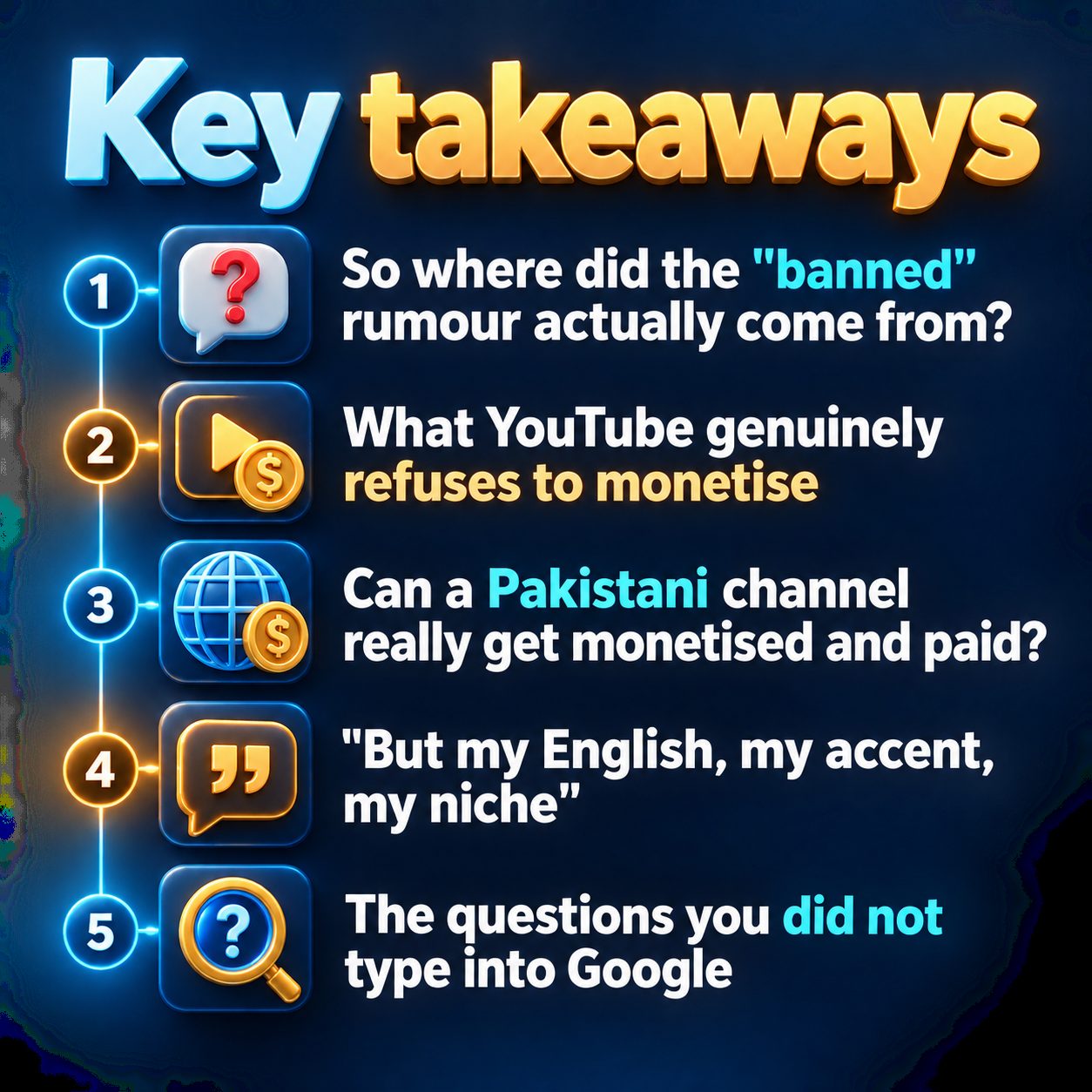
Can a Pakistani channel really get monetised and paid?
Yes. The YouTube Partner Program is available in Pakistan, and there are two doors in (official thresholds): 1,000 subscribers plus 4,000 valid public watch hours in 12 months, or 10 million Shorts views in 90 days.
Here is the practical read most guides skip. The long-form door is far more reachable than the Shorts door for a new channel, and long-form videos typically earn more ad revenue per view. If your plan is Shorts-only forever, you are aiming at the harder target. A sensible shape is Shorts for reach and discovery, plus longer 16:9 videos on the same topics so the watch hours start stacking.
Payment runs through Google AdSense. You set up an account, verify your address, and Google pays out once you cross its payment threshold via bank transfer. That works from Pakistan.
One honest caveat nobody says out loud: ad rates depend on where your viewers are and what your niche is, not where you sit. A channel watched mostly inside Pakistan earns less per view than the same channel watched in the US, UK, or Gulf. That is not a punishment, it is advertiser demand. If earnings are the goal, write in English for a global audience, or pick a niche advertisers pay for, and treat the first months as building the asset rather than collecting a salary.
"But my English, my accent, my niche"
This is usually the real objection hiding behind the ban question, so let's take it seriously.
Faceless removes the accent problem entirely. Your audience never hears you and never sees your room. What they do judge is the writing: whether the first line makes them stay, whether the facts hold up, whether the ending lands.
So the leverage is not your English pronunciation. It is your topic selection. Pick something you can be genuinely accurate about, because the channels that die are the ones where the creator is bored by video nine and starts padding. Browse a few faceless niches and choose based on what you would still find interesting in three months, not on what looks most profitable in a Reddit thread.
And if your audience is local, you can narrate in Urdu instead of English. That is a legitimate strategy, not a downgrade. It is a smaller ad market and a much smaller pool of competitors.
The questions you did not type into Google
"Will people judge me for posting AI content?" Some will say something in the comments. Far more will never notice, because viewers scroll past boring, not past synthetic. The judgment lands on videos that waste seven seconds getting to the point.
"Am I too late?" You are late to the easy version, where anything uploaded got views. You are not late to the version where a specific niche, a good hook, and daily posting still compound. That has never stopped working.
"What if I quit after two weeks?" Honestly, this is the likeliest failure, more likely than any policy problem. Most channels die from a skipped week that becomes a skipped month. So build for the tired version of you: one niche, one format, a cadence you can hit on your worst day. Three good videos a week that you actually ship beat a daily plan you abandon.
What to actually do this week
Pick one niche. Write ten topic lines for it, not one. Decide your cadence and write it somewhere you will see it.
Then make the first video and post it, before you buy a course or a mic or a domain. You need real data from your own channel more than you need another plan.
The friction that kills most people here is the middle: scripting, voicing, sourcing visuals, cutting, captioning, uploading, every single day, after a full-time job. That is the job MaqtAi does. You give it a niche and a topic and it writes a hook-first script, narrates it, generates moving visuals, adds animated captions, and hands you a vertical video in a few minutes. If you want it running without you, Autopilot needs a paid plan and works from a topic queue on a daily, three-a-week, or weekly schedule, and by default every finished video waits for your one-tap approval before anything goes out.
Waiting has a cost, and it is quiet. The channel you would have started in January would have a month of algorithm data by now. Your competitor with the same idea is on video thirty and knows which of their hooks work. You cannot buy that back later.
So make one video. Verify your email and you get 450 free credits to do it with, no card, enough for three or four watermarked still-frame Express videos, or one with AI motion. That is your last excuse gone.
Doing this by hand is the part most people quit at. MaqtAi writes the script, narrates it, generates the visuals and captions, and assembles the faceless short for you. Verify your email and you get 450 free credits: about 3 videos on the still-frame tier, or one with AI motion. Free renders carry a watermark.
Try it on your niche freeFrequently asked questions
Is faceless YouTube automation legal in Pakistan? Yes. There is no Pakistani law banning faceless or AI-assisted video channels. Local rules govern what you publish, the same as for any other content, not how you produce it.
Can Pakistanis join the YouTube Partner Program? Yes, YPP is available in Pakistan and payouts run through Google AdSense to a local bank account once you pass its payment threshold. You still need to meet YouTube's subscriber and watch-hour or Shorts-view requirements.
Will YouTube demonetise my channel for using AI? Not for using AI itself. It demonetises reused content and mass-produced repetitious uploads, and it expects disclosure on realistic synthetic media. Original scripts and varied topics keep you on the right side of that line.
Should I narrate in English or Urdu? English reaches a bigger advertiser market; Urdu reaches a less crowded local one. Pick based on which audience you can genuinely write well for, and test rather than guess.
Results vary. Nothing here is a guarantee of income, monetisation, or reach.