
What a hook actually has to do in two seconds
A hook is not a clever sentence. It is a decision you force the viewer to make. In the first two seconds they are already deciding whether to keep scrolling, so your job is to plant one thought loud enough to stop the thumb: I need to know how this ends.
That is the whole game. Not entertainment yet. Not information yet. Just an open loop the brain wants closed. Everything else in the video is you paying off the promise your first line made.
So the practical rule is simple. Your hook has to promise something specific, and the promise has to be something the viewer cannot already guess the answer to. "Here are some tips for saving money" promises nothing. "The bank teller told me to stop doing this one thing" opens a loop. One of those gets scrolled past. You already know which.
The five hook shapes that keep working
You do not need talent for this. You need a few reliable shapes and a topic that fits one of them. Here are the ones that carry faceless content over and over.
The forbidden claim. Say the thing that sounds like it should not be said. "They stopped teaching this in schools for a reason." Works for history, psychology, finance.
The open question. Ask something the viewer secretly wonders but never Googled. "Why do old buildings feel safer than new ones?" The brain hates an unanswered question on screen.
The reversal. State the thing everyone believes, then hint it is wrong. "Drinking water first thing in the morning might be doing the opposite of what you think."
The mid-story drop. Start inside the action, no setup. "By the time he realized the door was locked from the outside, it was already too late." Perfect for scary stories, true crime, comic stories.
The stakes upfront. Name what someone stood to gain or lose. "He risked everything he owned on one phone call." Great for startup stories and stoic motivation.
Notice none of these use a fake number. You do not need "this made me rich in 30 days." A precise, honest hook beats an inflated one because inflated hooks train viewers to distrust your payoff, and the payoff is where retention lives.
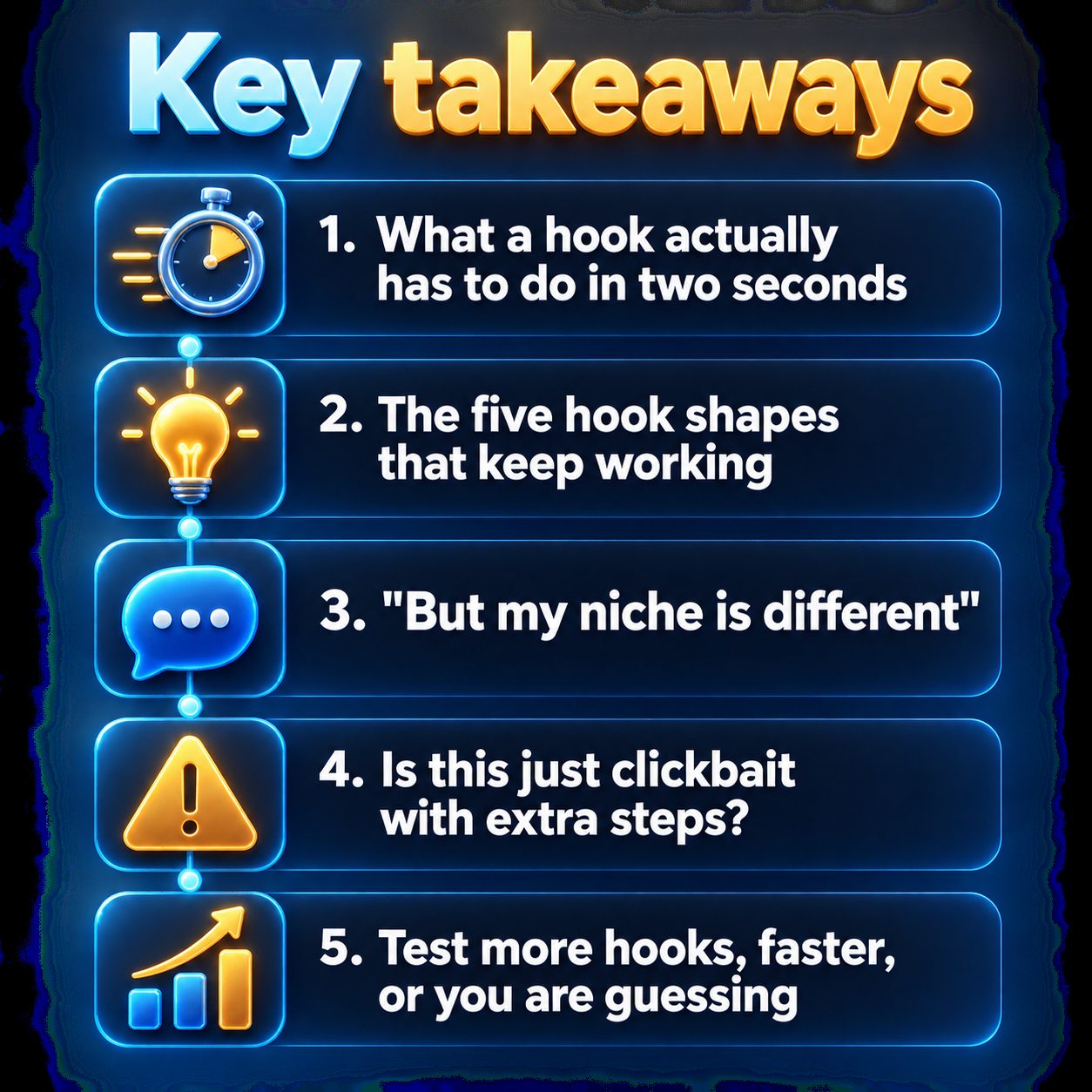
"But my niche is different"
Every creator thinks their niche is the exception. Bedtime stories are too calm. History is too dry. Stoic quotes are too repetitive. The niche is never the problem. The framing is.
A sleep channel does not hook with drama. It hooks with a promise of relief: "The story I read my daughter every night when nothing else worked." A history channel does not need explosions. It needs a secret: "Everyone knows the date this empire fell. Almost nobody knows what happened the night before." Same mechanism, different temperature.
If you run several niches at once, you feel this fast, because a hook that crushes on true crime falls flat on stoic motivation. The fix is not one universal hook. It is knowing which of the five shapes your niche naturally leans on. Scary, crime, and comic content live on the mid-story drop. History and psychology live on the open question and the forbidden claim. Motivation and startup content live on stakes. If you want a sense of which formats map to which audiences, the use-cases page breaks the common faceless niches down.
Is this just clickbait with extra steps?
Fair question, and worth answering straight, because a hook that overpromises is the fastest way to kill a channel. A good hook and clickbait use the same opening move. The difference is what happens next.
Clickbait opens a loop it never closes. You promise a shocking answer and deliver filler, so the viewer bounces, watch time craters, and the algorithm reads that as a bad video. A real hook opens a loop and closes it inside the video. The tension you create is a debt, and the rest of the video pays it.
So the honest test for any hook you write: can the video actually deliver this? If the hook says "the one thing rich people never talk about" and your script never names that thing clearly, you did not write a hook. You wrote a trap. Write the payoff first. Then write the hook that points at it. That order keeps you honest and keeps retention high.
Test more hooks, faster, or you are guessing
Here is the part nobody likes. You cannot know which hook works by staring at it. Your taste is not the audience. The only way to learn is to ship many hooks and read the retention curve, specifically that first two-second drop-off.
That means volume. If you post one video a week, you get roughly one hook experiment a week, and it takes months to see a pattern. If you post daily across a couple of niches, you learn what stops your specific audience in a matter of weeks, not seasons. This is the real reason consistent posting beats perfect posting: not because the algorithm rewards frequency for its own sake, but because frequency is how you gather enough data to stop guessing.
The bottleneck is usually production. Scripting, narrating, and editing a video by hand for the sake of testing one line feels absurd, so most people never test. This is where an AI faceless-video tool changes the math. You write ten hook variations, generate ten short videos, and let the numbers tell you which shape your niche rewards. MaqtAi writes hook-first scripts tuned per niche, narrates them, builds the visuals, and assembles a vertical video in a few minutes, so the cost of testing a hook drops to almost nothing. On a paid plan you can even queue topics and let Autopilot render and post them on a schedule while you read the results.
Doing this by hand is the part most people quit at. MaqtAi writes the script, narrates it, generates the visuals and captions, and assembles the faceless short for you. Verify your email and you get 450 free credits: about 3 videos on the still-frame tier, or one with AI motion. Free renders carry a watermark.
Try it on your niche freeWhat waiting actually costs you
Every week you spend polishing one hook in a doc is a week your channel is not gathering the data that would tell you what actually works. The algorithm learns nothing from videos you did not post. Meanwhile the creator in your niche who ships daily is building a library of tested hooks and a feed that already knows who to show them to.
You do not need to overhaul anything today. Pick one niche, write three hooks using three of the shapes above, and turn them into three short videos. New accounts get 450 free credits after email verification, enough for about three or four videos on the still-frame Express tier with a watermark, no card needed, so your first round of hook tests costs you an afternoon and nothing else. See the free credits and how they work, make the first video, and let the retention curve tell you the rest.
Results vary, and nothing here is a guarantee of income.