
The real killer is quitting before the data shows up
Here is the uncomfortable truth. Most faceless channels do not die because the content was bad. They die because the person behind them posted six videos, saw 40 views on each, felt stupid, and stopped.
Short-form platforms learn who your video is for by testing it on small batches of people and watching what happens. That takes reps. A channel with 5 videos has given the algorithm almost nothing to work with. A channel with 30 has given it a pattern. The gap between those two numbers is where nearly everyone gives up.
So when you ask why channels die in month one, the honest answer is that month one is exactly the stretch that feels the most pointless. The views are flat. The comments are silent. And there is no reward loop yet to pull you forward. People do not fail the channel. They fail the waiting.
"But my niche is different" is usually not the problem
Almost everyone who is struggling reaches for the niche as the reason. Too saturated. Too small. Too weird. I get it, because it feels like the one thing you can blame that is not you.
But walk any of the big faceless categories and you will find channels born the same month that went completely different directions. Scary stories, history explainers, stoic motivation, true crime, bedtime and sleep content, dark psychology. These are crowded rooms, and new channels still break through in them constantly. Saturation means demand exists. An empty niche is scarier than a crowded one, because empty usually means nobody wants it.
The channels that die in a crowded niche are not losing to the niche. They are losing to the ten accounts in that same niche that posted every day while they posted twice and quit. Same room. Different consistency.
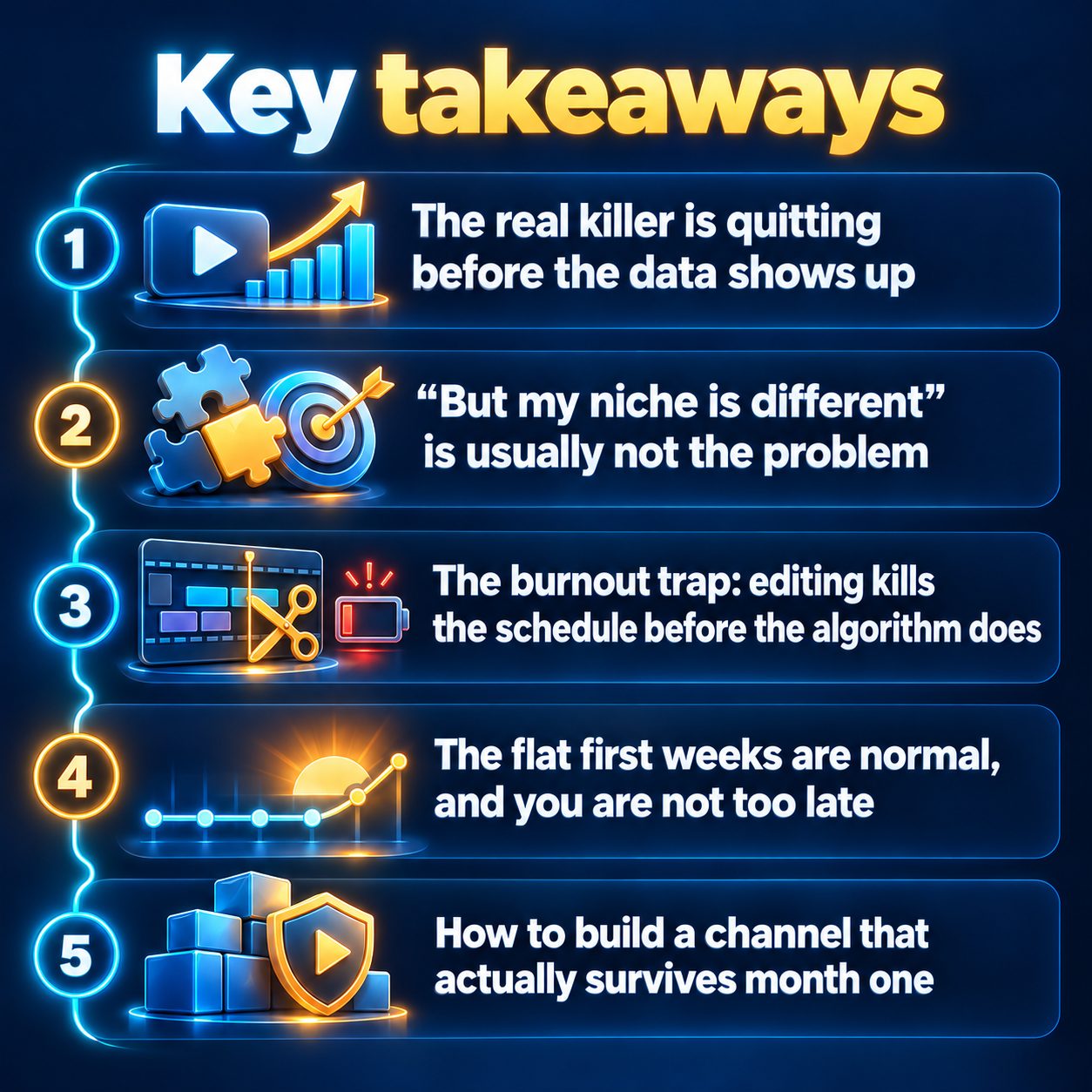
The burnout trap: editing kills the schedule before the algorithm does
Here is the actual mechanism that ends most channels, and it is boring on purpose.
You start motivated. Video one takes you four hours: writing the script, finding footage, recording narration or wrestling a text-to-speech tool, cutting it, adding captions. Video two takes three hours because you learned some shortcuts. By video five you are tired, it is a Tuesday, you have a job, and the idea of another three-hour edit for 40 views feels insane. So you skip a day. Then two. Then the channel is just sitting there.
That is not a discipline failure. That is a system failure. You built a channel that depended on you having energy every single day, and no human has energy every single day. The channels that survive month one are the ones where posting does not cost the operator four hours of manual work. When each video is cheap in time, a bad-mood Tuesday does not break the streak.
The flat first weeks are normal, and you are not too late
Two things run through your head in week two that nobody says out loud.
The first is "am I too late." You are not. New faceless accounts pass established ones every month because the platforms reward the individual video, not your account age. A strong video from a two-week-old channel can outrun a mediocre one from a two-year-old channel. Being late would matter if the algorithm ranked seniority. It ranks watch time.
The second is "will people judge me for this." Almost nobody knows or cares that a faceless video was made with AI, and the ones who do are not your audience anyway. Viewers care whether the first three seconds are interesting. That is the entire test. Nobody scrolling has ever paused to think about your production pipeline. They pause because the hook grabbed them or they keep scrolling because it did not.
So the flat weeks are not a verdict on your channel. They are the tax everyone pays. The only people who fail it are the ones who read it as a stop sign.
How to build a channel that actually survives month one
If the killer is quitting before the data shows up, then the whole game is staying alive long enough to accumulate reps without burning out. A few things that actually help:
- Batch. Do not make one video the day it posts. Make several in one sitting when you have energy, then release them on a schedule. This alone saves most channels, because it separates the work from the mood.
- Commit to a post count, not a result. Tell yourself you will post 30 videos before you judge anything. Take views completely off the table until then. It removes the daily disappointment that makes people quit.
- Kill the time cost per video. This is the real lever. If a video takes twenty minutes instead of four hours, month one stops being a test of willpower and becomes just a routine.
That last point is where a tool earns its place. MaqtAi takes a niche and a topic and writes the hook-first script, narrates it in an AI voice, generates moving visuals, adds animated captions, and assembles a vertical video, usually in a few minutes. You never film and you never record your voice. The point is not that it is fancy. The point is that it makes daily posting survivable, which is the exact thing that keeps channels alive through the flat weeks.
It also handles the part everyone drops first: consistency. Autopilot renders from a topic queue on a schedule you set and, on a paid plan and only if you opt in, publishes to YouTube, Instagram, and Facebook Reels. Every finished video can wait for your one-tap approval, so nothing posts that you have not seen. That is the difference between a channel that depends on your Tuesday energy and one that just keeps running.
Doing this by hand is the part most people quit at. MaqtAi writes the script, narrates it, generates the visuals and captions, and assembles the faceless short for you. Verify your email and you get 450 free credits: about 3 videos on the still-frame tier, or one with AI motion. Free renders carry a watermark.
Try it on your niche freeThe cost of waiting here is quiet but real. Every week you spend deciding is a week the algorithm collects zero data on your channel, and a week the account in your niche that started today gets ahead. Month one only ends one way if you never begin it. Verifying your email gets you 450 free credits, about three or four watermarked still-frame videos on the Express tier, no card. Make the first one this afternoon and let the counter start.
Frequently asked questions
How many videos should I post before deciding if my channel works? Aim for at least 30 before you judge anything. The algorithm needs reps to learn who your content is for, and small sample sizes tell you almost nothing. Take views off the table until you hit that number.
Is my niche too saturated to start now? Almost certainly not. Saturation means demand exists, and new faceless channels break into crowded niches constantly because platforms rank the individual video, not your account age. An empty niche is the bigger warning sign.
Does posting every single day actually matter? Consistency matters more than raw frequency, but a steady cadence gives the algorithm more data faster. Pick daily, three times a week, or weekly and hold it. Batching videos ahead of time is how people keep that promise without burning out.
Will viewers care that my videos are made with AI? No. Viewers decide in the first three seconds whether a video is interesting. They are not thinking about how it was produced, and the handful who care were never going to be your audience.
Results vary, and nothing here is a guarantee of income.