
You're not shadowbanned
Here's the thing you need to hear first: no major platform down-ranks a video because it was made without showing a face on camera. TikTok, Instagram, YouTube, and Facebook all rank shorts by viewer behavior. Watch time, completion rate, likes, shares. Not by whether a human appeared on screen.
So if your channel isn't growing, the algorithm isn't broken and you aren't being suppressed. You're most likely invisible because of a few specific, fixable patterns in your content. Let me walk through each one.
Your hook is the single biggest lever
The number one reason faceless shorts die is the opening. You have roughly two seconds before someone scrolls. If your video starts with a title card, a slow fade, or a generic "Did you know..." opener, you've already lost most of your potential viewers.
Strong hooks do one of three things: they make a specific promise ("Three signs your boss is about to fire you"), they create instant tension ("This country technically doesn't exist"), or they contradict something the viewer believes ("The healthiest breakfast food is actually making you sick"). The pattern is the same across every faceless niche.
Go back to your last ten videos right now. Watch only the first two seconds of each. If you wouldn't stop scrolling for your own hook, nobody else will either. Rewrite those openings before you create another batch. This single change moves the needle more than anything else on this list.
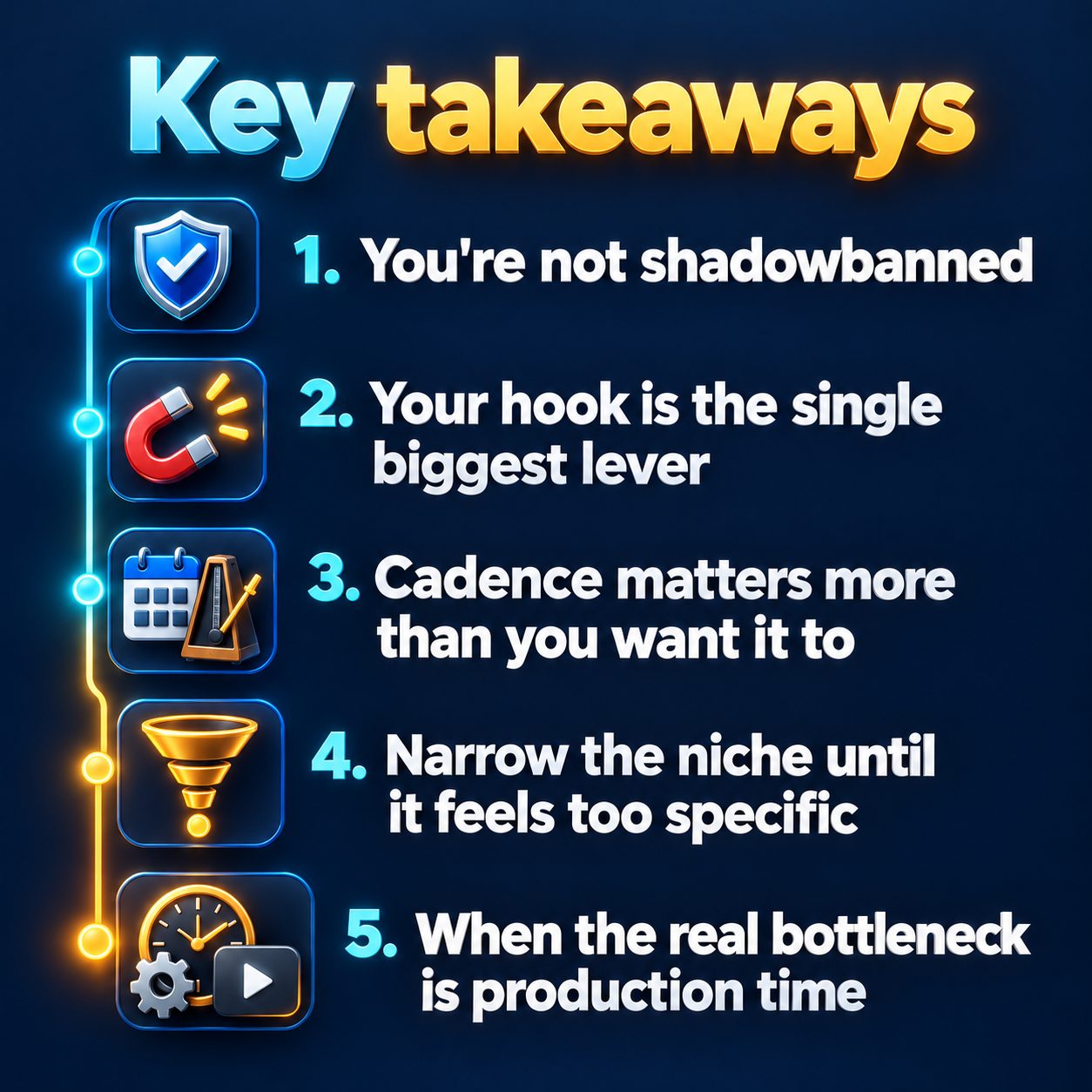
Cadence matters more than you want it to
"Just be consistent" is the most common growth advice and also the least useful version of a true idea. Consistency alone fixes nothing. But here's what actually matters: giving the platform enough data to learn who your audience is.
When you post once or twice a week, the algorithm gets a tiny sample of viewer reactions. It can't tell the difference between "this content doesn't resonate" and "we haven't shown it to enough people yet." Daily or near-daily posting solves that. More videos means more signals, which means faster feedback loops.
This isn't about grinding yourself into the ground. It's about math. If you've been posting twice a week for three months and growth is flat, try posting every day for three weeks. Watch what happens to your average views per video. The increase usually comes from the algorithm finally having enough data points to place your content confidently.
Narrow the niche until it feels too specific
"History" is not a niche. "Dark history of everyday objects" is a niche. "Motivation" is not a niche. "Stoic advice for people rebuilding after a breakup" is a niche.
When your channel covers a topic too broadly, the algorithm can't build a consistent audience profile. Every video attracts a slightly different viewer, your retention patterns scatter all over the place, and the platform never learns who to recommend you to.
The counterintuitive truth: narrowing your focus feels like you're shrinking your audience, but it actually concentrates your reach. A viewer who watches three of your very specific videos sends a much stronger interest signal than one who watches a single general video. That signal is what triggers the recommendation engine.
If you're wondering whether to start a brand new channel or just refocus, try refocusing first. Pick one specific angle within your existing niche, commit to it for 20 videos, and measure whether the numbers shift. Starting fresh resets all the watch-time data you've already accumulated. Narrowing keeps everything you've earned.
When the real bottleneck is production time
This is where most growth advice falls apart. Post daily. Tighten your hooks. Vary your format. All true. But if each video takes you two to three hours to script, narrate, edit, and caption, daily posting isn't a strategy. It's a second full-time job.
The friction usually isn't creativity. Most people stuck at low growth have plenty of topic ideas. The friction is production time per video. That's the specific problem tools like MaqtAi solve. You pick a niche and a topic, and it handles the script, voiceover, visuals, motion, captions, and even auto-publishing and scheduling across TikTok, Instagram, YouTube, and Facebook on a paid plan. The video that used to eat your entire evening now takes a few minutes, which means daily cadence stops being theoretical and becomes something you actually do.
You can test the production side without spending anything. Verifying your email on MaqtAi gives you 450 free credits, enough for roughly three to four still-frame Express videos, no card required, free renders carry a watermark and have no talking presenter, and publishing needs a paid plan. That's enough to know whether faster production changes your growth curve.
The real cost isn't a tool. It's another month of posting twice a week, getting the same flat numbers, and slowly convincing yourself the whole faceless model is broken. It isn't broken. Your approach just needs these specific adjustments.
Pick the one fix that hit closest to home while reading this. Change it tonight. If production speed is the bottleneck keeping you from posting daily, make your first video free this afternoon and see what consistent cadence actually does.
Doing this by hand is the part most people quit at. MaqtAi writes the script, narrates it, generates the visuals and captions, and assembles the faceless short for you. Verify your email and you get 450 free credits: about 3 videos on the still-frame tier, or one with AI motion. Free renders carry a watermark.
Try it on your niche freeFrequently asked questions
Should I delete my old underperforming videos? Generally no. Older videos sometimes get picked up by the algorithm weeks or months after posting. Deleting them removes whatever watch-time data they contributed. Focus your energy on making the next batch better.
Will the algorithm punish me for changing my content style mid-channel? Not directly. Platforms evaluate each video individually based on viewer behavior. A shift in style might temporarily confuse existing subscribers, but new viewers have no context for comparison. If the new approach performs better per video, the algorithm adapts.
Do I need to disclose that my videos are AI-generated? Platform rules vary. YouTube requires disclosure when realistic synthetic media could be mistaken for real footage, and TikTok has similar guidelines. The disclosure label itself doesn't reduce distribution, but skipping it when required risks content removal.
Is it too late to grow a faceless channel? New channels break through regularly because the algorithm favors individual video performance over account age. The barrier to growth isn't timing. It's niche specificity and consistent output.