
Pick a corner of history, not all of history
The fastest way to get ignored is to call yourself "a history channel." That is a category, not a niche. Viewers scroll past generic. They stop for specific.
Think about which slice of history genuinely interests you. Ancient warfare. Forgotten empires. Bizarre royal scandals. Cold War espionage. History of everyday objects. Medieval daily life. Each of these could sustain its own channel with its own loyal audience.
Why does the sub-niche matter so much? Short-form algorithms learn who to show your videos to. If your first videos jump from Roman gladiators to the Space Race to Victorian fashion, the algorithm gets no consistent signal. Stay in one lane, and it finds your people faster.
You do not need a history degree. You need genuine curiosity about one topic area and the willingness to research each video before you publish.
Week one: Build the foundation and publish your first videos
Days one and two: Channel setup. Create your YouTube channel (or TikTok, or Instagram, or all three). Pick a name that signals your sub-niche. Write a short bio. Choose a profile image. None of this has to be perfect yet.
Day three: Batch your topic ideas. Write a list of video topics. Think about questions people genuinely wonder about: "Why did a single dye cost more than gold in the ancient world?" or "How did people keep food from spoiling before refrigeration?" Frame each idea as a question or a surprise. These become your scripts.
Days four through seven: Publish one video per day. Each short should cover one focused idea in under 60 seconds. The opening line (the hook) matters more than anything else. If a viewer does not care in the opening seconds, they swipe.
You are not filming anything. A faceless history short uses AI narration over visuals that match the topic. The goal of week one is getting videos live, not getting them perfect.
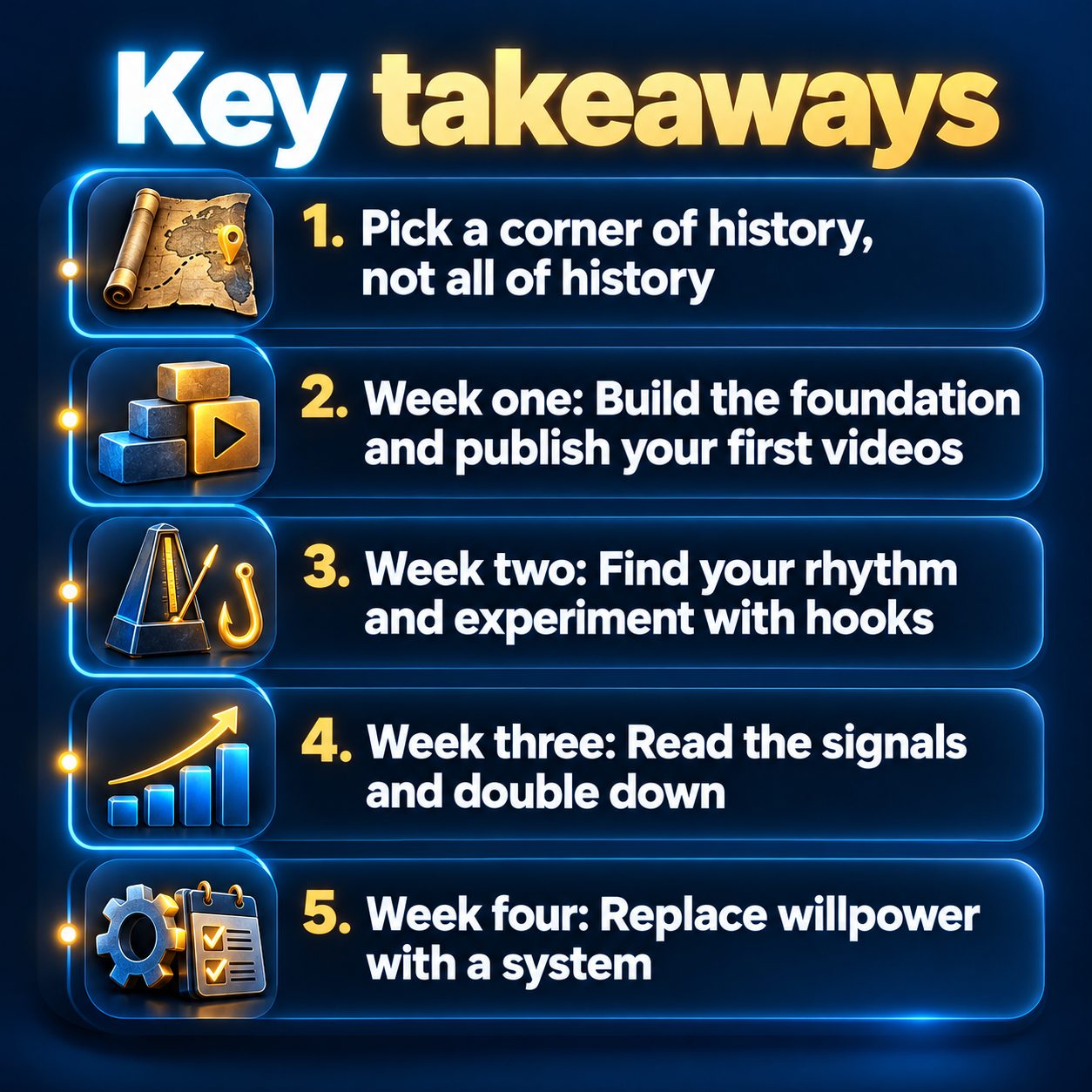
Week two: Find your rhythm and experiment with hooks
Keep publishing daily. Consistency matters more than polish at this stage. Your creative instincts sharpen with every video you finish.
This week, test different opening styles. Try a direct question ("How did ordinary people survive a medieval siege?"). Try a surprising statement ("You use something every day that was invented by accident centuries ago."). Try an unsolved mystery ("A hidden chamber was discovered inside a famous monument, and nobody has ever opened it."). Pay attention to which style keeps people watching.
Keep a simple log. Note each video's topic, hook type, and relative performance compared to your other shorts. You are not chasing big numbers yet. You are looking for patterns in what holds attention.
Week three: Read the signals and double down
Some of your shorts will have done noticeably better than others. Even a small gap in performance is a useful signal.
Check retention, not just views. On YouTube, open the audience retention graph in YouTube Studio analytics. A video where most viewers watch to the end tells you more than one with higher views but heavy early drop-off.
Make more of what worked. If your video about strange punishments held viewers but your video about ancient trade routes did not, lean toward what resonated. You are not locked in forever, but following the data early accelerates everything.
Notice your scripts improving. By week three, your writing will be tighter. Shorter sentences. Faster hooks. Less filler. That quiet improvement is real progress, even if the view counts have not caught up yet.
Week four: Replace willpower with a system
Motivation carried you through three weeks. A system keeps the channel alive after the novelty fades.
Batch your production. Instead of creating one video daily, set aside one or two sessions per week to make several at once. Batching is faster because your mind stays in the same creative mode.
This is where a tool like MaqtAi fits naturally. You give it a topic, and it writes a hook-first script, generates the voiceover, creates visuals with real motion, adds animated captions, and assembles a publish-ready short. For a history channel, you focus on research and topic selection while the tool handles production.
Automate your posting schedule. Publishing daily matters, but doing it by hand every single day is exactly what burns creators out. MaqtAi can schedule and auto-publish to TikTok, Instagram Reels, YouTube Shorts, and Facebook Reels, so your channel keeps moving even on your busiest days.
Keep refilling your topic list. The channel dies when you run out of ideas, not when you run out of time. Add new topics whenever you stumble on a historical rabbit hole. A running list is your most valuable asset.
The honest limits of AI history content
Here is the part most guides skip. AI tools write scripts and build visuals, but they do not fact-check themselves. History content carries a higher accuracy bar than most niches because your audience will notice mistakes and call them out in the comments.
Your job as the creator: verify the key claims before you publish. Read a source or two on each topic. Edit anything that feels wrong or oversimplified. This takes a few minutes per video, and it is what separates a channel people trust from one they dismiss.
Also worth saying plainly: no platform penalizes a video for being AI-made. TikTok, YouTube, and Instagram rank shorts by watch time, completion, and engagement, not by production method. What does hurt reach is spam behavior (posting near-identical content across many accounts), weak hooks, or skipping a platform's AI-disclosure label when one is required.
Doing this by hand is the part most people quit at. MaqtAi writes the script, narrates it, generates the visuals and captions, and assembles the faceless short for you. Verify your email and you get 450 free credits: about 3 videos on the still-frame tier, or one with AI motion. Free renders carry a watermark.
Try it on your niche freeYou have a plan now. The only piece left is the first video. You can make one right now for free: MaqtAi gives new users enough credits for their first videos after email verification, no card needed. Pick one topic from your sub-niche, create the short, and post it today. Every day you wait is a day the algorithm is not learning who your audience is, and a day a future competitor is already publishing.
Frequently asked questions
Do I need to be a history expert to run this kind of channel? No. Each short covers one narrow topic, so you only research one idea at a time. If you enjoy reading about the past and can verify your facts before publishing, you have what it takes.
Should I start on YouTube, TikTok, or Instagram? Start wherever you already spend time as a viewer, since you will understand that platform's culture best. If you have no preference, YouTube Shorts connects to a long-form ecosystem you can grow into later.
Can a faceless AI history channel get monetized? YouTube does not ban AI content outright, but its reused content policies warn against mass-produced repetitive material. Make each video genuinely distinct, always disclose synthetic media when the platform requires it, and focus on building real audience engagement.
Results vary for every channel and nothing in this article is a guarantee of income.