
Two separate meters, and watch hours belong to only one
YouTube's Partner Program has one subscriber bar and two ways to clear the second requirement. You need 1,000 subscribers plus either 4,000 valid public watch hours in the last 12 months or 10 million valid public Shorts views in the last 90 days. That's the whole rule.
The part that confuses almost everyone is this: time people spend watching your Shorts in the Shorts feed doesn't count toward watch hours. A channel with a big Shorts library and a few long videos isn't quietly stacking hours in the background. Each path is counted on its own meter, and you only need to finish one of them.
That's also why YouTube Studio can show a flood of Shorts views while your watch-hour bar barely moves. Nothing is broken. You're looking at two different meters.
"That Shorts number is impossible for a channel like mine"
Honestly? For most new channels, the Shorts view path is the harder one. It's a large bar, it runs on a rolling 90-day window, and one viral Short won't carry you unless the rest of the channel keeps pulling views after it. Views from three months ago simply age out.
The long-form path usually comes within reach sooner. Hours accumulate across a full year, and one solid explainer that people watch to the end does more for that meter than a pile of Shorts ever can, because Shorts feed time never touches it.
And before you think "my niche is different": it probably isn't, in the way that matters here. History, true crime, money explainers, sleep stories, startup stories. If your niche has a story with a middle, it can hold someone for a few minutes, and that's what earns hours. You can browse how different niches work as faceless channels on our use cases page.
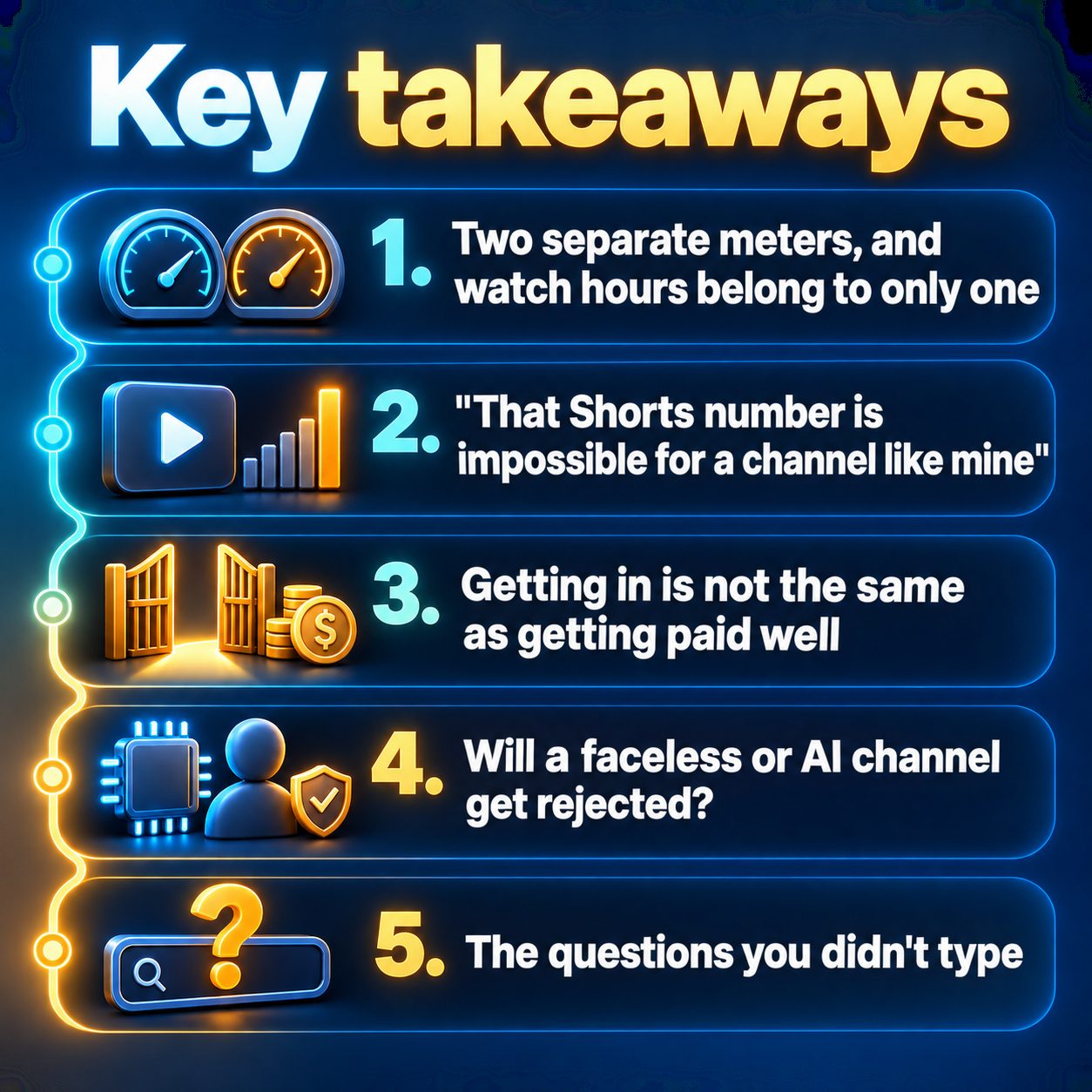
Getting in is not the same as getting paid well
Qualifying is the start, not the paycheck. Shorts earn from a shared revenue pool with its own rules, laid out on YouTube's Shorts monetization policy page. Regular videos typically earn far more ad revenue per view than Shorts do.
So the watch-hour path has a quiet bonus. The videos that get you accepted are the same kind that pay better once you're in.
None of this makes Shorts a waste. They're how strangers find you, cheaply and fast. They're just a weaker way to get paid on their own.
Will a faceless or AI channel get rejected?
Being faceless is fine. Plenty of accepted channels never show a person. Being AI-made isn't the problem either: no platform down-ranks a video just because of how it was produced. Shorts and long videos get ranked on viewer behavior, like watch time and whether people stay to the end.
What YouTube does reject is mass-produced, repetitive content. Its inauthentic-content policy is the reason channels pumping out near-identical videos get demonetized, AI or not. Reviewers look at the channel as a whole, so the test is simple: would a viewer feel each video was made on purpose? A different story each time, a real angle, a payoff worth staying for.
Here's the honest limit. No tool, AI or otherwise, can make a thin idea interesting. If the topic is filler, a polished render is still filler. And if your visuals are realistic synthetic media, use YouTube's AI disclosure. The label doesn't hurt distribution, but skipping it can get a video removed.
The questions you didn't type
Am I too late? No. Viewers don't care when your channel started. They care whether this video deserves their next minute, and YouTube shows new channels to new people every single day.
What if I stop after two weeks? That's the real risk, far bigger than the algorithm. Both paths reward months of steady posting. So pick a cadence you can keep on a bad week, maybe three videos a week instead of daily, and protect it. A slower channel that keeps going beats a fast one that disappears.
Will people judge me for AI content? A few will. Most are judging something else: whether the video was worth watching. Earn that and the rest fades.
A plan that uses both paths
Treat long-form as your monetization engine and Shorts as your discovery engine. Something like one widescreen explainer a week, a few minutes long, plus Shorts on other days that each stand on their own and nudge people toward the full video on your channel.
YouTube decides the format by shape. A vertical or square video up to 3 minutes counts as a Short (YouTube Help), and a widescreen video counts as a regular one, earning hours.
This is where a tool can take friction off, if filming is what's stopping you. In MaqtAi, picking 16:9 at 2 or 5 minutes in the Length & aspect step gives the script a long-form structure: a hook, themed sections, and a recap. Once it's finished, a "Make a companion Short" button creates a separate vertical video on the same topic with its own payoff, ending with an invite to the full guide on your channel. It's priced like any other video, and you can schedule a steady cadence with Autopilot. It won't choose your topic for you, and it can't make anyone watch. Your niche and your hooks still do that part.
What waiting actually costs
The watch-hour meter only fills from videos that exist. Every week without a long video is a week of hours that never started counting, inside a 12-month window that keeps rolling forward. Meanwhile YouTube isn't learning who your viewers are, and someone in your niche is posting today.
So don't plan the whole channel tonight. Make one long video and its companion Short this week, and see how it feels. Most new accounts that verify their email get free starter credits, no card needed, though not every account qualifies and free renders carry a watermark. It's enough to find out if this format fits you before you spend anything. Details are on the pricing page.
Doing this by hand is the part most people quit at. MaqtAi writes the script, narrates it, generates the visuals and captions, and assembles the faceless short for you. Verify your email and you get 450 free credits: about 3 videos on the still-frame tier, or one with AI motion. Free renders carry a watermark.
Try it on your niche freeFrequently asked questions
Do Shorts views count toward watch hours? No. Time watched in the Shorts feed doesn't count toward the watch-hour requirement, as YouTube's Partner Program page explains. The two paths are tallied separately.
Can I combine Shorts views and watch hours to qualify? Not into one total. You qualify through either the watch-hour path or the Shorts-view path, though subscribers you gain from Shorts count toward the subscriber requirement either way.
Can a faceless channel join the Partner Program? Yes. What matters is that the channel is original and not repetitive, since YouTube's inauthentic-content policy demonetizes mass-produced lookalike videos whether or not a face appears.
How long does it take to qualify? There's no honest fixed answer. It depends on your niche, your opening seconds, and how consistently you post, so plan in months rather than weeks.
Results vary, and nothing here is a guarantee of income.