
The skeleton under almost every short that works
Open up any short-form video that held you to the end and you will find the same bones, whatever the niche.
Hook. One line. A claim, a tension, or a fact that feels wrong until you explain it.
Promise. One line telling the viewer what they get if they stay. Sometimes it is baked into the hook. Never skip it entirely.
Beats. A handful of short chunks that deliver on the promise. Each one should end where the next begins, so there is no natural place to swipe away.
Payoff. The thing you promised, said plainly. Do not be clever here. Be clear.
Exit. One line that earns a rewatch, a comment, or a follow. "That is why it never happened again" beats "like and subscribe" every time.
That is the whole template. The reason it feels repeatable is that it is repeatable. Your job each time is not to invent a new format, it is to find a topic worth putting through this one.
Write the hook last, then write five of them
Most people write the hook first, get stuck, and never write the script. Do it backwards. Write the body while you still care about the topic, then come back and write several openers for it, out loud, quickly, without judging them.
Patterns that keep earning their keep:
- The correction. "Everyone tells you to X. It is the reason your Y is broken."
- The specific noun. Not "an old shipwreck", but the name, the year, the number of people aboard. Specifics feel like information.
- The stakes up front. "He had eleven minutes to decide." Now the viewer has a clock.
- Mid-action. Start inside the scene, explain nothing for a beat, let the confusion do the pulling.
- Direct address. "If you have ever done this at work, stop."
Then read the five aloud and pick the one that would stop you in a feed at midnight. Kill anything that starts with "In this video", "Hey guys", or a slow scene-setting sentence. Feeds autoplay, so the opening frame and the opening sentence are doing all the work of a thumbnail.
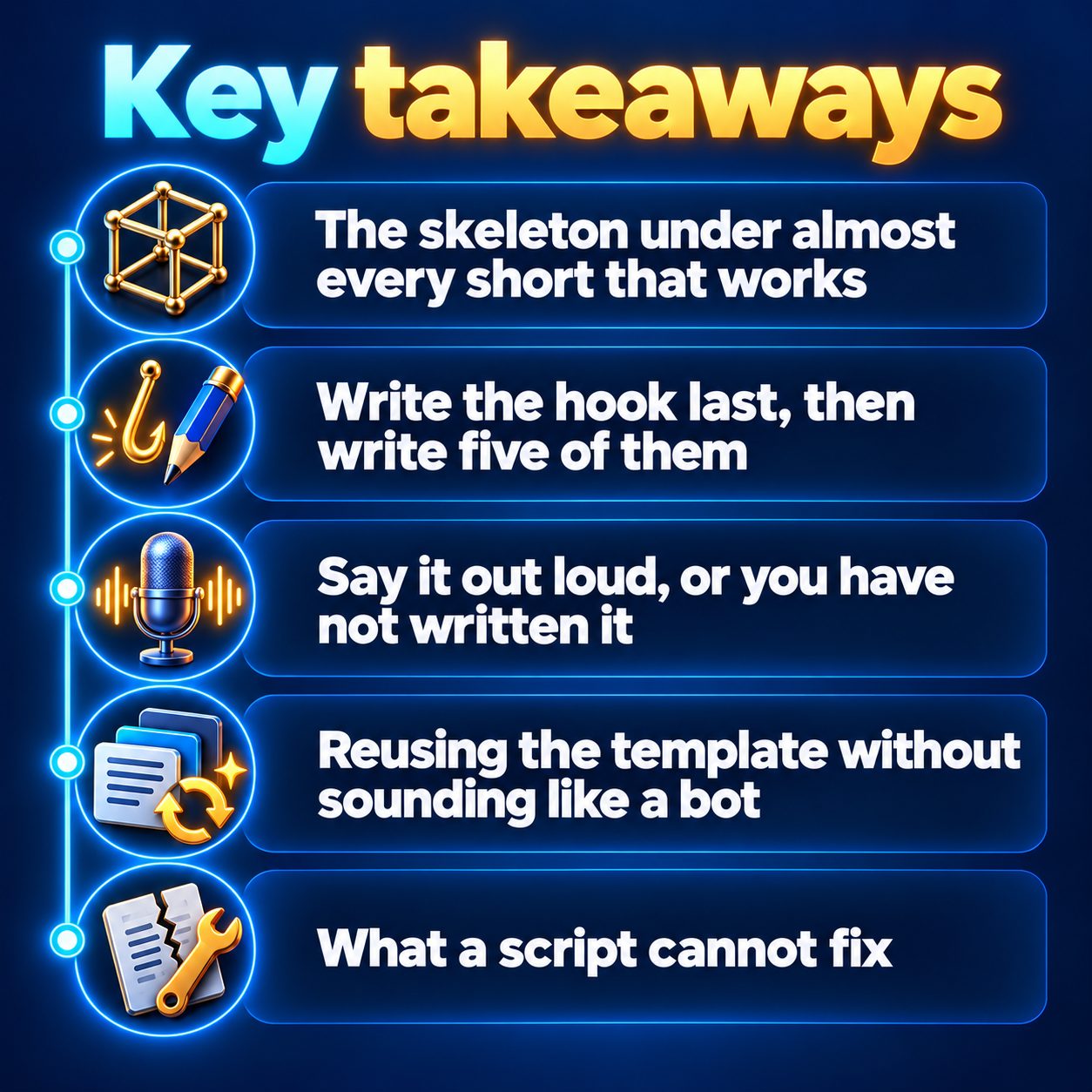
Say it out loud, or you have not written it
A script for video is not prose. It is speech with the boring parts removed.
The test takes a minute. Read your script into your phone's voice recorder at a normal talking pace and play it back. You will hear the problems immediately: the sentence with three clauses, the word you would never actually say, the beat where your own attention drifts. Cut those. One idea per line. Concrete nouns over adjectives. Present tense for stories.
Timing matters more than word count. A tight 30 seconds beats a padded minute, and if you are aiming at Shorts, YouTube classifies vertical uploads up to 3 minutes as Shorts, so length is a choice you should make on purpose before you write, not after. If the script needs to be longer, add a second beat with its own small payoff, not more words around the same one.
One more thing that changes how you write: animated captions. When each word lands on screen as it is spoken, short punchy lines look intentional and long winding ones look like a wall. Write knowing the text will be read as much as heard.
Reusing the template without sounding like a bot
The fear here is real. Use one structure for weeks and every video starts to sound like the last one. The fix is not a new structure, it is rotating the shape you pour into it.
Keep a short list and cycle through it: the story (one event, chronological), the correction (a common belief taken apart), the walkthrough (how a thing works), the list (three items, no more), the question (asked in the hook, answered at the payoff). Same skeleton, completely different feel.
Then vary the entry point and the ending. Some videos start at the climax and rewind. Some end on a question, others on a flat statement. Also let the niche set the rules: sleep and bedtime content needs slow pacing and a soft opener, because a punchy shock hook actively works against it. History and true crime need sourcing you would defend in the comments. Motivation lives on rhythm, so those scripts should be read aloud twice.
What a script cannot fix
A good script will not rescue a niche nobody is searching for, and it will not make up for posting twice a month. Structure lifts a decent topic. It cannot manufacture interest in a topic you picked because it seemed easy.
On the worry nobody types out loud: no platform down-ranks a video simply because AI helped write it. Shorts are ranked on viewer behavior, watch time, completion, shares. What does hurt you is spam behavior, near-duplicate uploads across accounts, weak opening seconds, and ignoring disclosure rules. If your video contains realistic synthetic footage or voice, YouTube requires you to disclose it; the label itself does not shrink your reach, skipping it risks removal.
And viewers judge the video, not the process. Nobody in your comments knows or cares which part you typed. They care whether the first line was worth their next 30 seconds.
Making it repeatable week after week
Batch. Writing one script from cold is hard, writing several in one sitting is much easier because your brain stays in the same voice. Pick a block of time, list topics first without writing anything, then run each through the skeleton, then do a hook pass over all of them at once. Keep a running notes file of topics so you never start from an empty page.
If the writing itself is the part that stalls you, that is where a tool earns its place. MaqtAi writes hook-first scripts per niche, then narrates them, generates the visuals with real motion, adds the animated captions and assembles the vertical video, usually in a few minutes (here is the three-step version). If you already have a script you like, paste it into the Script step and skip Generate, and it gets used word for word, split into scenes exactly as you wrote it. Set a cadence and scheduling and auto-publishing handle the posting so writing day and posting day stop being the same day, on a paid plan.
Here is the honest urgency. Nothing bad happens if you wait another week. Nothing good happens either. The channel does not accumulate the watch-time data the algorithm needs to figure out who to show you to, your hook writing does not get faster, and whoever is already posting daily in your niche keeps building the head start. The way out is small: write one script tonight using the skeleton above, read it aloud once, and get it out.
You can make the first video without spending anything. Verifying your email comes with 450 free credits and no card, enough for three or four watermarked still-frame videos, so see what a credit actually buys and use them on the script you just wrote.
Doing this by hand is the part most people quit at. MaqtAi writes the script, narrates it, generates the visuals and captions, and assembles the faceless short for you. Verify your email and you get 450 free credits: about 3 videos on the still-frame tier, or one with AI motion. Free renders carry a watermark.
Try it on your niche freeFrequently asked questions
How long should a short-form script be? Write to time, not to word count. Read it aloud at your normal speaking pace and aim for 30 seconds or less when you are starting out, because holding attention all the way to the end matters more than covering everything.
Should I write the script myself or let AI draft it first? Either works, and most people end up mixing. Drafting yourself gives a stronger voice, generating first is faster when you are stuck. If you paste your own script into MaqtAi without pressing Generate, it is used verbatim rather than rewritten.
How do I stop every video from sounding the same? Keep the skeleton and rotate the shape: story, correction, walkthrough, list, question. Change the entry point and the ending too, so the rhythm shifts even when the structure does not.
What if I run out of topics after two weeks? Everyone does, which is why you list topics separately from writing them. Keep a notes file, add to it whenever something catches you, and never start a writing session from a blank page.