
What a faceless short is actually made of
Pull apart any faceless short that held you to the end and you will find five things: an opening line that stopped the scroll, one idea, a voice reading it at a decent pace, visuals that give your eyes something to do, and captions on screen. That is the recipe. Not one of those five is an editing skill in the way people usually mean the word. No color grade. No multicam sync. No transition packs.
The format is small on purpose. YouTube treats vertical or square video up to 3 minutes as a Short (YouTube's spec here), and most of what performs runs a lot shorter than the ceiling. A video with one idea does not need craft in a timeline. It needs a decision about what to say and the discipline to cut everything that is not that.
Traditional editing skill still matters somewhere. It matters for long documentary work, for narrative film, for anything where the cut carries meaning. It does not matter for a 40-second explainer about a Roman emperor.
The four skills that actually decide this
None of them live in software.
Picking a niche you can stand for months. This is the real filter. Pick scary stories, stoic motivation, history, personal finance, true crime, whatever you would happily read about on a Sunday. If the topic bores you by week three, no amount of polish saves the channel. There are plenty of faceless niches that work without filming, and the right one for you is the one you would keep going with unpaid.
Writing a first sentence. Your opening line is the whole job. It should make a promise, name a tension, or ask something the viewer wants answered. "Here are some facts about sharks" dies. "The shark that scientists could not explain for eleven years" does not. You can learn this by watching thirty shorts in your niche and writing down only their first lines.
One idea per video. Beginners cram three. The video gets vague and people leave. One idea, set up, paid off, done.
Cadence. Posting once a day beats posting a masterpiece once a fortnight, because the algorithm needs data points and you need reps. This is the skill that actually separates channels, and it has nothing to do with editing either.
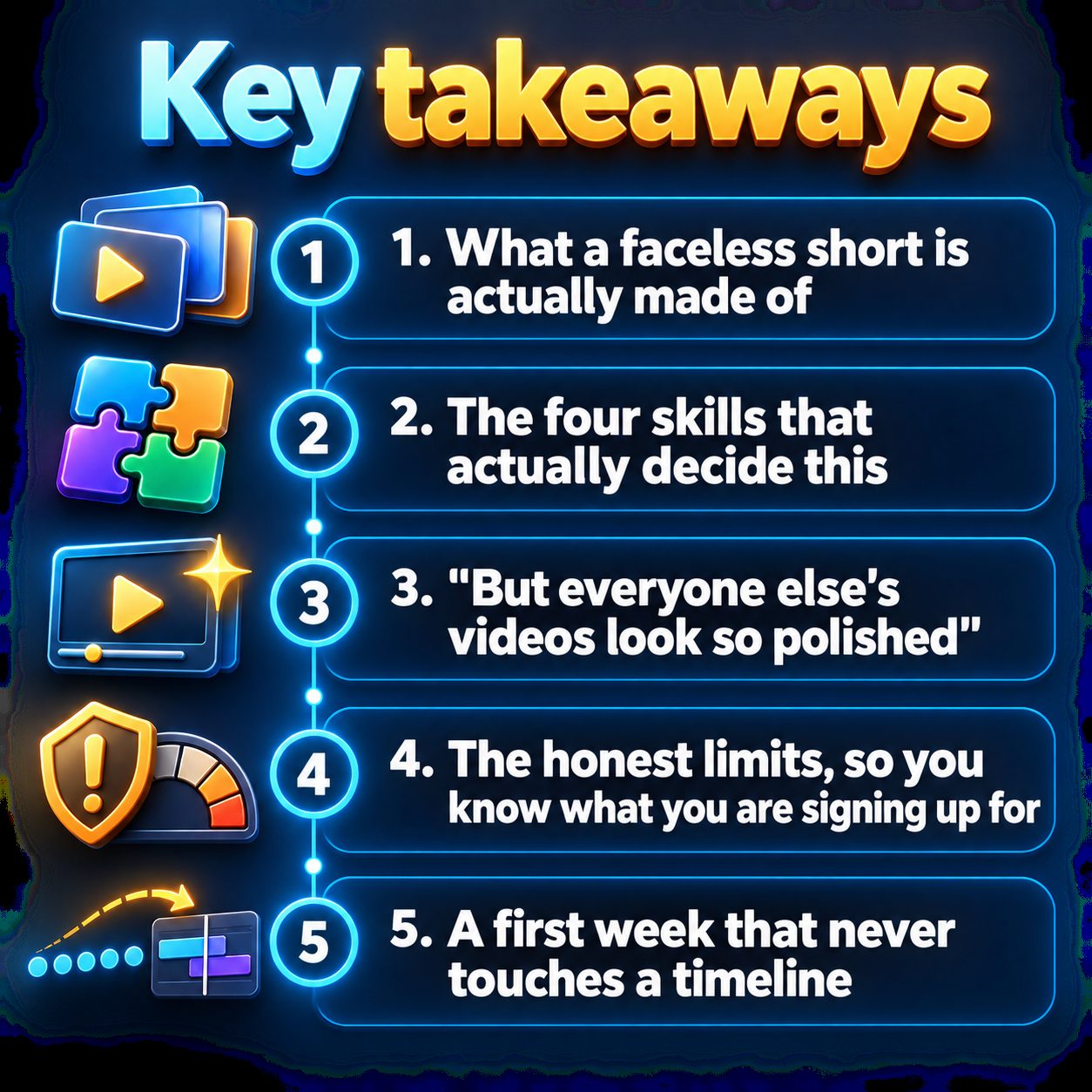
"But everyone else's videos look so polished"
They look polished because the format is forgiving, not because those creators trained. Full-screen footage, big animated captions, a clear voice. That look is a template now, and templates are exactly what software is good at.
The quieter worry underneath is usually different: will people think less of me for making AI content? Honestly, almost nobody in your feed is thinking about how a video was produced. They are deciding in the first second whether to keep watching. And no major platform down-ranks a video simply for being AI-made. TikTok, Instagram, YouTube and Facebook rank short video by viewer behavior: watch time, completion, shares. What does hurt you is spam patterns like near-identical files posted across many accounts, weak opening seconds, or ignoring a platform's disclosure rule for realistic synthetic media. The disclosure label itself does not shrink your reach. Skipping it when it applies can get the video removed.
And no, you are not too late. Faceless channels are not a land grab with a closing window. They are a cadence game, which means the people ahead of you are simply the people who started posting earlier.
The honest limits, so you know what you are signing up for
This is where most articles go quiet, so: automation removes the assembly work. It does not remove the thinking.
Nothing picks your niche for you. Nothing tells you whether your hook is good. Nothing has taste. If you generate a video about a topic nobody searches for, written with a flat opening line, you get a clean, well-captioned video that nobody watches. That is not a tool failure. That is a content decision.
Some niches also carry real obligations. History and true crime need you to check facts before you publish, because an AI script can state something confidently and be wrong. If you would be embarrassed to have your name on it, edit it before it ships.
Publishing has quirks worth knowing up front. YouTube Shorts publishes directly to any channel. TikTok posts publish directly and publicly too, with a visibility level you pick before posting, or you can send a draft to your app inbox instead. Instagram Reels needs a Business or Creator account linked to a Facebook Page, since personal accounts cannot publish through the API. And on money: the YouTube Partner Program needs 1,000 subscribers plus either 4,000 valid public watch hours in the last 12 months or 10 million valid public Shorts views in the last 90 days. That takes months of posting, whether a human edits your videos or not.
A first week that never touches a timeline
Day one: pick the niche. Write a list of topics you could cover, one line each, on your phone.
Day two: write only opening lines for those topics. Nothing else. Keep the ones that make you want to hear the rest.
Day three: make your first video. This is where a tool like MaqtAi does the assembly: you give it a niche and a topic, and it writes the script, narrates it with an AI voice, generates visuals as still frames by default or with AI motion if you switch it on, adds animated captions and assembles a vertical video, typically in a few minutes. You can edit any line before it renders, or paste your own script and have it used word for word. Nothing gets generated or charged until you press launch.
Day four onward: post one a day and watch retention, not subscribers. If people drop in the first two seconds, the hook is wrong. If they drop halfway, the middle sagged. Fix the next video, not the old one.
When the manual rhythm gets tiring, that is when scheduling and auto-publishing earn their keep, because keeping the cadence is the part that beats you, not the editing you never had to do.
What waiting actually costs
Waiting until you "learn editing first" costs you the only thing that compounds here: posted videos. Every week you spend deciding is a week your channel gathers no algorithm data, builds no back catalog, and teaches you nothing about what your audience opens. Meanwhile somebody in your niche with worse ideas is posting daily and getting the reps.
So make one video. Not a channel plan, not a content calendar, one video about the topic you would happily explain to a friend. New accounts that verify their email get 450 free credits, no card, which covers three or four watermarked still-frame videos, or one with AI motion, so you can see your own idea come back as a finished vertical video before you spend anything. Then you will be arguing with a real video instead of an imaginary skill gap.
Doing this by hand is the part most people quit at. MaqtAi writes the script, narrates it, generates the visuals and captions, and assembles the faceless short for you. Verify your email and you get 450 free credits: about 3 videos on the still-frame tier, or one with AI motion. Free renders carry a watermark.
Try it on your niche freeFrequently asked questions
Do I need to know anything technical at all? You need to be able to type a topic, read a script and press publish. The wizard walks through topic, style, length, script, voice, music and captions in order, and nothing renders until you launch.
Will my videos look generic if I do not edit them? They will if your script is generic. The visuals follow the words, so the fastest way to look different from everyone else in your niche is a sharper angle and a better opening line, not fancier cuts.
Can I still change things after the video is generated? On a paid plan, yes. Text, voice, music and caption edits cost no credits for 7 days after the render, and regenerating a scene's visuals costs the normal per-scene credits for that video's quality tier, shown before you apply it. Free accounts get at most one free fix per video and cannot regenerate visuals. See pricing and credits for the details.
Do I own what I make? Yes. Videos you generate are yours to post, monetize and use commercially on your own channels.
Results vary. Nothing here is a guarantee of income.