
What YouTube actually checks before it pays you
Nobody at YouTube sits down, listens to your narration, and rules on whether the voice has lungs. There are two doors, and they are separate.
The first door is numeric. The Partner Program asks for 1,000 subscribers, plus either 4,000 valid public watch hours in the last 12 months or 10 million valid public Shorts views in the last 90 days. A synthetic narrator has no effect on any of that. Those numbers come from people choosing to keep watching.
The second door is policy. YouTube's inauthentic content rules go after mass-produced and repetitious uploads: the same template, the same stock clips, the same recycled text, over and over. That rule catches human narrators too. A guy reading scraped listicles into a USB mic in his bedroom fails it just as fast as a bot does. The question the reviewer is answering is whether a viewer got something out of your video, not who spoke it.
So the honest answer to "can I use an AI voice" is yes, and it was never the real question. The real question is whether your channel is worth watching.
Decide the shape of the video before you decide the voice
This is the choice that changes your money more than any voice setting.
YouTube classifies automatically. Vertical or square, up to 3 minutes, is a Short. Widescreen, or anything longer, is a regular video. Regular videos typically earn far more ad revenue per view, and look again at the two thresholds above: watch hours accumulate steadily from long-form, while the Shorts view requirement is a much steeper hill for a channel starting from zero.
So if monetization is the actual goal and not just growth, do not build only vertical. A workable pattern is long-form as the backbone, with shorts feeding the channel. In MaqtAi you choose this at the Length and aspect step, before the script is written, so the duration shapes how much script gets written instead of stretching a thin one. Widescreen at the longer lengths gets an automatic long-form structure: hook, themed sections, recap. Finished widescreen videos also have a "Make a companion Short" button that creates a separate standalone vertical video on the same topic, with its own payoff, ending by pointing viewers at the full guide on your channel.
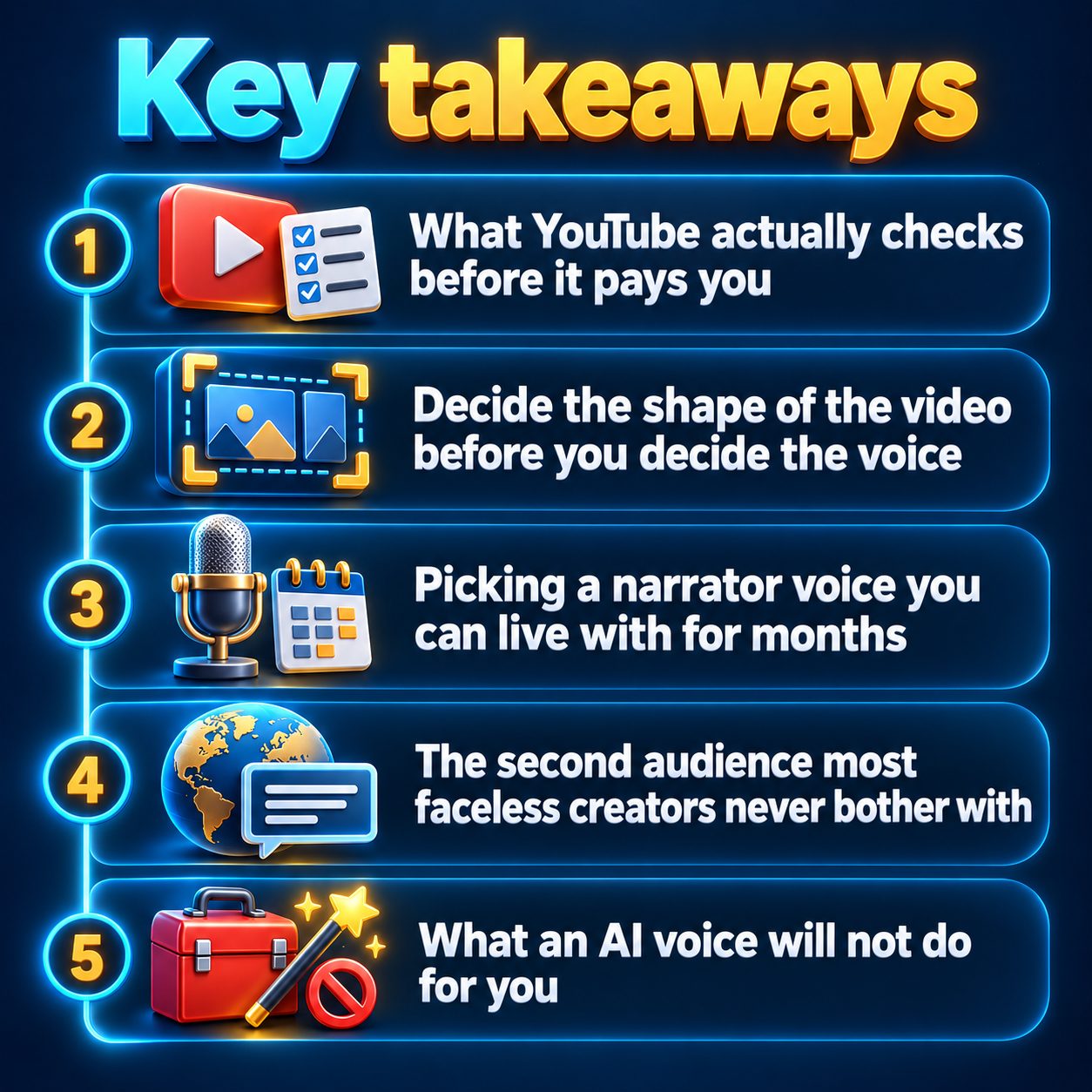
Picking a narrator voice you can live with for months
You are not choosing a voice for one video. You are choosing the sound of your channel for however long you keep going, and switching narrators later is jarring for anyone who subscribed.
A few things to weigh before you commit:
Match the voice to the niche, not to your taste. Sleep and bedtime content needs a slow, low, unbothered read with no spikes. True crime and dark psychology need something flatter and more restrained than people expect; drama in the delivery makes it sound cheap. Stoic motivation carries a slower, heavier read. Finance and explainer content wants brisk and plain. If a voice sounds impressive in preview but exhausting after three minutes, it is the wrong voice.
Preview before you generate anything. MaqtAi has a set of narrator voices with a preview button on the Voice step, and speech speed is adjustable if the default read feels rushed or draggy for your niche. Nothing is generated and no credits are charged until you press Launch on the Review step, so auditioning costs you nothing but a couple of minutes.
Consider your own voice, honestly. Clone Studio lets you record a short guided reading to clone your voice, and there is a voice-only mode with no photo, so your cloned voice can narrate videos without ever fronting one. It is labeled Beta in the app for a reason, and a calm recording in a quiet room makes a real difference to the result. If your voice is not part of your brand, a stock narrator is the lower-friction choice.
Write the words first, then hand them over. Every script MaqtAi generates opens with a hook, sets up a problem, pays it off, and ends with one next step, and you can edit any line on the Scenes step. If you already write, paste your own script and it gets used word for word.
The second audience most faceless creators never bother with
Here is where AI narration does something a human throat cannot do cheaply.
A finished picture-and-motion video has a Language versions panel that regenerates the same video, identical visuals, with a new voiceover and new captions in another language. Dozens of languages are supported, including Arabic, Spanish, French, Hindi and Japanese, and each version gets its own title written from the translated script. There is one all-in price per generation, shown on the button before anything is charged, and regenerating a language you already own costs much less because the first price buys the language. You can also just set the voiceover language up front on the Topic step, which controls script, narration and captions together.
Why this matters for monetization: watch hours are watch hours regardless of the language they were earned in, and competition in many non-English niches is thinner. Run the second language as its own channel, not as a dumping ground. One note of honesty: presenter and talking-head videos cannot be localized yet, because the lips would not match the new words.
What an AI voice will not do for you
It will not make anyone watch. Retention is decided in the opening seconds by what is said and shown, not by the timbre of the narration. A great voice reading a boring first sentence still loses the viewer.
It will not fix a niche nobody searches for, and it will not rescue a channel that posts three times and stops. It will not exempt you from disclosure: if your video contains realistic synthetic media, label it. The label does not reduce distribution, but skipping it can get the video removed. It will not protect you from the repetition rule either. If you queue up near-identical videos with a keyword swapped, you will hit the same wall as everyone else running that playbook.
And if you are already comfortable recording yourself and your channel is built around your personality, an AI narrator may genuinely be a downgrade. It removes recording and re-recording from the workflow. That is the whole job. It does not create demand.
The cost of waiting until you feel ready
The cost is not dramatic. It is just quiet. Every week you spend deciding is a week where no watch hours accrue, no algorithm data accumulates about who your videos are for, and the person in your niche who posts on a boring schedule gets further ahead. Nothing about monetization rewards a good plan. It rewards a channel that has been running.
So make one video this week. Pick a niche you would still find interesting in month three, choose widescreen if you are aiming at watch hours, audition two voices, and publish. You will learn more from that one upload than from another fortnight of research. Verifying your email gives you free credits to make the first one with no card, and the pricing page shows exactly what each video costs after that, while the feature tour covers scheduling and auto-publishing when you are ready to run it on a cadence.
Doing this by hand is the part most people quit at. MaqtAi writes the script, narrates it, generates the visuals and captions, and assembles the faceless short for you. Verify your email and you get 450 free credits: about 3 videos on the still-frame tier, or one with AI motion. Free renders carry a watermark.
Try it on your niche freeFrequently asked questions
Does YouTube demonetize videos with AI voiceover? Not for the voice itself. YouTube demonetizes mass-produced and repetitious content that adds no original value, which is a judgment about the video, not about who narrated it.
Should I disclose that the narration is AI? Disclose when your video contains realistic synthetic media, following the platform's own rule. The disclosure label does not reduce distribution, and skipping it when it applies risks removal.
Is long-form or Shorts the faster route to monetization? For most faceless channels, long-form. The watch-hour path is more reachable than the Shorts view path, and regular videos typically earn far more ad revenue per view.
Can I use the same AI voice across several channels? Yes, and you can connect multiple channels in one workspace or keep each in its own. Just do not post the same or near-identical files across accounts, which is the pattern platforms actually penalize.
Results vary. Nothing here is a guarantee of income or of monetization approval.