What "UGC style" actually means
It does not mean low quality. It means the video behaves like a person, not a brand. One face. One angle. One claim. A sentence that starts in the middle of a thought because that is how people talk. The reason marketers pay for this look is simple: it reads as a recommendation instead of a commercial, so viewers give it a few more seconds before they scroll.
That is worth writing down, because it changes what you actually have to build. You are not trying to match a studio. You are trying to match a friend holding up a bottle in their kitchen. Everything below is about the choices that create that feeling, and almost none of them require a shoot.
The parts that make it read as real
The first line does all the work. Not "Introducing our new..." but the thing your customer already thinks. "I stopped buying the expensive one." "This is the part nobody tells you about renting." If the opening line could belong to any product, it is not a UGC opening.
One claim, not five. Real people recommend one thing about a product. Ads list features. Pick the single reason someone would buy, and let the other four go.
Show the product as it actually looks. This is where most fake-feeling ads fall apart. A glossy rendered version of your product signals "brand." Your own photo, slightly imperfect, on your own table, signals "person." Use the pictures you already have.
Spoken rhythm. Read your script out loud. If you run out of breath or feel silly, rewrite it. Contractions, short sentences, one aside.
End with one instruction. "Link in bio" or "comment the word and I will send it." One. A stack of calls to action is the fastest way to sound like a company.
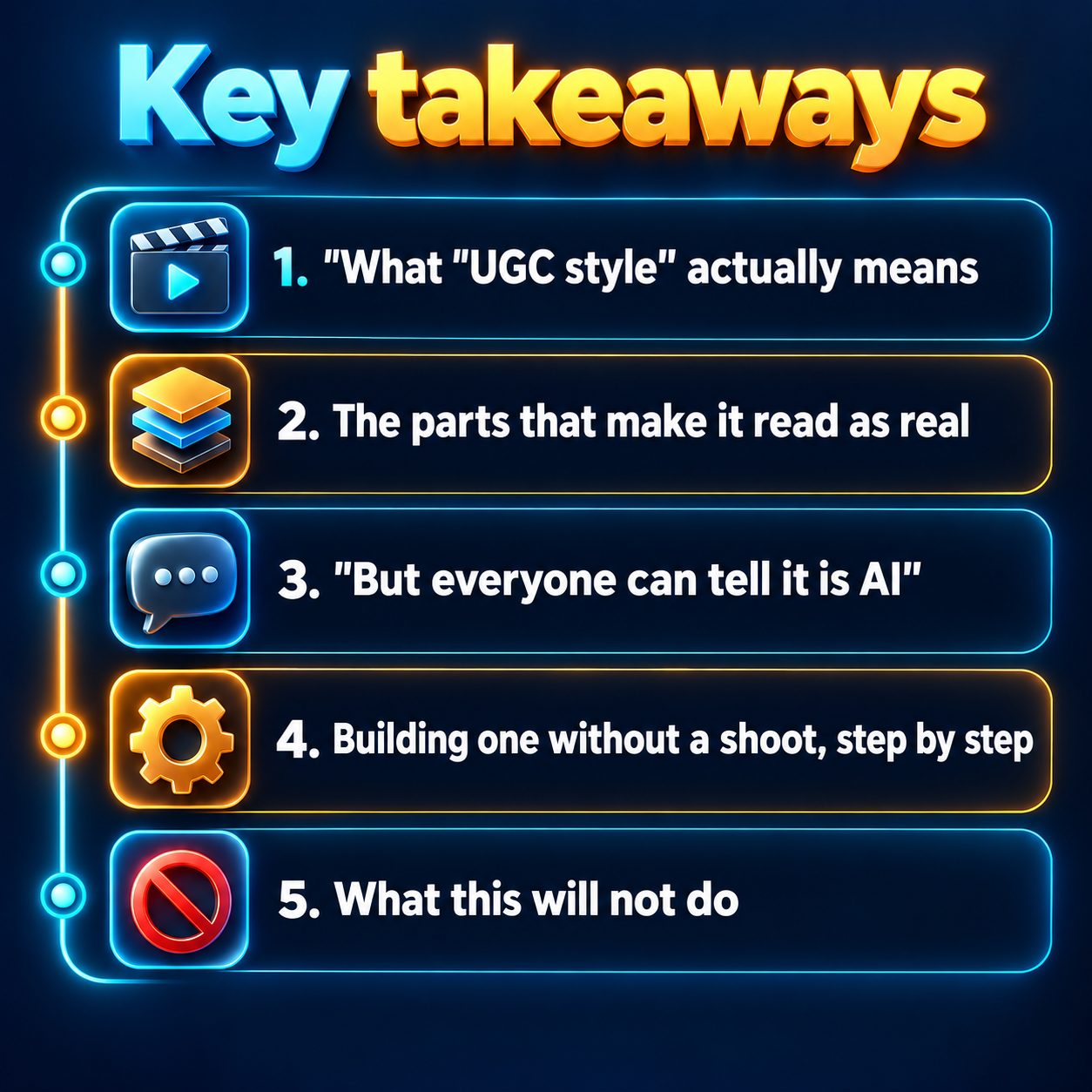
"But everyone can tell it is AI"
Some viewers will clock it. That is fine, and it matters less than you think, because the thing that gets a video ignored is almost never how it was made. Platforms rank short video by viewer behavior: how long people watch, whether they finish, whether they like and share. No platform down-ranks a clip for being AI-assisted.
What does hurt you is real, so know the list. Posting near-identical files across a pile of accounts looks like spam and gets treated like spam. A weak first two seconds kills the video before the algorithm ever forms an opinion. And if your video contains realistic synthetic media, the platforms have AI-disclosure rules; ticking the label does not reduce your reach, but skipping it when you should have used it risks removal. Tick the box and move on.
The honest version of the worry is different anyway. People are not scared of being detected. They are scared of being judged. Nobody in your comments is auditing your production method. They are deciding whether the thing you said is true.
Building one without a shoot, step by step
- Write your product facts before your script. Name, who it is for, the one claim, the one instruction at the end. Everything downstream comes from this, and a script written from real facts only claims what you actually wrote.
- Pick a presenter and a setting that match the claim. A kitchen product does not belong in a boardroom. Keep the setting plain enough that the viewer looks at the face.
- Gather two to six product photos. Shot on your phone, in normal light, as the product actually arrives. These carry your credibility.
- Keep it short. Fifteen to thirty seconds is the working range for a first ad. Longer only if the claim needs a demonstration.
- Watch it with the sound off, then with sound only. If it fails either test, fix the failing half.
- Post it, then make a second one with a different opening line. The opening line is the variable worth testing first.
If you would rather not stitch that together yourself, this is what MaqtAi's presenter ads do: a lip-synced presenter fronts a fixed six-scene UGC-style ad, written from the product facts you enter, with up to six of your own photos shown full screen while the presenter keeps talking. Your photos appear exactly as you uploaded them on a blurred fill, never redrawn, and the opening hook and closing instruction always stay on the presenter's face. You can use a stock presenter or record a short guided reading in Clone Studio and put your own face and voice in front of it.
What this will not do
It will not invent proof. A presenter saying your product is the best does nothing if you have no reason to believe it. If your claim is thin, no format saves it.
It will not demonstrate texture, fit, or motion. If your product has to be seen being used, a five second clip filmed on your phone will beat anything generated. Combine them.
The clone side is honest about being in beta: the likeness is close, but mouth movement and hands are the hardest parts. A sharp, well lit, front facing photo and a calm recording in a quiet room make more difference than anything else. And presenter videos have narrower editing afterwards, since changing the words would desync the lips, so get the script right before you render.
One more limit worth knowing up front: talking-avatar presenters are a paid feature, and so is Clone Studio. Free renders default to stills with pan and zoom, and they carry a watermark. Free is enough to learn the whole flow and see whether your script actually holds attention. It is not enough to ship the polished talking-head version.
Make one, not a campaign
Here is the cost of waiting, plainly. Every week you spend deciding is a week your ad has zero data attached to it. You do not know which opening line works. You do not know if your one claim is the right claim. That knowledge only exists on the other side of publishing something, and the people selling next to you are already collecting it.
So do not plan a launch. Write the product facts, pick one claim, and build a single video this afternoon. Verifying your email gets you 450 free credits with no card, which is three to four videos on the still-frame Express tier, or a single one if you switch AI motion on. If it is bad, you learned the claim was wrong, which is the useful outcome. If it is good, you have your first ad and a template for the next ten.
Winning ad creative is a volume game. MaqtAi turns a product photo or link into UGC-style presenter ads, with the script, presenter, and captions handled for you, ready for TikTok or Reels. Presenter ads use the talking presenter, which is on the paid plans. Verify your email for 450 free credits and start with faceless videos, no card needed.
Start freeFrequently asked questions
Do I need to appear on camera at all? No. You can use a stock presenter, including Middle Eastern and hijabi options, and never show your own face or record your own voice. Cloning yourself is available on a paid plan if you want it, but it is a choice, not a requirement.
Can I use these videos in paid ads and commercially? Yes. Videos you generate are yours to post, monetize, and use commercially on your own channels.
Why can I not pick a quality tier for a presenter ad? Presenter ads use a fixed six-scene structure and always render on the standard presenter engine, so a tier picker would not change anything. You do pick a length: 30, 60 or 120 seconds.
What if I have no product yet and just want the presenter talking about a topic? Leave the product fields empty on purpose. With no product name or selling points, the video becomes a topic talk with no sales arc instead of an ad.