
Is it too late to start a true crime channel?
This is probably the question you didn't type. True crime looks crowded, and it is crowded at the top. The crowding sits around a small set of famous cases, though. Everyone covers the same serial killers, so the same stories keep circling.
Short form works differently from a three-hour podcast. Each video is a fresh way in. Someone scrolling in a queue doesn't care that a large channel covered this case last year. They care whether your first line makes them stay. The opening is wide in the less-told corners: heists, cons, strange small-town mysteries, historical cases with a clean twist. You don't have to beat anyone on the famous names. You just have to tell a story they haven't heard yet, well.
The audience is mostly podcast listeners who have a minute, not an hour. They like puzzles more than gore. Keep that in mind and most of the other decisions get easier.
The hook: open on the detail, not the body
Generic channel advice says "start with a hook." In true crime, the specific hook that works is the anomaly. That's the one detail that doesn't fit.
- "The thieves got past every alarm in the vault. Then they left their lunch in a forest."
- "He robbed two banks in daylight, sure that nobody could see his face."
Both lines give the viewer a question they need answered. Compare that with "This is the most disturbing case you'll ever hear." Everyone uses that line, it promises nothing specific, and it trains your audience to expect shock you probably shouldn't deliver anyway.
The middle should run in three quick beats: who these people were, what went wrong, and the clue that broke it open. The ending should land the resolution, or name the open question if the case is unsolved. Don't tease a "part two" unless part two already exists. Viewers notice, and a cliffhanger with nothing behind it turns into a reason to unfollow.
The pacing differs from other dark niches too. Dark psychology runs on tension. True crime short stories run on curiosity. Calm, clear narration beats a dramatic growl. Let the facts be the strange part.
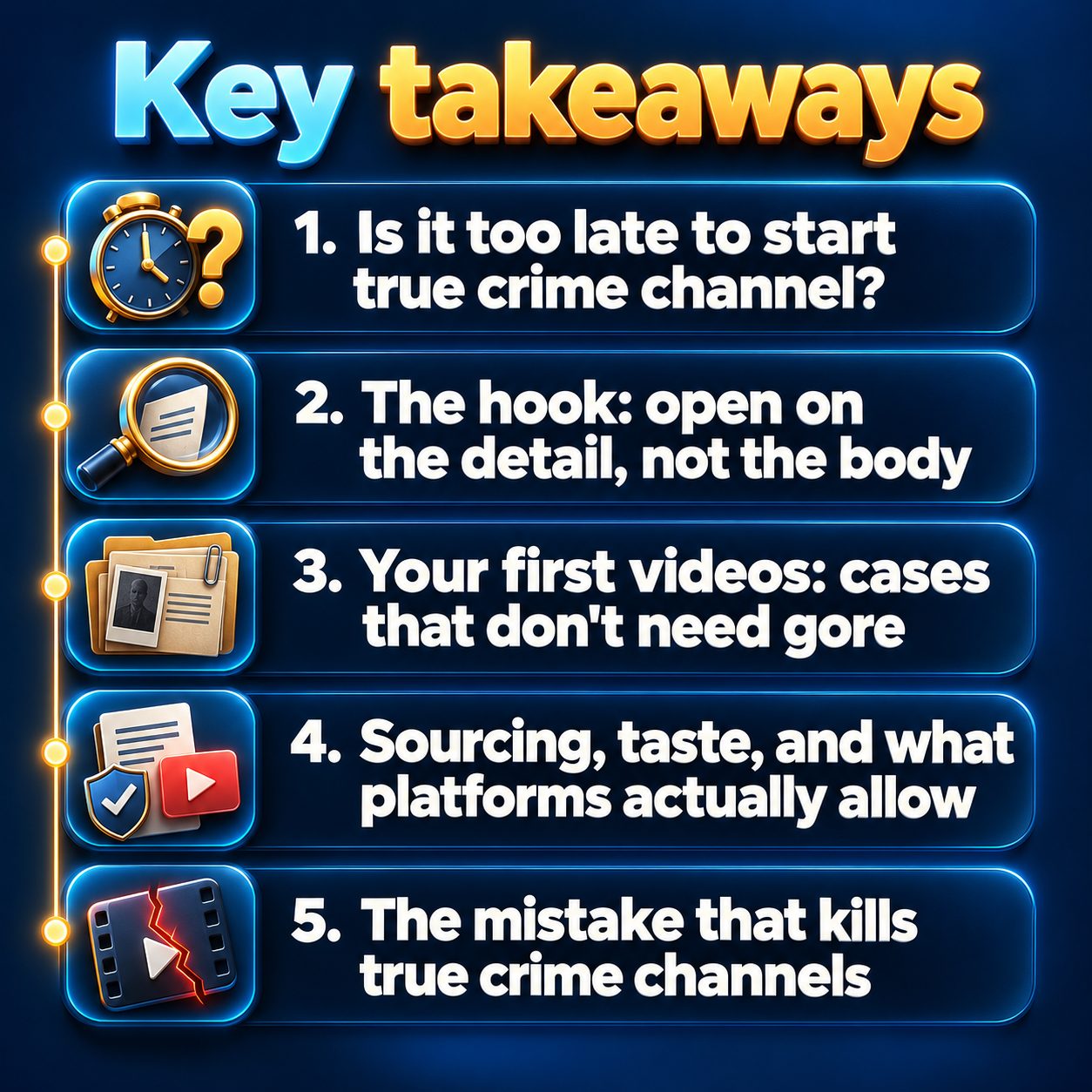
Your first videos: cases that don't need gore
Start with stories that are well documented, non-graphic, and have a satisfying twist. They're easier to source, easier on advertisers, and they teach you the format. Some first titles:
- The heist undone by a half-eaten sandwich (the Antwerp diamond heist)
- The man who jumped from a plane with the ransom and was never found (D.B. Cooper)
- How the Mona Lisa vanished from the Louvre and turned up years later
- The bank robber who thought lemon juice made him invisible
- The con man who "sold" the Eiffel Tower
That last one comes with a lesson. Some famous cases are part legend, and the popular version has drifted from the record. Your job is to tell the version you can source, and to say "reportedly" where the record is thin. That small word builds more trust than any hook.
Sourcing, taste, and what platforms actually allow
This is where most people's doubts sit, so here are the straight answers.
Sourcing. Use court records, reputable newspapers, and published books. Check each key fact against a second independent source, and list your sources in the description. True crime comment sections are full of people who know the case better than you do. One wrong date and they'll say so, publicly.
Taste. Real people were hurt. Avoid recent cases where families are still grieving in public. Never generate realistic AI images of real victims or suspects. Use stylized or atmospheric visuals instead: an empty street, a locked door, a courtroom sketch style. If a video shows realistic synthetic people or events, YouTube asks you to disclose altered or synthetic content. The label itself doesn't hurt your reach. Skipping it can get the video removed.
Monetization. Describing a crime is allowed. Lingering on graphic detail is what limits ads under YouTube's advertiser-friendly content guidelines. Tell, don't show. To join the YouTube Partner Program, you need 1,000 subscribers plus either 4,000 valid public watch hours in the last 12 months or 10 million valid public Shorts views in the last 90 days. YouTube also demonetizes mass-produced, repetitive content. Your research, your angle, and your case choices are what keep you on the right side of that line.
Is AI-narrated true crime just slop? It is when the facts are wrong and every script sounds the same. Platforms rank shorts by how viewers behave: watch time, completion, shares. They don't rank by how the video was made. An AI voice reading a carefully sourced, well-chosen case is not the problem. Lazy research is.
The mistake that kills true crime channels
It's chasing the shock. New channels see gory thumbnails getting attention and copy them. Then the trouble stacks up. Ads get limited, videos get age-restricted, and the audience they attract leaves the moment the gore runs out. The runner-up mistake is retelling the same handful of famous cases with the same facts everyone else uses. Then you're the tenth version of a story, and nobody follows the tenth version.
The channels that last pick a lane, such as heists, cons, or historical mysteries, and become the place for that lane.
Keeping it going week after week
In this niche the bottleneck is research, not editing. So batch it. Pick a sitting each week, research several cases, and write short case notes: who, what, the anomaly, the clue, the resolution, and your sources. Group them into loose series like "heists that almost worked" or "cons with a twist" so viewers know what's coming next.
Choose a cadence you can actually keep, whether that's post 1/day or three times a week. A channel that posts steadily for months beats one that posts daily for two weeks and goes quiet.
This is the stage where a tool like MaqtAi earns its place. True crime is one of its built-in faceless niches. The key point for this genre: if you paste your own researched script, it's used word for word, so your verified facts don't get rewritten. It then handles the narration, the visuals with motion, and the captions. Autopilot can work through a queue of your topics on a schedule. By default, every finished video waits for your one-tap approval before anything posts. Be clear about what it won't do, though. It doesn't research cases, check facts, or read trends. The judgment calls stay yours, and in true crime that's how it should be.
What waiting actually costs
No deadline is coming. But every week you spend deciding is a week with no videos, no viewer data, and no sense of which cases your audience stays for. The algorithm learns from what you post, and right now it has nothing to learn from. Meanwhile someone else in your lane is posting their sandwich-heist video tonight.
So take one small step. Write one case, the one with the strangest detail you know. Then make it into a video. Most new accounts that verify their email get free credits, no card needed (see pricing), which is enough to test the format. Free renders carry a watermark, so treat that first one as practice. Its job is to show you what your case sounds like when it's told well.
Doing this by hand is the part most people quit at. MaqtAi writes the script, narrates it, generates the visuals and captions, and assembles the faceless short for you. Verify your email and you get 450 free credits: about 3 videos on the still-frame tier, or one with AI motion. Free renders carry a watermark.
Try it on your niche freeFrequently asked questions
Can a true crime Shorts channel get monetized? It can, as long as you describe crimes without dwelling on graphic detail and your videos are original rather than mass-produced. Advertiser rules are stricter on violent content, so careful storytelling matters more here than in most niches.
Is it legal to tell real crime stories? Retelling facts from the public record is common practice. Stick to what's documented, and never imply guilt for someone who wasn't charged or convicted. This isn't legal advice, so check with a lawyer for anything borderline.
Should I use AI images of the real people involved? No. Use stylized or atmospheric visuals instead. Realistic synthetic images of real victims or suspects cross a taste line and can trigger disclosure and removal issues.
How long should a true crime short be? For a single case, 30 to 60 seconds usually tells it fully without padding. YouTube Shorts can run up to 3 minutes, so a complicated case has room to breathe.
Results vary, and nothing here is a guarantee of views or income.