
Win or lose the video in the first two seconds
Everything about a faceless short lives or dies on the opening. People scroll fast, and the platform is watching whether they stop. So the first line of your script is the whole game.
Stop writing intros. No "in this video" and no slow build. Open on the sharpest thing you have: the twist, the number, the question that makes someone need the answer. "This Roman emperor faked his own death three times" beats "Today we're going to talk about Roman history." Same facts, completely different retention.
A good habit: write the hook first, before the rest of the script exists. If the hook isn't good enough to make you stop scrolling, no amount of nice visuals later will save it. Pair it with motion in the first frame, because a static opening reads as "ad" to the eye and people flick past.
Pick one niche and be almost boringly consistent
The objection I hear most is "my niche is different" or "my niche is too crowded." Here's the honest truth: a crowded niche means demand exists. An empty niche usually means nobody wants it. Scary stories, stoic motivation, history, true crime, sleep content, these are crowded because they work.
What actually separates channels is focus. The algorithm can only recommend you well if it knows who you're for. If one video is history, the next is finance, the next is a meme, you've told it nothing. Pick a lane and stay in it long enough for the platform to build an audience profile around your content.
You're not too late, either. New faceless channels break out constantly because the platforms keep pushing fresh content to test it. Being late to a niche is not the same as being locked out of it. The people who lose are the ones who niche-hop every two weeks looking for the magic topic.
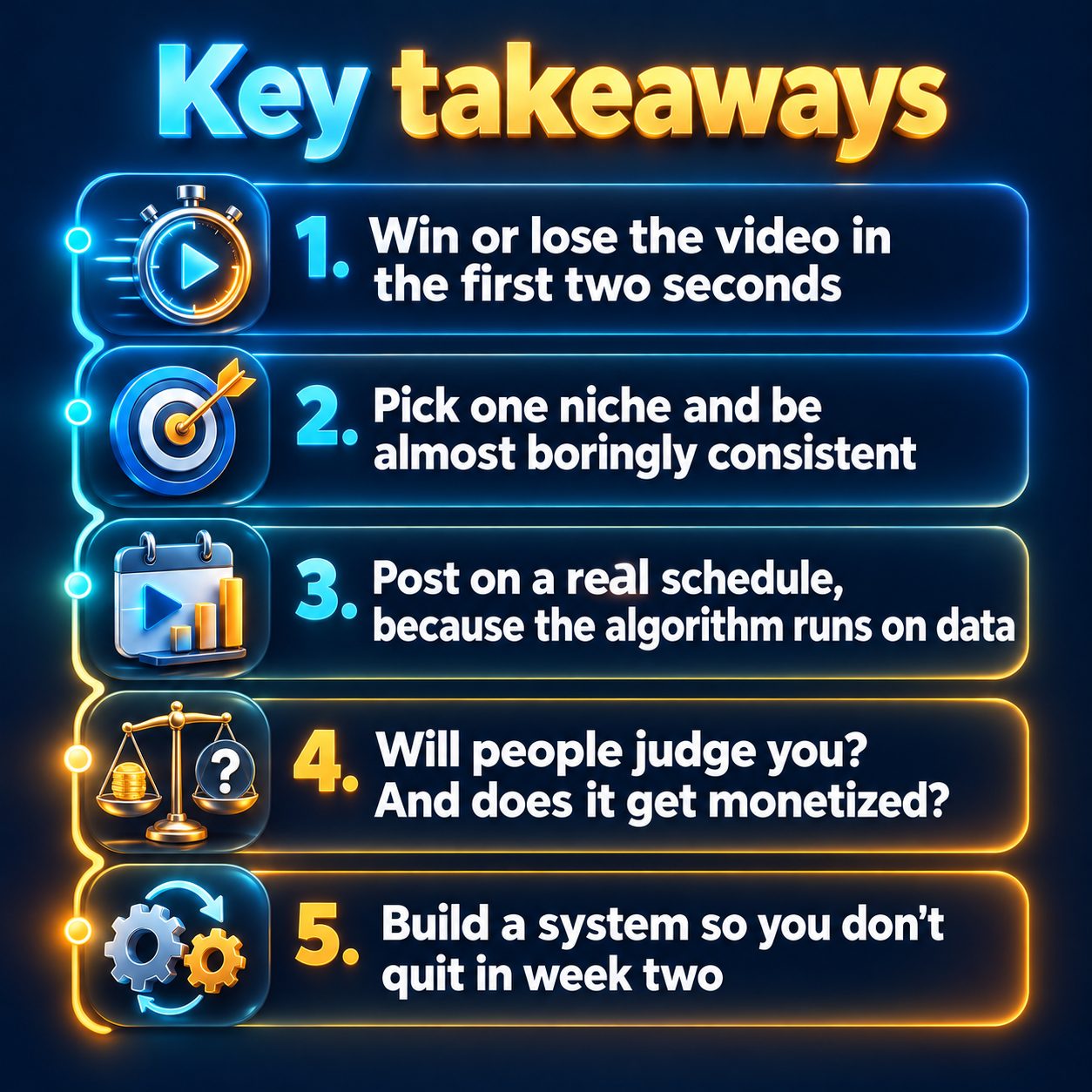
Post on a real schedule, because the algorithm runs on data
Here's the part nobody wants to hear: your first 20 or 30 videos are mostly data collection. Each one teaches the platform a little more about who watches, how long, and what to test next. A channel with 5 videos hasn't given it enough to work with.
Daily is the cheat code, but only if it's sustainable. Three genuinely good videos a week beats seven rushed ones that tank retention and teach the algorithm you're low quality. Pick a cadence you can actually hold, then hold it. Consistency isn't a personality trait, it's a system, which is the next point.
This is also the honest answer to "will AI faceless content even get views." It can, and plenty does, but not because it's AI. It gets views for the same reason any content does: a strong hook, tight pacing, a clear niche, and enough volume for the algorithm to find the audience. AI just lets you produce that volume without a camera. It doesn't exempt you from making something people want to watch.
Will people judge you? And does it get monetized?
Two quiet worries. First, judgment. Nobody watching a 40-second history short is inspecting whether the narrator is a real human throat. They're deciding if it's interesting. Faceless channels have run on stock footage, text-to-speech, and library music for years, long before generative tools. Your audience cares about the story, not your production method.
Second, monetization, which is the real uncertainty. The platforms don't ban faceless content, but they do have rules about low-effort, mass-produced, repetitive uploads. YouTube's own monetization policies reward original, meaningful content and demote channels that just reupload the same template with no added value. So the winning move isn't "pump out identical clips." It's use automation to remove the filming and editing grind, then spend your saved time on the parts that make a video actually good: better hooks, better topic selection, better scripts.
Write for one specific person. Content that's clearly made for a defined audience, with a real point of view, reads as original even when a tool assembled the visuals.
Build a system so you don't quit in week two
Most faceless channels die from burnout, not from bad content. Someone makes five videos by hand, each one takes an evening, the views are quiet because they're only five videos deep, and they stop right before the algorithm figures them out. The channel never gets its fair test.
The fix is to make the work small and repeatable. Batch your topics in one sitting, keep a running list of ideas, and separate "deciding what to make" from "making it." When production is a 20-minute task instead of a 3-hour one, showing up every day stops being a willpower problem.
This is where a tool earns its place. MaqtAi takes a niche and a topic and writes the hook-first script, narrates it with an AI voice, generates niche-matched visuals with real motion, adds animated captions, and assembles a finished vertical video, usually in a few minutes. It covers 19 faceless niches and, on a paid plan, can auto-publish on a schedule to YouTube Shorts, Instagram Reels, and TikTok. That turns "post daily" from a chore into a queue you set up once.
Read retention, not likes
Likes flatter you. Retention tells you the truth. If viewers drop off at second three, your hook is weak. If they leave at the midpoint, your pacing sags. Every analytics tab shows an audience-retention graph, and it's the single most useful thing you can study.
Make one change per batch and watch what moves. Tighter hooks. Shorter scripts. A different opening visual. You're running small experiments, and 30 videos of experiments teaches you more than 30 videos of hoping. The creators who improve are the ones who treat their own graph as feedback, not as a scoreboard.
The cost of waiting
Every week you spend deciding is a week the algorithm learns nothing about your channel, and a week a competitor in your niche posts seven more videos and pulls further ahead. Faceless growth compounds, but only after you start feeding it.
So make the first one. Verifying your email gives you 450 free credits, roughly three to four watermarked still-frame videos on the Express tier, no card required, which is enough to test a hook, a niche, and a voice against real numbers before you commit to anything. Pick one topic you already have an opinion about and see it become a finished vertical video this afternoon.
Doing this by hand is the part most people quit at. MaqtAi writes the script, narrates it, generates the visuals and captions, and assembles the faceless short for you. Verify your email and you get 450 free credits: about 3 videos on the still-frame tier, or one with AI motion. Free renders carry a watermark.
Try it on your niche freeFrequently asked questions
How many videos before a faceless channel starts working? There's no fixed number, but treat the first 20 to 30 as data collection while the algorithm learns who your audience is. Most channels quit before they've given the platform enough to work with. Consistency past that point is what separates the ones that grow.
Does faceless AI content get demonetized? Not for being faceless. Platforms demote low-effort, repetitive, mass-produced uploads, per YouTube's monetization policies. Use automation to remove the grind, then invest the saved time in strong hooks, good topics, and a clear point of view so each video adds real value.
How often should I post? Daily works best because it feeds the algorithm more data, but only if you can sustain it. Three strong videos a week beats seven rushed ones. Pick a cadence you can actually hold and keep it steady. On a paid plan you can schedule and automate posting so cadence isn't a willpower test.
Can I run more than one faceless niche at once? Yes. On a paid plan you can connect multiple accounts and run several niches or series in parallel, which is common once one channel finds traction and you want to test another lane without starting from scratch.
Results vary. Nothing here is a guarantee of income or views.