
Pick a storytelling genre that fits short form
Not every type of story works as a 30-to-60-second vertical video. The ones that do share a pattern: they promise something specific in the first two seconds and deliver a payoff before the viewer swipes away.
Genres that thrive in short form:
- Scary stories and urban legends. Built-in suspense. Viewers stay because they need to know the ending.
- History's strangest moments. "In 1932, Australia went to war with emus" hooks instantly.
- True crime snapshots. One case, one twist, one minute.
- Mythology and folklore. Every culture has stories most people have never heard.
- Dark psychology and human behavior. "Why do people confess to crimes they didn't commit?" is a scroll-stopper.
- Bedtime and sleep stories. Calm narration over soft visuals. People fall asleep to these, and watch time still counts.
Pick the genre you would actually watch yourself. That matters more than whatever seems "hot" right now, because you will write or review dozens of scripts and you need to care enough to spot a weak hook.
You do not need a face, a voice, or a film budget
The biggest misconception about YouTube storytelling is that you need to be on camera telling the story. Some of the most-watched channels in the storytelling space are completely faceless. The format is simple: narration over visuals with captions.
What you actually need:
- A script with a strong opening line.
- A voiceover (your own or AI-generated).
- Visuals that match the mood (AI-generated images, stock footage, or illustrated scenes).
- Animated captions so people watching on mute can follow along.
- A way to publish consistently.
That is it. No ring light. No editing software learning curve. No awkward "hey guys" intro. The story carries the video, not your face.
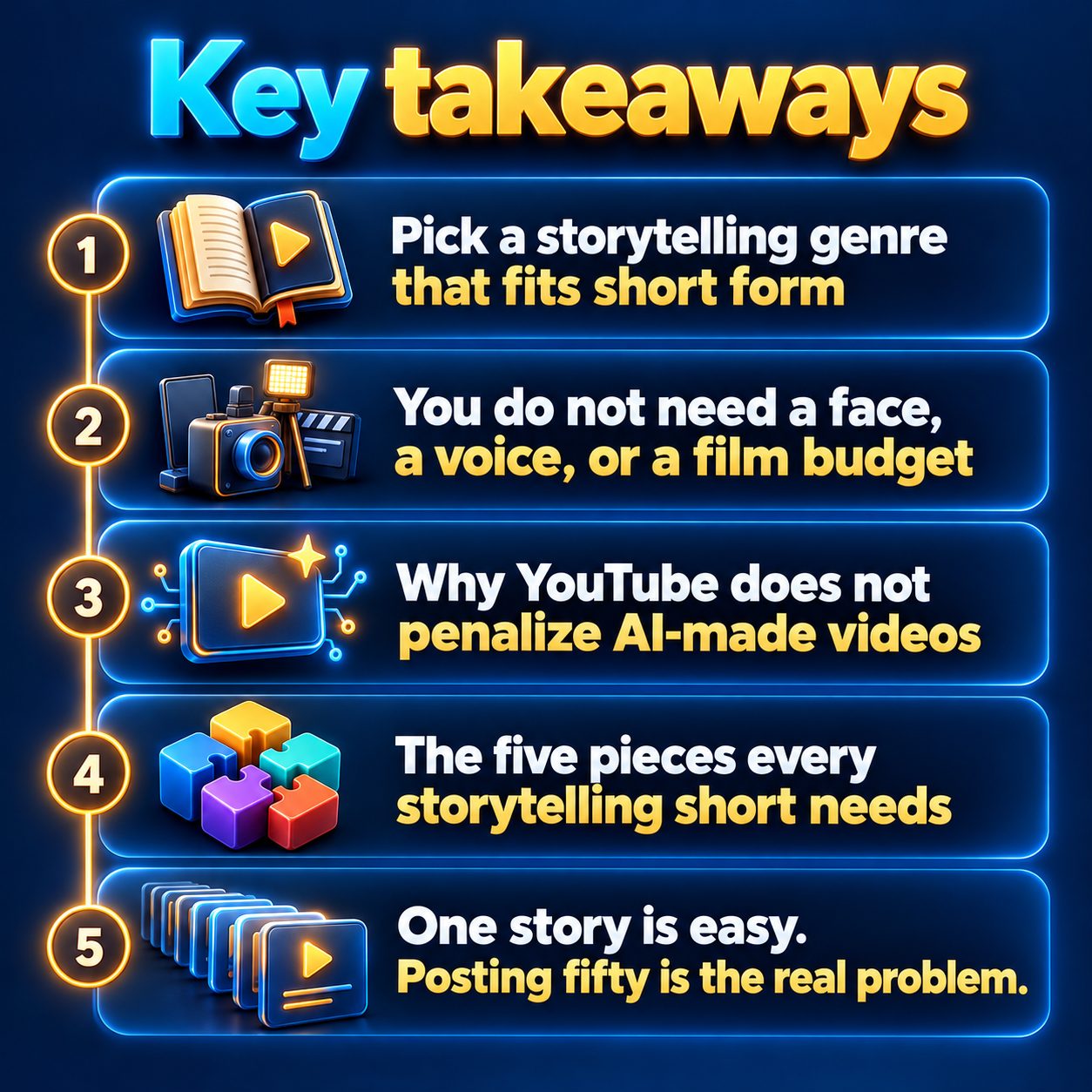
Why YouTube does not penalize AI-made videos
This is the question people research but rarely ask out loud: "If I use AI narration and AI visuals, will YouTube bury my video?"
No. YouTube ranks Shorts by viewer behavior: watch time, completion rate, likes, shares, and comments. The algorithm measures whether people enjoyed the video, not whether a human drew every frame. If your AI-narrated scary story keeps viewers watching until the final second, it gets recommended to more viewers.
What does hurt reach: uploading identical files across multiple accounts, mass-posting near-duplicate content, or ignoring YouTube's disclosure guidelines for realistic synthetic media. The disclosure label itself does not reduce distribution. Skipping it when required risks removal.
Be honest with yourself about quality. A lazy, robotic-sounding video with random stock images will not perform. But a well-paced story with matched visuals, natural narration, and clean captions? Viewers do not care how it was made. They care if it was good.
The five pieces every storytelling short needs
Every scroll-stopping story short follows the same skeleton:
1. A hook (first two seconds). Not "today we are going to talk about." Instead: "This man survived 76 days alone on a raft in the Atlantic." State the most interesting fact or question first.
2. Tension or curiosity. The middle needs a reason to keep watching. A question unanswered, a danger approaching, a twist building. "But what he didn't know was..."
3. Matched visuals. Each scene should reflect what the narrator is saying. Dark forest for a scary moment. An old photograph for a history beat. Mismatched visuals break immersion instantly.
4. A payoff. Deliver on the promise you made in the hook. If you asked a question, answer it. If you built suspense, resolve it. Viewers remember endings.
5. Captions. A huge portion of viewers watch without sound, especially on mobile. Animated animated captions are not optional anymore. They are how people consume vertical video.
One story is easy. Posting fifty is the real problem.
Here is the honest part. Making one storytelling short is straightforward. You could do it with free tools and an afternoon. But storytelling channels do not grow from one video. They grow from consistent posting, usually daily or near-daily, over weeks and months.
That is where most people quit. The first ten videos get almost no views (this is normal; the algorithm is still learning who to show your content to). By video fifteen, the scripting and editing grind feels heavy. By video twenty, you start skipping days.
The creators who break through are the ones who find a way to make posting sustainable. Some batch-record narration on weekends. Some use templates. And increasingly, some hand the production work to AI tools that handle scripting, visuals, narration, and assembly so they can focus on picking strong topics and reviewing output.
If you are looking at storytelling as a long-term channel, your real challenge is not "how do I make a video" but "how do I make video number forty without burning out."
Make your first story short this afternoon
You do not need to solve the consistency problem today. You need to make one video. Just one. See if you enjoy the process, see if the format clicks for your genre, and see what the result looks like.
MaqtAi was built for exactly this workflow. You pick a storytelling niche (scary stories, history, true crime, dark psychology, bedtime stories, and dozens more), type your topic, and the platform writes the script, generates the voiceover, creates and animates the visuals, adds animated captions, and assembles a publish-ready vertical video. No filming, no editing timeline, no voice recording. You review the result, tweak anything you want, and publish straight to YouTube, TikTok, or Instagram.
If the first video hooks you on the process, Autopilot and scheduling let you set a daily or weekly cadence and keep the channel running without manually producing every single video.
New accounts get free credits when you verify your email, enough to make your first few videos at no cost and with no card required. The real cost of waiting is not money. It is the weeks of algorithm data and audience feedback you are not collecting while you sit and decide.
Pick a story. Make the video. Post it. That is the whole first step.
Doing this by hand is the part most people quit at. MaqtAi writes the script, narrates it, generates the visuals and captions, and assembles the faceless short for you. Verify your email and you get 450 free credits: about 3 videos on the still-frame tier, or one with AI motion. Free renders carry a watermark.
Try it on your niche freeFrequently asked questions
Can I monetize a faceless storytelling channel on YouTube? Yes. Faceless channels are eligible for the YouTube Partner Program like any other channel. What matters is meeting the subscriber and watch-time thresholds and producing original, non-repetitive content. YouTube warns against mass-produced, repetitious AI content, so quality and variety matter.
What length works best for storytelling Shorts? Most successful storytelling Shorts land between 30 and 60 seconds. Long enough to tell a complete micro-story, short enough to earn high completion rates. You can also create longer videos in landscape format for regular YouTube uploads, which typically earn more ad revenue per view.
Do I need to disclose that my video uses AI? YouTube asks for disclosure when content contains realistic synthetic media that could be mistaken for real footage. A clearly stylized or illustrated storytelling video may not trigger that requirement, but adding the label is easy and does not reduce your reach. When in doubt, disclose.
Will people judge me for using AI to make videos? Most viewers never think about it. They care about the story, the pacing, and whether the video held their attention. Creators worry about this far more than audiences do.
Results vary. Nothing in this article is a guarantee of views, subscribers, or income.