
You Have Tried "Just Post Every Day" and It Didn't Stick
You already know consistency matters. Every YouTube advice video says it, and you have probably started strong more than once: five videos in the first week, three the next, one the week after, then silence. That pattern is so common it might as well be a universal law of content creation.
The frustration is not that you lack ideas or motivation. It is that making a single video eats half your Saturday. Between writing a script, recording or finding visuals, editing clips together, adding captions, exporting, uploading, and writing a title and description, one short can swallow two to four hours. Multiply that by "post daily" and you are looking at a part-time job on top of your actual job.
Of course you stop. Anyone would.
The Production Stack Is What Actually Breaks You
Think about everything a single YouTube Short requires: a hook that grabs in the first second, a tight script, voiceover or an on-camera take, visuals that hold attention, captions (because most viewers scroll with sound off at first), background music or ambient sound, and then the upload with metadata.
Each of those is a separate skill. Each takes time. And they all have to happen in sequence before you have a single thing to post.
The creators who post every day are not superhuman. They have either simplified their format to something dead-repeatable (a green screen and a teleprompter, for example) or they have automated large chunks of the pipeline. The ones who rely on raw discipline almost always burn out within a month or two.
So the fix is not "try harder." It is to shrink the effort each video costs you until posting feels closer to sending a text than producing a short film.
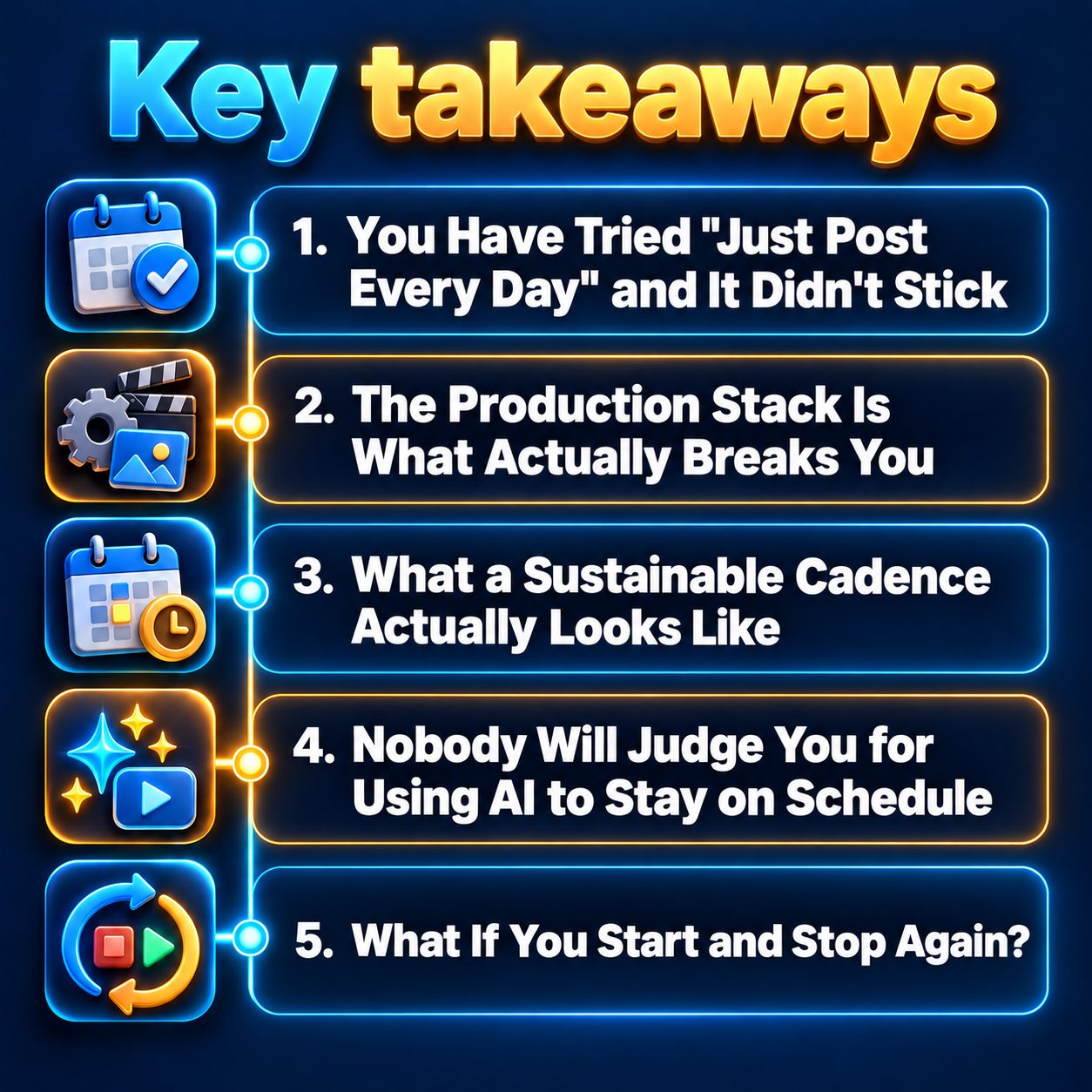
What a Sustainable Cadence Actually Looks Like
"Post every day" sounds great in a motivational video, but here is what actually matters: regularity over frequency.
Three videos a week on a predictable schedule will grow a channel faster than seven videos in week one followed by zero in week two. The algorithm rewards accounts that keep viewers returning, and it measures that through session behavior and returning-viewer signals, not raw upload count.
Pick a cadence you can maintain when you are tired, busy, or bored of your niche. For most people with a full-time job, that means two to four times per week. If you can do daily, great. But be honest with yourself about what "daily" looks like in month three, not just week one.
Write your cadence down. Block the time. Then make the per-video effort low enough that skipping a day feels harder than just posting.
Nobody Will Judge You for Using AI to Stay on Schedule
Here is the thing that quietly stops a lot of creators from automating their workflow: "Won't people know? Won't the algorithm punish AI content?"
No platform down-ranks a video simply because it was made with AI. TikTok, Instagram, YouTube, and Facebook rank shorts by viewer behavior (watch time, completion rate, likes, shares), not by production method. What does hurt reach: weak opening hooks, spam patterns like uploading identical files across many accounts, or ignoring a platform's AI-disclosure rule for realistic synthetic media. The disclosure label itself does not reduce distribution, but skipping it risks removal.
The honest limit worth knowing: mass-produced, repetitious content that all looks and sounds the same will eventually get flagged. But a channel with a clear niche, distinct topics per video, and solid hooks performs the same whether the creator sat in front of a camera or let AI generate the visuals. Viewers care about whether your video is interesting in the first three seconds, not how it was made.
What If You Start and Stop Again?
This might be the real fear underneath your search. You have probably quit a channel before. Maybe more than once. Starting again feels risky because you are not sure the outcome will be any different this time.
Two things worth remembering. First, every video you post is data. Even if a video gets ten views, you learn which hooks landed, which topics pulled clicks, and where viewers dropped off. That data compounds. A channel with fifty mediocre videos has dramatically more algorithmic signal than a channel with zero, and the algorithm uses that signal to find better audiences for your future uploads.
Second, the cost of waiting is concrete. Every week you spend planning instead of posting is a week your channel is not accumulating watch hours, subscribers, or momentum. The creator in your niche who posts three average videos this week is building a lead that gets harder to close the longer you sit on the sideline.
You do not need to commit to a year. Commit to one month. Thirty days of posting on a set schedule will teach you more about whether this works for you than thirty days of reading about it.
Make Your First Video Before You Make a Plan
The most reliable way to stay consistent is to make starting so easy that overthinking becomes impossible. If your first video takes ten minutes instead of four hours, you have already proven to yourself that the schedule is survivable.
That is where MaqtAi fits. You pick a niche and a topic, and it handles the script, voiceover, visuals, captions, and assembly. The finished video auto-publishes to YouTube Shorts, TikTok, Instagram Reels, or Facebook Reels on whatever schedule you set. You review and tweak anything you want, or let it run.
If you want to go fully hands-free, Autopilot renders videos from a topic queue on a cadence you choose (daily, three times a week, or weekly) and waits for your one-tap approval before anything goes live. You stay in control of what gets posted, but the grinding work of producing each video happens without you.
New accounts get free credits when you verify your email, enough for your first videos at no cost and no card required. That is the smallest possible first step: one video, today. See how it feels to have something posted instead of something planned. The expensive choice is not the tool. It is another week of not posting while your niche gets more crowded.
Doing this by hand is the part most people quit at. MaqtAi writes the script, narrates it, generates the visuals and captions, and assembles the faceless short for you. Verify your email and you get 450 free credits: about 3 videos on the still-frame tier, or one with AI motion. Free renders carry a watermark.
Try it on your niche freeFrequently asked questions
How many YouTube Shorts should I post per week to see growth? Two to four per week on a consistent schedule is enough to build real momentum. Regularity matters more than volume. Daily posting accelerates things if you can sustain it, but an irregular burst followed by silence does more harm than a modest schedule you actually keep.
Does YouTube penalize AI-generated videos? YouTube does not down-rank videos for being AI-made. It ranks by viewer engagement: watch time, likes, shares, and click-through rate. The platform does require disclosure for realistic synthetic media, but the label itself does not reduce reach.
Can I automate posting without losing quality control? Yes. MaqtAi's Autopilot lets you set a topic queue and cadence, and by default every finished video waits for your approval before publishing. You tap approve or reject. Nothing goes live without your say unless you explicitly enable automatic publishing.
What if I run out of video ideas after the first week? Start by listing fifteen to twenty topics before you begin posting. Use your niche's common questions, myths, or "things people get wrong" as a framework. MaqtAi's topic development tools can also turn one broad idea into multiple distinct angles and hooks, stretching a single concept into several videos.