The creator we are following, and what this is not
Picture a beginner with a full-time job, no camera, no budget past the phone in their pocket, and maybe 45 minutes free most evenings. No editing skills. No audience anywhere yet.
Be clear about what this article is: an illustrative plan, not a case study with receipts. There are no view counts here, no follower screenshots, no earnings. Anyone showing you those from a brand new faceless account is selling something. What you get instead is the sequence a sensible launch actually follows, week by week, and the specific places it tends to fall apart.
Week 1: one niche, one format, and a list of topics
The creator picks a single niche and stays in it. Not "motivation and history and horror". One. TikTok learns who to show your videos to by watching who finishes them, and a channel that hops genres gives the system nothing to learn from.
Pick on two criteria: could you keep making these for months, and does the subject have an emotional payoff that lands in under a minute. Scary stories, unsolved cases, stoic philosophy, odd history, money explainers, and product breakdowns all clear that bar. If you want to see how different genres are usually built, the use case breakdowns are a reasonable place to browse.
Then lock the format before writing anything: vertical, one narrator voice, one caption style, one visual look. Consistency in the frame is what makes a stranger recognize your second video after seeing your first.
Finish the week with a written list of topics, enough to cover the next two weeks. Choosing topics and making videos are different jobs, and doing them on the same evening is how people quit by day nine.
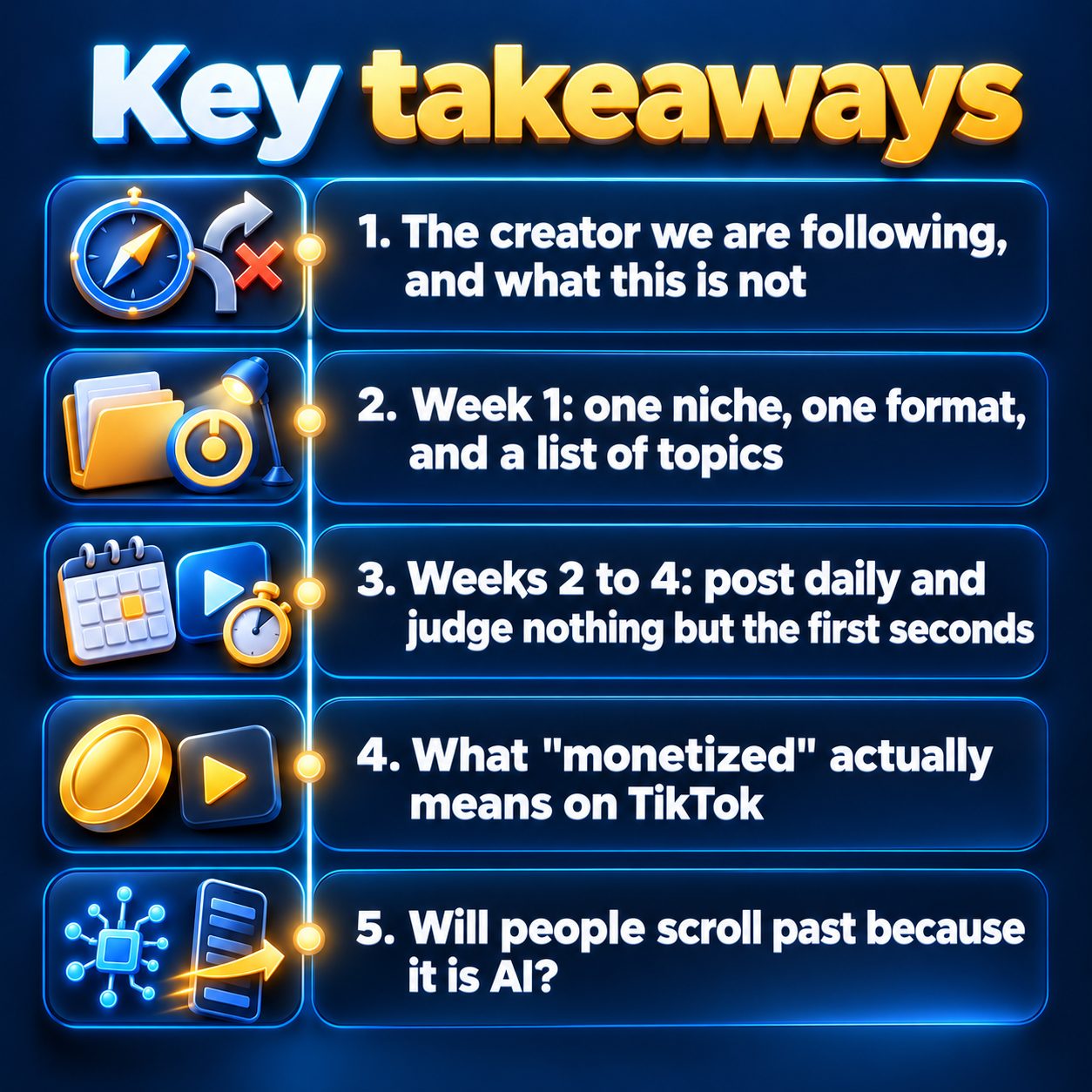
Weeks 2 to 4: post daily and judge nothing but the first seconds
One video a day. Same niche, same look. During this month the creator is not trying to grow, they are feeding the algorithm enough samples to figure out who this channel is for.
The only number worth reading in month one is watch time, specifically how many people are still there at the end. Followers lag. Likes lie. Retention tells you whether your opening line worked.
So rewrite hooks obsessively. Open in the middle of the story. Lead with the strangest fact and explain it after. Ask the question the video answers, then answer it. Delete anything that sounds like "hey guys, welcome back", because nobody has come back yet.
By the end of week 4 there are enough videos that patterns appear: two or three that held people, several that lost them at the same beat. That comparison is the entire point of month one.
What "monetized" actually means on TikTok
This is the part most guides skip. TikTok's Creator Rewards Program has a follower bar, a recent-views bar, an eligible-country list, and a minimum video length: qualifying videos have to run longer than a minute. Read the current thresholds on that page yourself, because TikTok changes them.
Two honest consequences. First, if you want TikTok's own payouts, your videos need to be over a minute from the start, so a channel built on 20-second clips has to be rebuilt later. Second, most faceless creators touch money through affiliate links, TikTok Shop commissions, or a small brand deal well before Creator Rewards.
That is also why the plan does not stay TikTok-only. YouTube's Partner Program takes 1,000 subscribers plus either 4,000 valid public watch hours in the last 12 months or 10 million valid public Shorts views in the last 90 days. The watch-hours path is far more reachable than the Shorts path, and long-form videos earn far more per view than Shorts do. Posting the same work to both surfaces is simply the sane move.
Will people scroll past because it is AI?
No platform down-ranks a video for being AI-made. TikTok, Instagram, and YouTube rank short video on viewer behavior: watch time, completion, shares. There is no "made by a human" input in that scoring.
What does hurt is real, though. Spam patterns get punished: the same file posted across several accounts, near-duplicate videos pushed out at volume. Weak opening seconds get punished by viewers before any algorithm gets involved. And skipping the AI disclosure toggle on realistic synthetic media risks removal, while the label itself costs you nothing in reach. On YouTube, mass-produced repetitious content can be demonetized under the inauthentic content policy, so "churn out endless near-identical videos" is a strategy that ends badly.
The question nobody types: will people judge me for this? Viewers judge boring. They rarely stop to audit how a video was made, and faceless channels have been normal for years.
The other one: am I too late? Short-form has almost no incumbency advantage. A big back catalog does not protect anyone when every video is re-auditioned in the feed.
Weeks 5 to 12: the stretch where most channels quit
Nothing dramatic happens in month two. That is exactly the difficulty. The novelty is gone, growth is uneven, and the evening you skip becomes the week you skip.
Three habits carry the creator through. Batch: one production evening beats seven scattered ones. Keep the topic list stocked ahead of the schedule so you never sit down to a blank page. And stop renegotiating the niche, because switching resets the learning you just paid a month to build.
This is where MaqtAi fits in the plan, purely as the thing that removes the friction named above. Its Autopilot renders videos from a topic queue you manage, with a "Suggest topics" button that drafts a batch from your niche, or an AI-niche mode that refills the queue on its own, on a cadence you set, and by default every finished video waits for one-tap approval before anything is published; auto-publishing is opt-in, not the default. Scheduling and publishing are covered in the feature tour. Two honest caveats: Autopilot needs an active plan and only unlocks a channel after you publish to it manually once, and it cannot post to TikTok automatically yet, so a TikTok destination waits in the approval queue for you to send it. The topics, the hook, and the taste are still yours.
What another month of deciding costs
Nothing dramatic, which is the problem. The channel does not exist, so no algorithm anywhere is learning who your videos are for. The topics you keep meaning to use go stale. Someone in your niche who started before you is months of videos ahead, and the gap is not talent, it is calendar.
The smallest useful step is not a plan. It is one video, today, on one topic, so you find out whether you enjoy making the thing before you commit ninety days to it. Verifying your email gives you 450 free credits, no card, which is three or four videos on the still-frame Express tier, watermarked, no talking presenter, enough to see the format for yourself; the credit and plan details are all published.
Doing this by hand is the part most people quit at. MaqtAi writes the script, narrates it, generates the visuals and captions, and assembles the faceless short for you. Verify your email and you get 450 free credits: about 3 videos on the still-frame tier, or one with AI motion. Free renders carry a watermark.
Try it on your niche freeFrequently asked questions
How long before a faceless TikTok makes money? Plan in months, not weeks. TikTok's own program has follower, view, and video-length requirements, and most faceless creators earn first through affiliate or brand income rather than platform payouts.
Do my TikToks need to be longer than a minute? For TikTok's Creator Rewards, yes, qualifying videos must run over a minute. Short clips can still grow an audience, but decide early, because rebuilding your format later costs you months.
Can I post the same faceless video to TikTok and YouTube? Yes. Posting your own video to your own channels on several platforms is normal and is not what platforms mean by duplicate spam. What they penalize is the same file spread across many accounts.
Do I have to disclose that a video is AI-generated? Use the platform's AI disclosure toggle for realistic synthetic content. The label does not reduce your distribution, and skipping it when the rules require it can get the video removed.
Results vary. Nothing here is a guarantee of income, and no plan can promise monetization.