Know your one sentence before you draft anything
Every video essay that lands can be squeezed into one sentence a viewer could repeat to a friend. "Sleep trackers can make people sleep worse." "The Roman concrete story is really a story about seawater." "Most productivity advice is written for people who already have free time."
If you cannot say yours out loud, you do not have an essay yet. You have a topic. Topics wander. Arguments hold.
Write that sentence at the top of your document and leave it there while you draft. It becomes your delete key. Every paragraph that does not push it forward, however interesting, gets cut. That single habit fixes more scripts than any writing tip I know, because the thing that loses viewers is almost never bad prose. It is a script that forgot what it was about somewhere in the middle.
The five beats that actually hold someone to the end
Narration-led essays run on the same skeleton whether they are 30 seconds or fifteen minutes.
The hook names a tension, not a subject. "Today I want to talk about sleep trackers" is a subject. "The device you bought to fix your sleep might be the reason you cannot fall asleep" is a tension. First line, no throat clearing, no channel intro. Nobody has earned the right to an intro in the first three seconds.
The stakes tell them why this costs them something. One or two lines. What happens if they keep believing the wrong thing.
The turn is the whole essay. This is where the obvious answer breaks. You set up what everyone assumes, then show the crack in it. If your script has no turn, it is a list, and lists get skipped.
The payoff resolves the tension you opened with. Answer the hook literally. Viewers feel cheated by essays that end on "so what do you think?" without ever landing the point.
The close gives one next step. One. A thing to try, a thing to notice tomorrow, a question to sit with. Not a monologue about subscribing.
For a short essay you compress those into a single arc. For a long one you repeat the shape inside each section, because attention resets every couple of minutes and a viewer who tuned out at minute four needs a fresh hook at minute five.
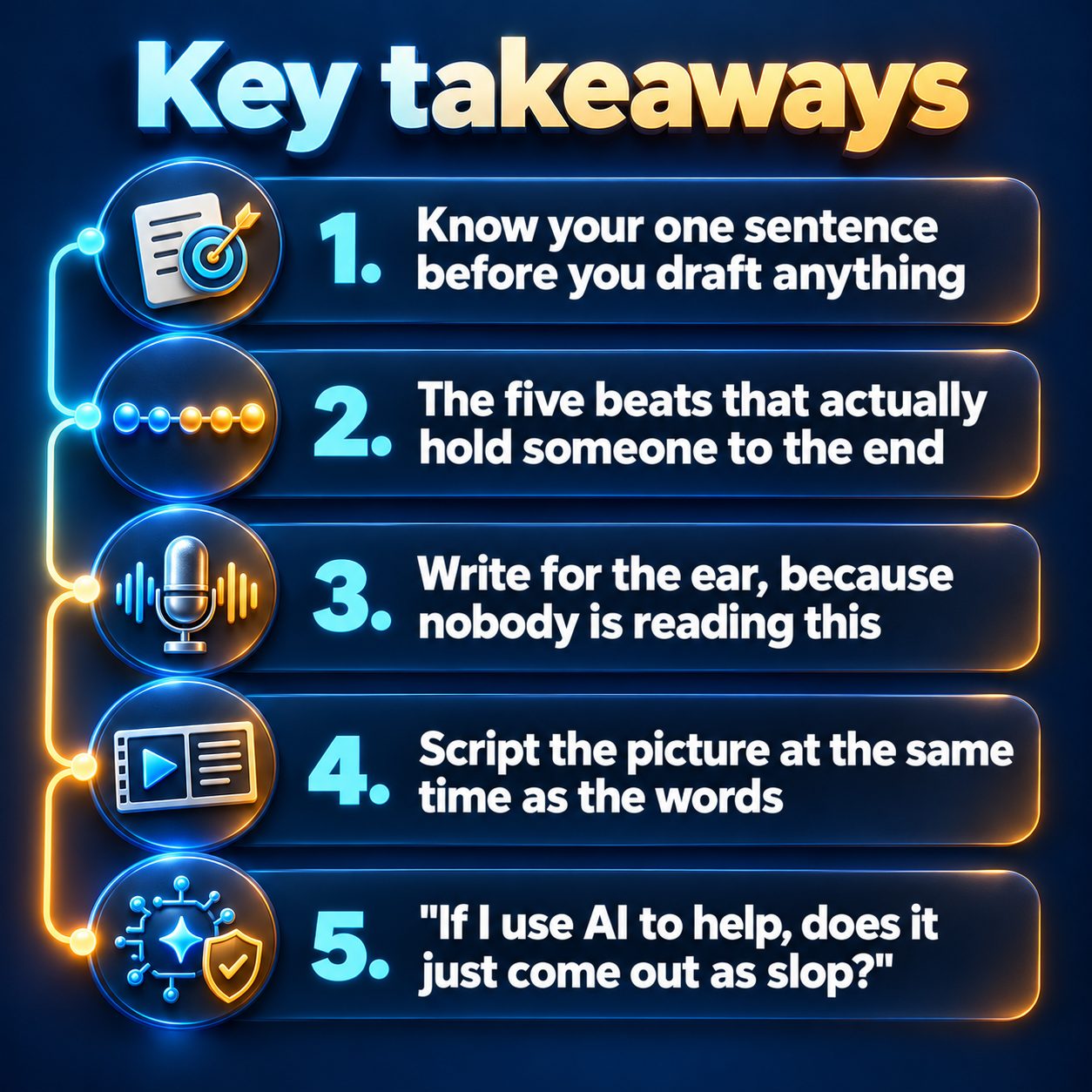
Write for the ear, because nobody is reading this
The most common mistake in a first script is that it is good writing. Well built clauses, semicolons, careful qualifications. Spoken aloud it sounds like a court filing.
Things that fix it fast:
Read every draft out loud, standing up. Anywhere you stumble, the sentence is wrong. Not "could be better", wrong. Rewrite it the way you tripped over it, which is usually shorter.
One idea per sentence. If you need a comma to hold two thoughts together, use a full stop instead.
Cut the connective tissue you would use in an article. "As mentioned earlier", "it is important to note", "in this video we will explore". Listeners cannot skim, so signposting that helps a reader just slows a viewer down. Say the thing.
Use plain verbs and concrete nouns. "Seawater ate into the concrete" beats "a chemical interaction occurred".
And read for breath. If you cannot say a sentence in one breath, neither can a narrator, human or synthetic.
Script the picture at the same time as the words
A voiceover script that ignores visuals is only half a script. Write it in two columns, or write scene by scene, but every line of narration needs an answer to "what is on screen while I say this?"
The useful rule: change the picture when the idea changes, not when you run out of footage. If a scene sits still while you deliver three separate points, viewers drift. If the picture cuts every two seconds for no reason, they get seasick.
This is also where you decide the shape. Vertical or square videos up to three minutes get classified as Shorts on YouTube, while 16:9 uploads go out as regular videos. That is a scripting decision, not just an export setting. A three minute vertical essay needs the turn to arrive early. A ten minute widescreen essay can breathe, build sections, and recap. The long-form route also matters if monetization is on your mind, since the Partner Program's main path asks for 1,000 subscribers and 4,000 valid public watch hours in 12 months, which long essays accumulate far faster than shorts do.
"If I use AI to help, does it just come out as slop?"
Honest answer: it depends entirely on what you hand it.
Drafting tools are decent at structure, at smoothing transitions, at tightening a paragraph you have overwritten, and at generating variations of a hook so you can pick rather than stare. They are genuinely bad at the things that make an essay yours: a point of view, a specific example you happen to know, sourcing you can defend, and taste about what to leave out. An essay assembled entirely from generic material reads as generic, and viewers can feel it even when they cannot name it.
So use the machine on the mechanics and keep the argument. Write your one sentence and your turn yourself. If you are covering history, crime, health or anything factual, check claims against a real source before they go into narration, because a confidently wrong line in a voiceover is the kind of thing comment sections remember.
Also worth saying plainly: no platform demotes a video for being AI-assisted. Feeds rank on watch time, completion and shares. What does get punished is near-duplicate mass posting and weak opening seconds, which are writing problems, not technology problems.
Getting a finished script into a finished video
This is the part where most people stall. The script is done and now it needs a voice, visuals, motion, captions and an export, and that is an evening of software you may not want to learn.
A tool like MaqtAi exists for exactly that gap. You paste your own script into the wizard without pressing generate and it is used word for word, split into scenes verbatim rather than rewritten, then narrated with an AI voice, matched with visuals and animated captions, and assembled over a few minutes into a finished video. You pick the aspect ratio and length before the script step, choose a narrator from previews, and adjust speech speed if the read feels rushed. If you would rather write in one language and narrate in another, the voiceover language picker on the topic step controls script, narration and captions together. The three-step version is here, and scheduling and auto-publishing live on the features page, on a paid plan, if you plan to run this as a series.
It will not have opinions for you. That is still your job, and it is the only part that matters.
The cost of leaving the doc open
A script that stays in drafts teaches you nothing. You cannot tell whether your hook works, whether your turn lands, or whether people stay past the first thirty seconds until a real audience meets it. Every week it sits there is a week your channel gathers no data and somebody covering your topic publishes again.
So take the smallest possible step tonight. One sentence. Five beats. Read it aloud once, fix what you stumble on, and get it out as a video rather than a document. New accounts get 450 free credits after email verification with no card, enough for three or four watermarked still-frame videos, so you can see your own words narrated and captioned before you decide whether this is a thing you want to keep doing. Credits and plans are laid out here if you want to look first.
Doing this by hand is the part most people quit at. MaqtAi writes the script, narrates it, generates the visuals and captions, and assembles the faceless short for you. Verify your email and you get 450 free credits: about 3 videos on the still-frame tier, or one with AI motion. Free renders carry a watermark.
Try it on your niche freeFrequently asked questions
How long should a video essay script be? Count roughly by speaking pace rather than page count: read your draft aloud and time it. For a vertical short you want it under three minutes so it is classified as a Short, and for widescreen essays the length should be whatever your argument actually needs.
Should I write the hook first or last? Write a placeholder hook first so you know what you are proving, then rewrite it once the essay is finished. The best hook usually comes from a line you accidentally wrote in the middle.
Can I keep my own writing style if I use an AI video tool? Yes. A script pasted in without pressing generate is used word for word and split into scenes verbatim, so your phrasing survives. Edits after that are made on the scene lines rather than the script box.
Do I need to disclose that the narration is AI? Check the rules of each platform you post to. The label itself does not reduce distribution, but skipping a required disclosure for realistic synthetic media can get a video removed.
Results vary. Nothing here is a guarantee of views or income.