Why scary stories still dominate Shorts
You might think the horror niche is too crowded. Hundreds of channels already post creepy narrations daily. But that volume is actually proof the audience is enormous and hungry. Fear triggers a fight-or-flight response that keeps viewers glued past the first few seconds, and watch time is the single metric every platform rewards most.
The scary stories niche also has something most faceless niches lack: infinite source material. Urban legends, true crime adjacent tales, creepypastas, historical horrors, mythology, paranormal encounters. You will never sit around wondering what to post next. And because viewers binge horror content (one video leads to three more), the algorithm tends to chain-recommend channels that post frequently in this space.
You do not need a camera, mic, or editing skills
This is where the niche really shines for faceless creators. Nobody expects to see your face. In fact, showing your face would break the mood. The entire genre is built on atmospheric visuals, a narrator voice, and captions that pull the viewer through the story.
Here is what a scary stories video actually requires:
- A script. A tight, hook-first story that opens with tension. Think "The door was already open when I got home" rather than "Hey guys, today I want to tell you about..."
- A narrator voice. Deep, steady, slightly unsettling. AI voices handle this well because horror narration is deliberately measured and controlled.
- Dark, atmospheric visuals. Shadowy corridors, foggy forests, abandoned buildings. These are exactly the kind of images AI generates convincingly.
- Captions. Animated text the viewer reads along with the narration. This is standard for the genre and boosts retention.
You do not need to record a single thing. Tools exist that handle every piece of this pipeline. The important part is having a good story and a strong opening line.
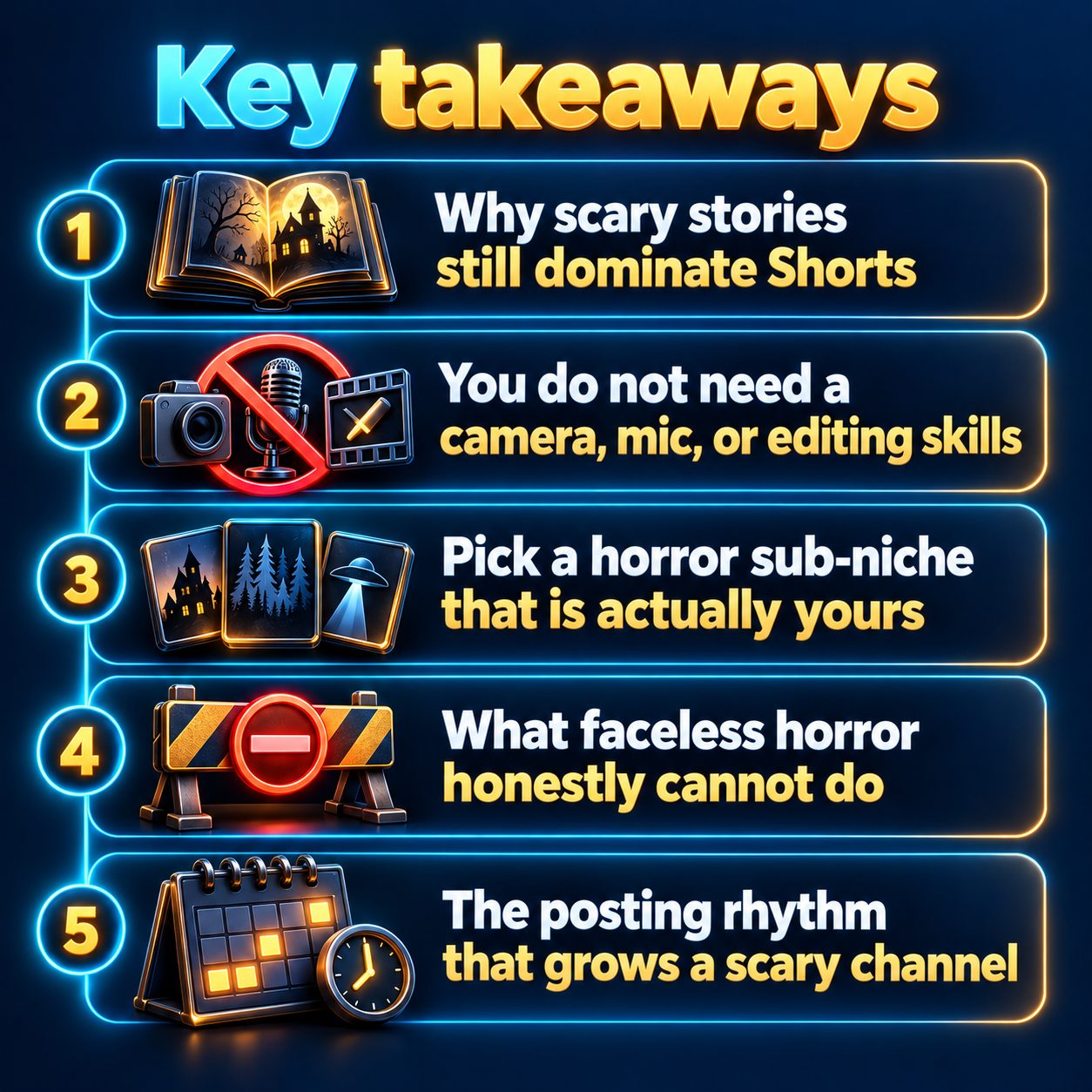
Pick a horror sub-niche that is actually yours
"Scary stories" is a category, not a channel identity. The channels that grow fastest carve out a recognizable corner. Some directions worth considering:
- True unsolved mysteries. Real cases with creepy details. Viewers treat these like mini documentaries.
- Creepypasta narrations. Classic internet horror fiction, retold with fresh visuals.
- Historical horror. Plagues, cursed expeditions, haunted locations from centuries past. Educational and eerie.
- Sleep and ambient horror. Longer, slower stories meant for listeners at night. These rack up enormous watch time because people fall asleep during them.
- Dark folklore. Stories from specific cultures: Japanese yokai, Slavic mythology, Latin American legends. Underserved and fascinating.
Pick one lane and stay in it for at least your first twenty videos. This trains the algorithm to understand what your channel is about and who to show it to. You can always branch out later.
What faceless horror honestly cannot do
Here is where I want to be straight with you. AI-generated horror content is good at mood, atmosphere, and narration. It is not perfect at everything.
Faces are the hardest thing for AI visuals. If your story needs a specific character expression or a subtle human reaction, the generated image might land in uncanny valley territory. For horror, that accidental creepiness sometimes works in your favor, but it is worth knowing the limitation.
You also cannot mass-produce identical videos across multiple channels and expect results. YouTube's policies around repetitive content are clear: mass-produced, near-duplicate uploads risk demonetization. One channel posting original stories with real variety in scripts and visuals is the right approach.
A note on monetization: YouTube does not ban AI content from the Partner Program, but content that is mass-produced and repetitious can be flagged. The difference is quality and originality. A channel that tells genuinely interesting stories with care will be treated differently than one pumping out cookie-cutter clips. YouTube also requires AI-disclosure labels for realistic synthetic content, and using the label does not reduce your reach.
The posting rhythm that grows a scary channel
Consistency matters more than perfection. A scary stories channel that posts three to five times per week will grow faster than one posting a masterpiece every two weeks. The algorithm needs regular signals to keep recommending you.
Here is a realistic weekly rhythm:
- Monday through Friday: Post one short scary story per day. Keep scripts tight and punchy.
- Weekends: Batch your topics and outlines for the coming week so you are never scrambling on a Tuesday morning.
The hardest part of any faceless channel is not making the first video. It is making the fiftieth. That is where automation becomes essential. MaqtAi's Autopilot and scheduling tools let you queue up topics, set a posting cadence, and have videos rendered and published automatically, with an approval step so nothing goes live without your review. For a niche like scary stories, where the format is consistent and the content pipeline is deep, this kind of system turns a side project into a real channel.
Your first video is free to make
The expensive decision here is not starting a channel. It is spending another month thinking about it while someone else claims the sub-niche you wanted. Every day you wait is a day your channel has zero videos for the algorithm to learn from.
You do not need equipment. You do not need editing software. You do not need to figure out voiceover. You need one good scary story and about twenty minutes.
MaqtAi gives you free credits when you verify your email, enough to make your first few videos with no card required. Pick scary stories as your niche, type your first topic, and see what comes out. If you hate it, you spent nothing. If you like it, you have a channel.
Doing this by hand is the part most people quit at. MaqtAi writes the script, narrates it, generates the visuals and captions, and assembles the faceless short for you. Verify your email and you get 450 free credits: about 3 videos on the still-frame tier, or one with AI motion. Free renders carry a watermark.
Try it on your niche freeFrequently asked questions
Do YouTube Shorts work for scary stories or should I make longer videos? Both work. Shorts (vertical, up to three minutes) are great for building an audience fast. Longer horizontal videos tend to earn more ad revenue per view once you qualify for the Partner Program. Many successful horror channels run both formats from the same channel.
Will YouTube demonetize my channel for using AI-generated content? Not for using AI itself. YouTube's Partner Program policies target mass-produced, repetitious content regardless of how it was made. A channel posting original, varied stories with real effort behind the scripting is treated like any other creator channel. Disclose AI use where required and focus on quality.
How do I find stories to tell on my channel? Public domain horror (classic literature, folklore), original writing, and community submissions are the safest sources. Avoid reading copyrighted creepypastas word-for-word without permission. Many creators rewrite and adapt public stories into their own versions, which is both legal and better for standing out.
Can I run a scary stories channel in a language other than English? Absolutely. Horror is universal. MaqtAi supports voiceover and captions in over 50 languages, so you can target audiences in Spanish, Arabic, Hindi, Japanese, or dozens of other markets where horror content demand is high but supply is thin.
Results vary and nothing here is a guarantee of income.