
The algorithm is not hiding your Shorts, your opening is losing them
Here is the part that stings. Your Shorts are being shown to people. That is what the feed does. A viewer sees your first frame, hears your first line, and decides almost instantly whether to stay. When a Short gets almost no views, it usually means it got its small test audience and those people swiped.
So open your last five Shorts and watch only the start of each. One question: does the first line promise something specific? If it says "hey guys, welcome back to the channel," you found the leak.
Hooks that actually hold a thumb:
- Lead with the payoff. "This is why Roman concrete is still standing."
- Start mid-story. "She called the police three times. Nobody came."
- Contradict a belief. "Saving money is the reason you are broke."
- Pose a question they cannot answer. "Why does every airport smell the same?"
Three mechanical fixes while you are in there. Cut any intro card or logo animation. Put motion in the very first frame, because a static opening reads as "skip." And burn captions on screen from the first word, because a huge share of feed viewing happens with sound off.
Then check the ending. A Short that trails off with "anyway, thanks for watching" kills your completion rate at exactly the moment it matters. End on the payoff, or loop back into the opening line.
"My niche is different, that advice does not apply"
Partly true. The mechanic is universal, the execution is not.
If you run sleep or ambient content, a shouty hook is wrong. Your "hook" is the visual: a beautiful first frame and a calm first sentence that names the destination. If you do true crime or dark psychology, your hook is a fact, not a tease, and you need real sourcing because getting it wrong follows you around. History channels live or die on a specific, checkable claim in line one. Finance content needs a number the viewer recognizes from their own life. Motivation needs a sentence that sounds like it was written about the viewer personally.
What does not change: something must be promised before the viewer decides. If you are not sure which niches suit this format, the use cases page is a decent map of what people actually build.
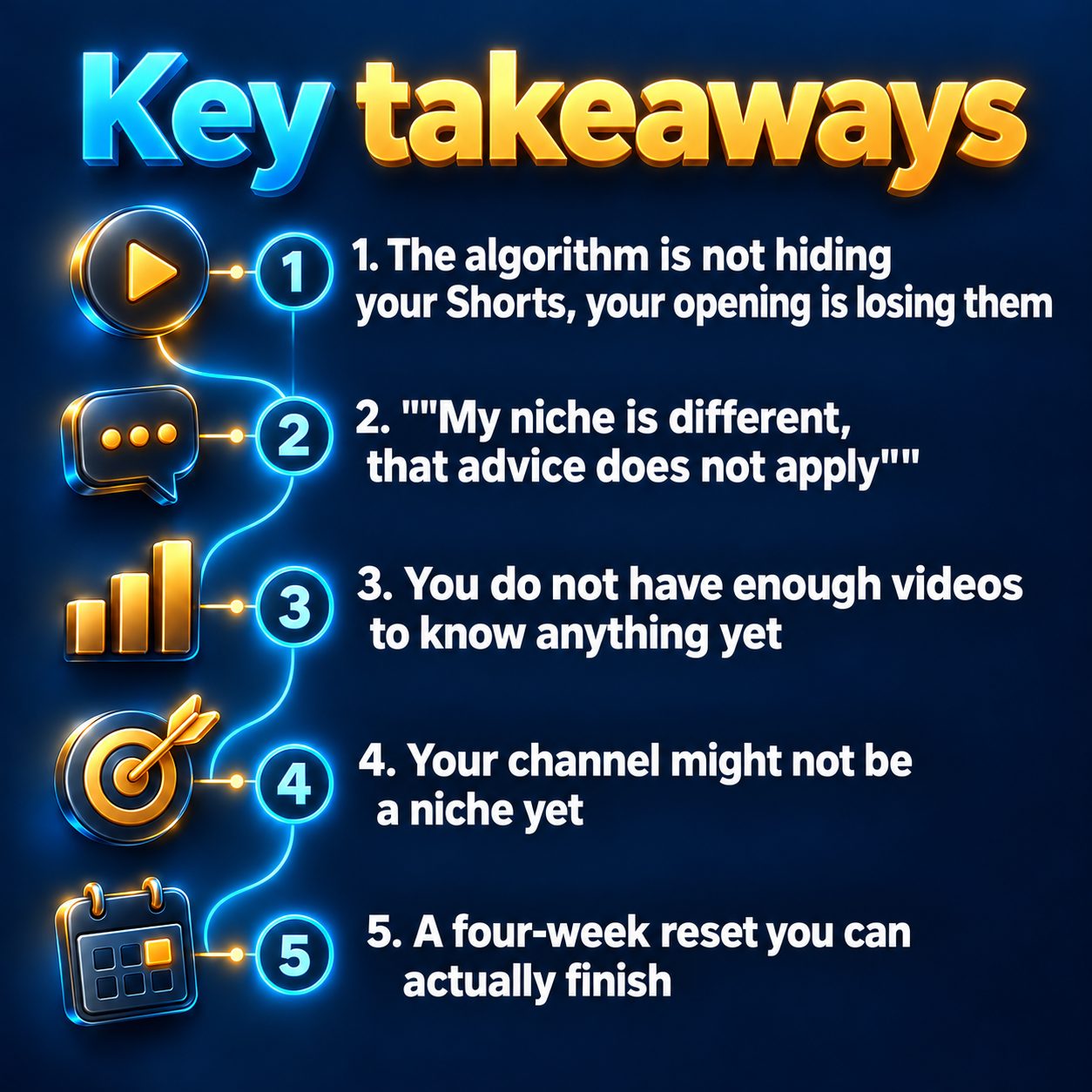
You do not have enough videos to know anything yet
This is the uncomfortable one. Short-form is a sampling game. Each video is one data point, and one data point tells you nothing. If you post once a week, you are running an experiment that takes months to produce a readable result, and you will quit before then.
Posting daily is not about "feeding the algorithm." It is about getting to a body of work fast enough that patterns become visible: which hook style holds, which topic gets saved, which length gets finished. After a couple of dozen videos you can actually see it. After four, you are reading noise.
If daily is not realistic, pick three a week and hold it. A cadence you keep beats a cadence you admire.
Your channel might not be a niche yet
Open your channel page and read the titles top to bottom. Would a stranger be able to finish this sentence: "this channel is about ___"? If the answer is a shrug, that is your growth ceiling.
Scattered topics break two things at once. The platform cannot work out who to show you to, because your viewers have nothing in common. And nobody subscribes, because a person who liked your video about ancient Rome has no reason to expect another one.
The fix is boring and it works: pick one subject and stay there for a month. Not "history," but "unsolved disappearances." Not "business," but "how one-person companies actually make money." Narrow enough that you could name your next ten topics right now.
A four-week reset you can actually finish
Week 1. Pick the niche. Write out topics for the whole month in one sitting. Rewrite the hook of every video before you touch anything else.
Week 2. Post daily on the new niche and change nothing else. Same voice, same style, same length. You are isolating one variable.
Week 3. Look at retention, not views. Which videos held people past the opening? Copy the structure of those two. Ignore the view counts entirely this week, they lag.
Week 4. Keep the cadence, start varying one thing: hook style, or length, or opening visual. One thing.
At the end you will not have a big channel. You will have something better, which is evidence about what your audience responds to.
When the real problem is that you stop after two weeks
Be honest about which problem you have. If your hooks are weak, the fix above is enough. But most people reading this already know their hooks need work. What breaks them is that scripting, recording, and editing a video every single day is a second job, and around day nine it quietly ends.
That is the friction worth removing. MaqtAi takes a niche and a topic and produces a finished vertical video: script, AI voiceover, moving visuals, animated captions. Nothing filmed, nothing edited. With Autopilot you load a topic queue and pick a cadence of daily, three times a week, or weekly, and finished videos wait for your one-tap approval before anything publishes.
What it will not do: pick a good niche for you, know your audience better than you do, or make a boring topic interesting. It also will not save a bad hook. Views come from the niche, the hook, and the cadence. A tool only removes the reason you stopped posting. And skip it entirely if your problem is that you have never enjoyed making these videos, because faster output will not fix that.
One more thing worth saying plainly, since it is the doubt behind the question: no platform down-ranks a video for being AI-made. They rank on watch time, completion, and shares. What does get punished is spam behavior, near-duplicate uploads across accounts, and skipping a platform's AI disclosure rule on realistic synthetic media. Make things people finish and you are fine.
What another month of not posting costs
Nothing dramatic happens if you wait. That is the problem. The channel sits at the same number, the platform accumulates no new data about who to show you to, and someone in your niche posts every day while you decide.
The smallest useful step is one video with a rewritten hook, published today. New accounts get free credits on email verification, no card, which is enough to make that first one and see whether the format feels like something you would keep doing. Details are on the pricing page.
Doing this by hand is the part most people quit at. MaqtAi writes the script, narrates it, generates the visuals and captions, and assembles the faceless short for you. Verify your email and you get 450 free credits: about 3 videos on the still-frame tier, or one with AI motion. Free renders carry a watermark.
Try it on your niche freeFrequently asked questions
How long before Shorts start getting views? There is no fixed timeline, and anyone who gives you one is guessing. What is predictable is that consistent posting in one niche produces readable signal much faster than occasional posting across many.
Should I delete my old Shorts that flopped? No. Deleting does not help you and removes videos that might still get picked up later. Just start the new run and let the old ones sit.
Am I too late to start a Shorts channel? No. Short-form feeds serve content based on viewer behavior, not account age, which is why brand new channels regularly out-perform old ones on a single video.
Will Shorts alone get my channel monetized? It is a hard road. The Shorts view path to the YouTube Partner Program is far steeper than the long-form path of 1,000 subscribers plus 4,000 watch hours, so many creators use Shorts to find an audience and longer videos to earn.
Results vary. Nothing here is a guarantee of views, growth, or income.