
Which "not monetized" are you dealing with?
You open YouTube Studio, check the Earn tab, and it still says you're not eligible. You've put real evenings into this, so that stings. Before you change anything, figure out which problem you actually have. They look the same from the outside, but they need different fixes.
You haven't hit the threshold yet. Under the YouTube Partner Program rules, you need 1,000 subscribers plus either 4,000 valid public watch hours in the last 12 months or 10 million valid public Shorts views in the last 90 days. If you're short on any of those, nothing is wrong with your channel. You just aren't there yet.
You applied and got rejected. This usually points to reused or repetitive content. A reviewer looked at your uploads and saw videos that felt interchangeable.
You're in, but earning almost nothing. Shorts revenue works differently from regular videos and follows its own policy. A Shorts-only channel can be monetized and still earn very little per view.
Once you know your case, the rest of this gets much simpler.
The path you pick matters more than people admit
There are two roads to the threshold, and lots of creators drift between them without choosing.
The Shorts road counts Shorts views. The long-form road counts watch hours, and those come from regular videos, not Shorts. So if your channel is all vertical clips, you're only working toward the Shorts target, which is a big number for a small channel.
The long-form road is usually more reachable for a small niche channel, and regular videos typically earn far more per view once you're in. YouTube decides the format by shape and length: vertical or square videos up to 3 minutes are treated as Shorts, while horizontal or longer uploads count as regular videos.
The practical move is a mix. Use Shorts for discovery, and add regular horizontal videos on the same topics so new viewers have something to watch for longer. That's what builds the hours.
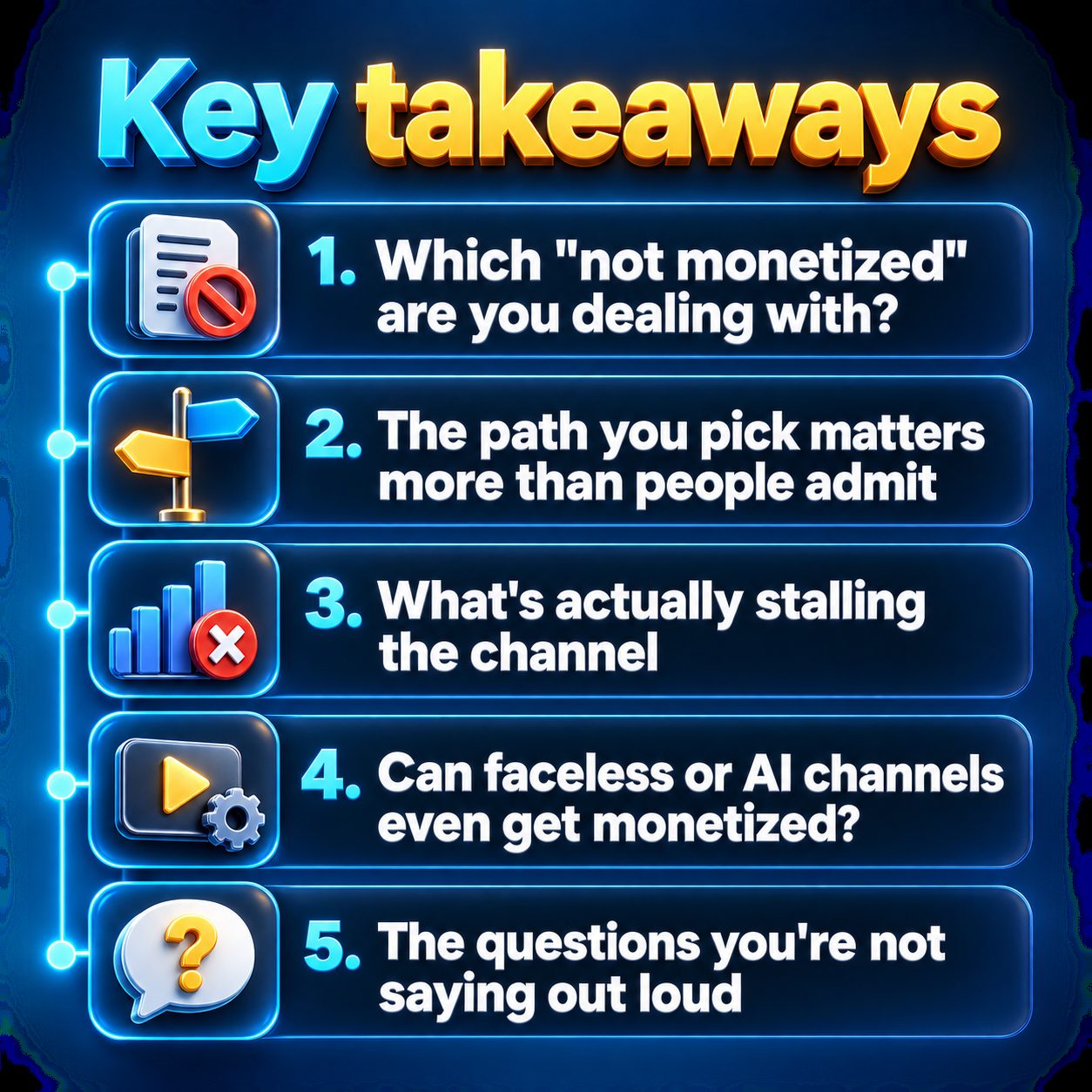
What's actually stalling the channel
Here's the honest diagnosis. It's almost never "you need better software." It's usually one of three things.
Cadence. You post five videos in a burst, then nothing for three weeks. The algorithm can't learn who your audience is from a channel that keeps going quiet.
Hooks. Open your retention graph in YouTube Studio. If the curve drops hard in the opening seconds, the topic isn't the problem. Your first line is. Viewers decide almost instantly whether to stay.
Niche. "Interesting facts" is too wide to build a returning audience. "Strange facts about ancient Rome" gives people a reason to subscribe, because they know what the next video will be.
Pick the one that matches your analytics. Fix that first. Changing everything at once means you never learn what worked.
Can faceless or AI channels even get monetized?
Yes, and this is where a lot of people get spooked by bad advice. No platform pushes a video down just because AI helped make it. YouTube, TikTok, Instagram and Facebook rank short videos by how viewers behave: watch time, completion, likes, shares.
But here's the honest limit. YouTube's inauthentic content policy demonetizes mass-produced, repetitious content. If every video is the same template with one noun swapped, that's exactly what gets a channel rejected, faceless or not. A reviewer wants to see that each upload gives the viewer something the last one didn't.
Two more things matter. If you use realistic synthetic people or footage, follow the platform's AI disclosure rule. The label itself doesn't reduce reach, but skipping it can get videos removed. And don't post identical files across a pile of accounts. That reads as spam.
The questions you're not saying out loud
"Am I too late?" No. People start new niche channels all the time and grow them. What's changed is that low-effort channels get filtered faster, which actually helps you if you care about quality.
"Will people judge me for faceless content?" Viewers judge whether the video was worth their time. Plenty of beloved channels never show a face.
"What if I quit after two weeks again?" That's the real risk, and it's worth planning for. Most stalled channels didn't fail on quality. They failed because posting felt like a second job. Choose a cadence you can keep on a bad week, not a good one.
A fix you can start this week
- Choose your road. Shorts only, or Shorts plus regular videos. If you're far from the Shorts target, add horizontal videos.
- Build one series. One repeatable format with a clear promise, like "one forgotten battle, explained simply." Each episode covers something new.
- Set a cadence you'll keep. Post 1/day if you can sustain it, three a week if you can't. Consistency beats volume.
- Rewrite your opening lines. Lead with the most surprising thing, not an introduction.
- Review once a week. Check where retention drops and what got shared, then adjust one thing.
- Batch the work. Make several videos in one sitting so a busy week doesn't break the streak.
If production is where you keep stalling, that's the specific friction MaqtAi removes. You give it a niche and a topic, and it writes the script, voices it, animates the visuals, adds captions, and can publish on a schedule you pick through Autopilot, with every video waiting for your approval unless you turn on automatic publishing. You can also make horizontal regular videos, which get a long-form structure with a hook, themed sections and a recap, and then make a separate companion Short on the same topic. What it won't do: pick your niche, fix a weak idea, or make a repetitive template pass YouTube's review. Your judgment still decides whether each video earns its place.
What waiting is costing you
Every week you don't post is a week the algorithm doesn't learn who your viewers are. Your watch hours don't accumulate, and somewhere a channel in your exact niche is posting today and collecting that data instead. You don't need a perfect plan to start. You need the next video out.
So make one. Pick a topic from your series and see what a finished version looks like. New accounts that verify their email usually get free credits, no card needed. A free render is watermarked, so treat it as a test of whether this workflow fits you, not a finished upload. That's an afternoon, and it answers the question you've been circling.
Doing this by hand is the part most people quit at. MaqtAi writes the script, narrates it, generates the visuals and captions, and assembles the faceless short for you. Verify your email and you get 450 free credits: about 3 videos on the still-frame tier, or one with AI motion. Free renders carry a watermark.
Try it on your niche freeFrequently asked questions
Why was my channel rejected for monetization? The most common reason is reused or repetitive content, where uploads feel mass-produced or interchangeable. Make each video add something new, then reapply once you've posted a stretch of stronger uploads.
Do Shorts views count toward watch hours? No. Shorts views count toward the Shorts threshold, while watch hours come from regular videos. That's why adding horizontal videos often helps a small channel reach the long-form path.
Can a faceless AI channel be monetized? Yes, if the content is original and varied. No platform down-ranks a video just for being AI-made, but YouTube demonetizes mass-produced, repetitious content.
How long until my channel gets monetized? There's no fixed timeline. It depends on your niche, your hooks, and how consistently you post, so focus on the cadence you can keep rather than a date.
Results vary, and nothing here is a guarantee of monetization or income.