What YouTube pays for, and what it doesn't
Most of the confusion starts with the rules, so start there. YouTube only shares ad revenue with channels in its Partner Program. YouTube's eligibility page says full entry needs 1,000 subscribers plus either 4,000 valid public watch hours in the last 12 months or 10 million valid public Shorts views in the last 90 days.
That covers the ad money. It isn't the only money. YouTube doesn't own your description box, your viewers' trust, or your inbox. A small channel is free to recommend products, sell something of its own, or take a sponsor. You just have to disclose it. When you upload, tick the paid promotion box.
The same eligibility page also describes an earlier tier, available in many countries. It opens fan-funding features like channel memberships and Super Thanks before ad revenue starts. Check whether it applies where you live, because it's free money you might be leaving switched off.
Four ways a small channel can earn right now
1. Affiliate links. Pick products your niche already talks about and link them. There's one catch with Shorts: links in Shorts descriptions aren't clickable. Put your affiliate links in your long-form video descriptions, in a pinned comment on those videos, and in the links section of your channel profile. Shorts bring people in. Longer videos give them somewhere to click.
2. Your own offer. This is usually the best earner for tiny channels. A personal finance channel can sell a budgeting spreadsheet. A fitness channel can offer form checks. A local business can book appointments. You don't need a crowd. You need the right handful of people.
3. Small brand deals. Smaller brands often care more about niche fit than audience size. Don't wait for them to find you. Send a short note that explains who watches, what you post, and one specific video idea featuring their product.
4. Fan funding. If the earlier tier is available to you, switch on memberships or Super Thanks. Don't expect much at first. Still, it costs nothing, and loyal viewers like having a way to say thanks.
If ad revenue is your long-term goal, here's a tip. Regular horizontal videos typically earn far more ad revenue per view than Shorts, and for most channels the watch-hours path is far more reachable than the Shorts-views path. Plenty of creators use Shorts for discovery and long-form for watch hours and links.
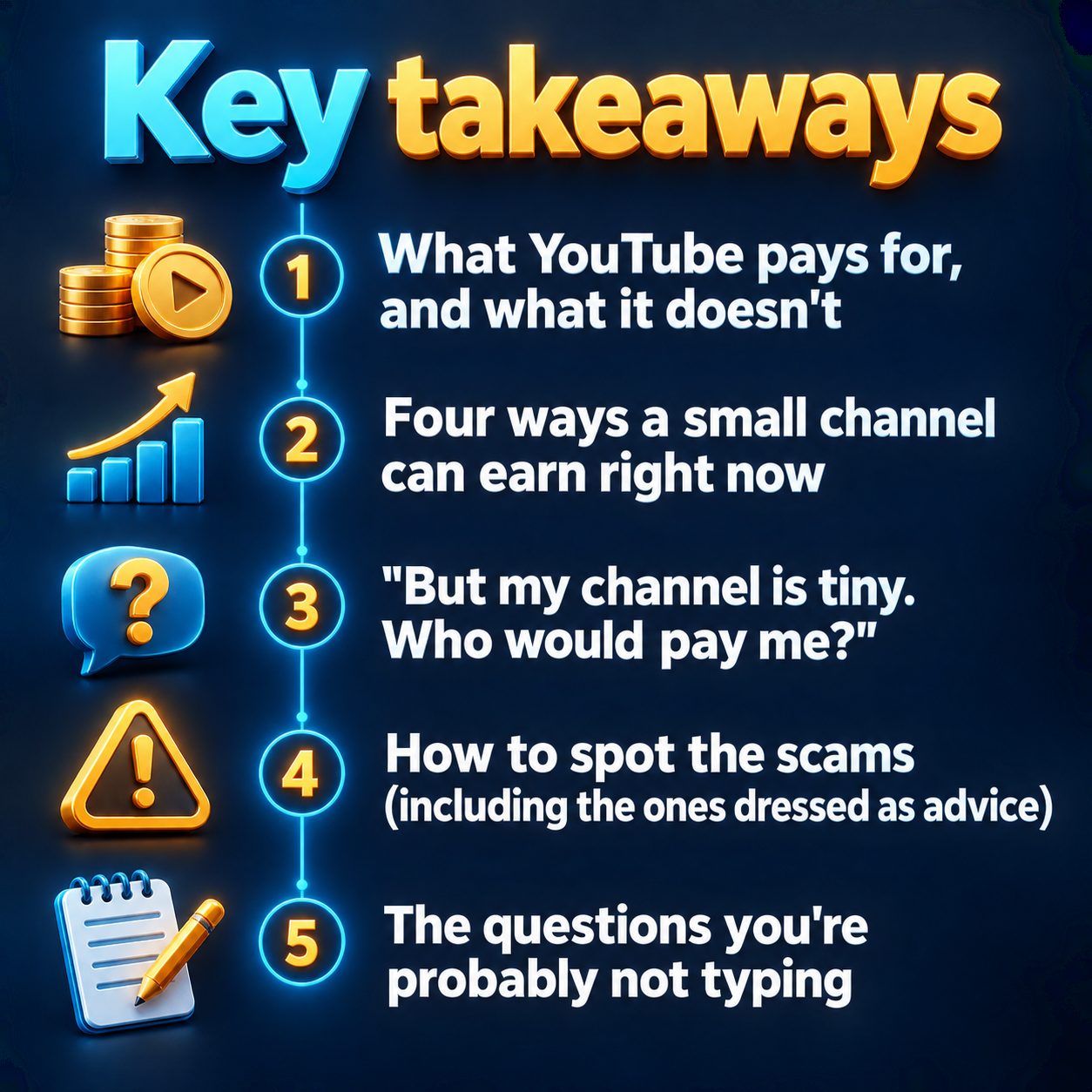
"But my channel is tiny. Who would pay me?"
That's a fair worry, so here's the honest answer. Income follows attention. A small channel earns small amounts, and some months it earns nothing. That's normal, and you haven't failed.
The thing that changes the math is how specific you are, not how big you are. A general "interesting facts" channel attracts people who scroll past. A channel about one thing, like stoic habits for night-shift workers, attracts people with a shared problem. People with a problem buy things. Pick a niche where viewers already spend money. Then every video becomes a small ad for your offer, even before YouTube pays you a cent. If you're still choosing, these niches work well without filming.
How to spot the scams (including the ones dressed as advice)
Your radar should be up, because this topic attracts junk. Here's what to skip:
- Buying subscribers or views. It breaks YouTube's fake engagement rules and can get the channel removed. Fake viewers also never buy anything.
- Sub-for-sub groups. You get subscribers who never watch, and that drags your numbers down.
- "Guaranteed income" courses. Nobody can guarantee what an algorithm or an audience will do.
- Mass-produced lookalike videos. YouTube's inauthentic-content policy demonetizes repetitive, mass-produced AI content. AI itself isn't the problem. Sameness is.
And here's the limit nobody likes saying out loud: none of the four methods above works without people watching. They turn attention into money. They don't create the attention.
The questions you're probably not typing
Am I too late? No. New viewers show up every day looking for answers in your niche. What's crowded is generic content. Specific channels still have room.
Will people judge me for AI-made videos? Viewers judge boring videos. No platform down-ranks a video just for being AI-made. Ranking comes from watch time, completion, likes and shares. The one rule to respect: if a video shows realistic synthetic people or events, use the platform's AI disclosure label.
What if I quit after two weeks? This is the real risk. Channels rarely die from a bad idea. They die from going quiet. Usually the cause is the hours: scripting, recording, editing, every single day.
Where the hours go, and how to cut them
That's the friction worth solving. Write your offer and your affiliate list once. The thing you'll repeat forever is making the next video.
This is the job MaqtAi was built for. You give it a niche and a topic. It writes the script, narrates it with an AI voice, generates moving visuals, adds captions and assembles the video, so you never appear on camera or record your voice. It can also make 16:9 videos at 2 or 5 minutes with a long-form structure, which is the format that builds watch hours. A finished long video can spin off a separate companion Short on the same topic. Once you know what works, Autopilot can run a daily, three-times-a-week or weekly cadence from your topic queue. Every video still waits for your approval unless you turn on automatic publishing.
What it won't do: choose your niche, write your offer, or promise views. Those are still your calls.
What waiting actually costs
Every week you spend deciding is a week of zero videos. That means zero viewer data telling you which hooks work, and zero chances for someone to click your first affiliate link. Meanwhile the channel in your niche that posts daily is collecting all of it.
So take one small step. Make one test video on the topic you'd post first. Most new accounts that verify their email get free credits, no card needed. Free renders carry a watermark, so treat this as a test before you publish anything. Pricing shows how far those credits go. It's an afternoon, and you'll find out if this fits you before you pay for anything.
Doing this by hand is the part most people quit at. MaqtAi writes the script, narrates it, generates the visuals and captions, and assembles the faceless short for you. Verify your email and you get 450 free credits: about 3 videos on the still-frame tier, or one with AI motion. Free renders carry a watermark.
Try it on your niche freeFrequently asked questions
Can I put affiliate links on YouTube Shorts? Links in Shorts descriptions aren't clickable. Put them in long-form video descriptions, pinned comments on those videos, and your channel's links section instead.
Do I need the Partner Program to get brand deals? No. Sponsorships are between you and the brand. Just mark the video as including paid promotion when you upload.
Will AI-made videos get demonetized? Not for being AI-made. YouTube's inauthentic-content policy targets repetitive, mass-produced content, so keep every video genuinely different and label realistic synthetic media.
How soon can I earn my first money? There's no honest timeline. Affiliate and product income can start whenever a viewer buys, which depends on your niche, your offer and how consistently you post.
Results vary, and nothing here is a guarantee of income.