
Two channels only make sense if they serve two different viewers
Here is the test I would run before anything else. Take a video idea from channel A. Could it sit on channel B without a single viewer blinking? If yes, you do not have two channels. You have one channel split in half, and you just cut your own momentum in two.
YouTube learns who to show your videos to by watching who watches them. When one channel covers stoic motivation and the other covers weird history facts, each one builds a clean signal. When both are vaguely "self improvement", the signal is mush on both sides.
So write down, in one sentence each, who watches channel A and who watches channel B. If the two sentences describe the same person, merge them and run one channel properly. If you are still deciding what the second one should be, the niches page is a decent place to see what people actually build faceless channels around.
The account setup is the easy part
This is the part people overthink. You do not need a second email, a second phone, or a VPN. One Google account can hold multiple channels through brand accounts, and you switch between them from the account menu. Google's own guide on creating a new channel walks through it in a couple of minutes.
Two things worth doing while you are in there:
- Verify each channel by phone in YouTube Studio. Unverified channels cannot upload custom thumbnails, which quietly hurts you later.
- Give each channel its own banner, description, and handle. No shared branding. They should look like strangers to each other.
That is the whole setup. The hard part is week three, not day one.
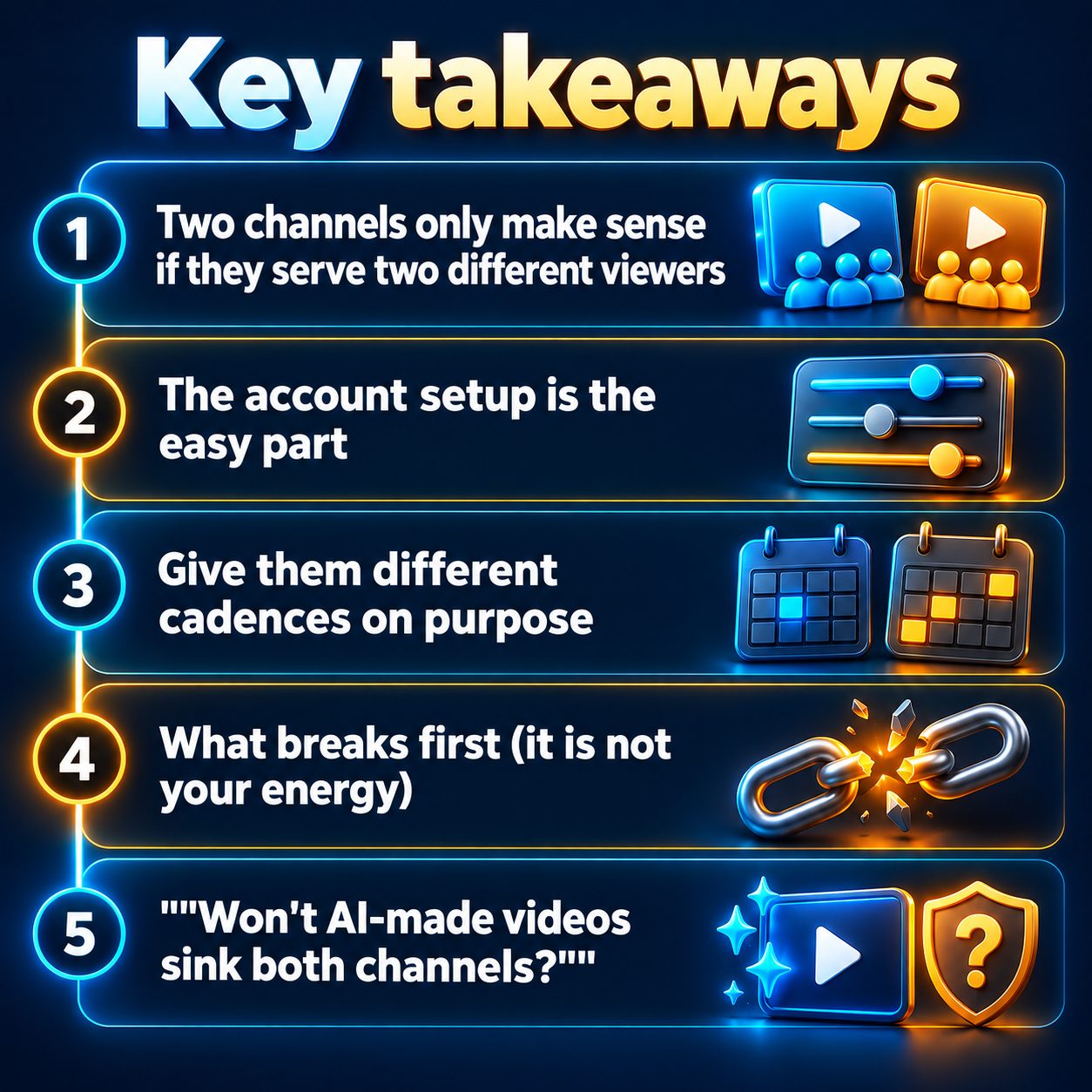
Give them different cadences on purpose
Most people running two channels try to post the same amount on both, get behind on both, and then feel like a failure on both. Do not do that.
Pick a primary. The primary gets your best cadence, daily or close to it. The second channel gets three posts a week. That is not a demotion, it is what keeps the whole thing alive when you have a bad week. If a week goes sideways, the second channel drops to weekly and the primary holds.
Then batch by stage, not by channel. One sitting for topics (both channels), one sitting for scripts, one sitting for covers and captions. Switching between "topic brain" and "editing brain" is what actually eats your evening, not the work itself.
Keep a running topic bank for each channel, one idea per line, and top it up whenever an idea shows up. An empty topic list on a Tuesday night is the single most common reason a second channel dies.
What breaks first (it is not your energy)
Three things go wrong in a predictable order.
Hooks get lazy. When you are producing double the volume, the first three seconds are the first thing you stop thinking about. Every video still needs a specific opening line, not "today we are going to talk about".
The second channel becomes a dumping ground. Ideas that were not good enough for the primary end up there. Viewers can feel that instantly.
The monetization math doubles. Each channel clears the bar on its own. Nothing carries over. Per YouTube's Partner Program requirements, that means 1,000 subscribers plus either 4,000 valid public watch hours in 12 months or 10 million valid public Shorts views in 90 days, for each channel separately. Which is a real argument for making at least one of your channels horizontal long-form rather than betting both on Shorts.
And do not upload the identical file to both channels. Near-duplicate posting across accounts is a spam pattern, and it is one of the few things that genuinely gets you throttled.
"Won't AI-made videos sink both channels?"
Fair worry, and the honest answer has two halves.
No platform down-ranks a video for being AI-made. TikTok, Instagram, and YouTube rank short-form by viewer behavior: watch time, completion, shares. There are AI-presenter channels pulling millions of views a month. The production method is not the input.
What does hurt you: weak opening seconds, near-identical files posted across accounts, and ignoring disclosure rules. YouTube asks creators to disclose realistic altered or synthetic content, and the label itself does not reduce distribution, but skipping it can get a video removed. Separately, YouTube's inauthentic content policy demonetizes mass-produced repetitious content, which is exactly what you get if you point a generator at one topic and let it churn. Two channels with distinct niches, distinct scripts, and a human picking topics is a different thing entirely.
Remove the production friction, not the thinking
If you have read this far, you already know the plan. What stops people is that two channels means writing, narrating, editing, and uploading twice, on a Wednesday, after work.
That is the part worth handing off. MaqtAi takes a niche and a topic and produces the vertical video end to end: script, AI voiceover, moving visuals, animated captions, publish-ready. One workspace can connect more than one YouTube channel, so both show up as separate choices when you publish, and you pick which one gets which video. If you want the cadence to hold itself, Autopilot renders from a topic queue you fill yourself or let it suggest, on a schedule (daily, 3x a week, or weekly) and, by default, waits for your one-tap approval before anything posts.
The honest limits, because they matter: it does not pick your niche, it does not find trending topics for you, and it will not save a channel with a boring premise. You still own the two sentences about who watches each channel, and you still own the hooks. Autopilot needs an active plan, and every video draws credits from your balance. What it removes is the production tax, which is the specific thing that kills second channels.
The cost of deciding for another month
Waiting is not neutral. The second channel that does not exist yet is not accumulating any algorithm data, no watch time is stacking toward its own monetization bar, and someone in your niche is posting today. Momentum on YouTube is mostly just time on the clock.
So make it small. Pick the second channel's one-sentence audience tonight, write five topics, and produce one video. New accounts get 450 free credits after verifying their email, no card, which is three or four watermarked still-frame videos, enough to see the output before you commit. Details on how credits work are on the pricing page.
One video this week beats a perfect two-channel plan you start in October.
Doing this by hand is the part most people quit at. MaqtAi writes the script, narrates it, generates the visuals and captions, and assembles the faceless short for you. Verify your email and you get 450 free credits: about 3 videos on the still-frame tier, or one with AI motion. Free renders carry a watermark.
Try it on your niche freeFrequently asked questions
Can I run two YouTube channels from one Google account? Yes. Brand accounts let one login hold multiple channels, and you switch between them from the account menu. Each channel keeps its own subscribers, branding, and analytics.
Should both channels post at the same frequency? No, and trying is how people burn out. Give your primary channel the heavier cadence and let the second run three times a week or weekly. Consistency at a lower rate beats a stalled channel.
Does monetization carry over between my channels? No. Each channel is reviewed and must clear the Partner Program thresholds on its own. Subscribers and watch hours do not transfer.
What if the second channel does not work? Then you stop it and put the time back into the first. Give it a few months of real cadence before you judge, because a handful of videos is not enough data on any niche.
Results vary. Nothing here is a guarantee of income, views, or monetization approval.