An Urdu channel is its own decision, not a translated English one
The objection I hear most goes like this: "Isn't the Urdu audience too small to bother with?" I think that's the wrong way to look at it. An English faceless channel about stoicism is up against a huge crowd of near-identical channels. An Urdu channel on the same idea has far less company, and its viewers are actively looking for content in their own language. Yes, the pond is smaller. But you don't need everyone. You need to be the channel someone in Lahore, Karachi or Birmingham saves and comes back to.
What changes is how you pick a niche. Choose one where the language actually matters to the viewer: Islamic history, Urdu poetry explained line by line, folk tales and scary stories, everyday money lessons, motivation. Niches that are pure visuals, like satisfying clips, gain almost nothing from Urdu narration. If you want a wider list to choose from, the niches on our use cases page are a good place to start.
Then write for the actual viewer. A money video for an Urdu audience should talk about committees and family budgets, not retirement accounts they've never heard of. A history video should cover the Mughals, the Partition and the poets people grew up quoting. Machine-translated English topics with Urdu narration on top feel hollow, and viewers can tell.
Shorts or longer videos for an Urdu channel?
This is the part most people can't work out on their own. YouTube decides based on the shape of the video: anything vertical or square up to 3 minutes counts as a Short, according to YouTube's Shorts guidelines. Widescreen, or anything longer, goes in as a regular video.
The shape matters for money. Under the YouTube Partner Program rules, you need 1,000 subscribers plus either 4,000 valid public watch hours in the last 12 months or 10 million valid public Shorts views in the last 90 days. For a channel in a smaller language, the watch-hours route is usually much easier to reach than the Shorts-views route. Regular videos also tend to earn more ad revenue per view.
So here's what I'd do: use Shorts to get discovered and longer widescreen videos to build watch hours. In MaqtAi you choose the shape on the Length & aspect step. Widescreen videos at the longer lengths automatically get a long-form structure (a hook, themed sections and a recap). A finished widescreen video also has a "Make a companion Short" button. It creates a separate vertical video on the same topic with its own payoff, which you publish on its own.
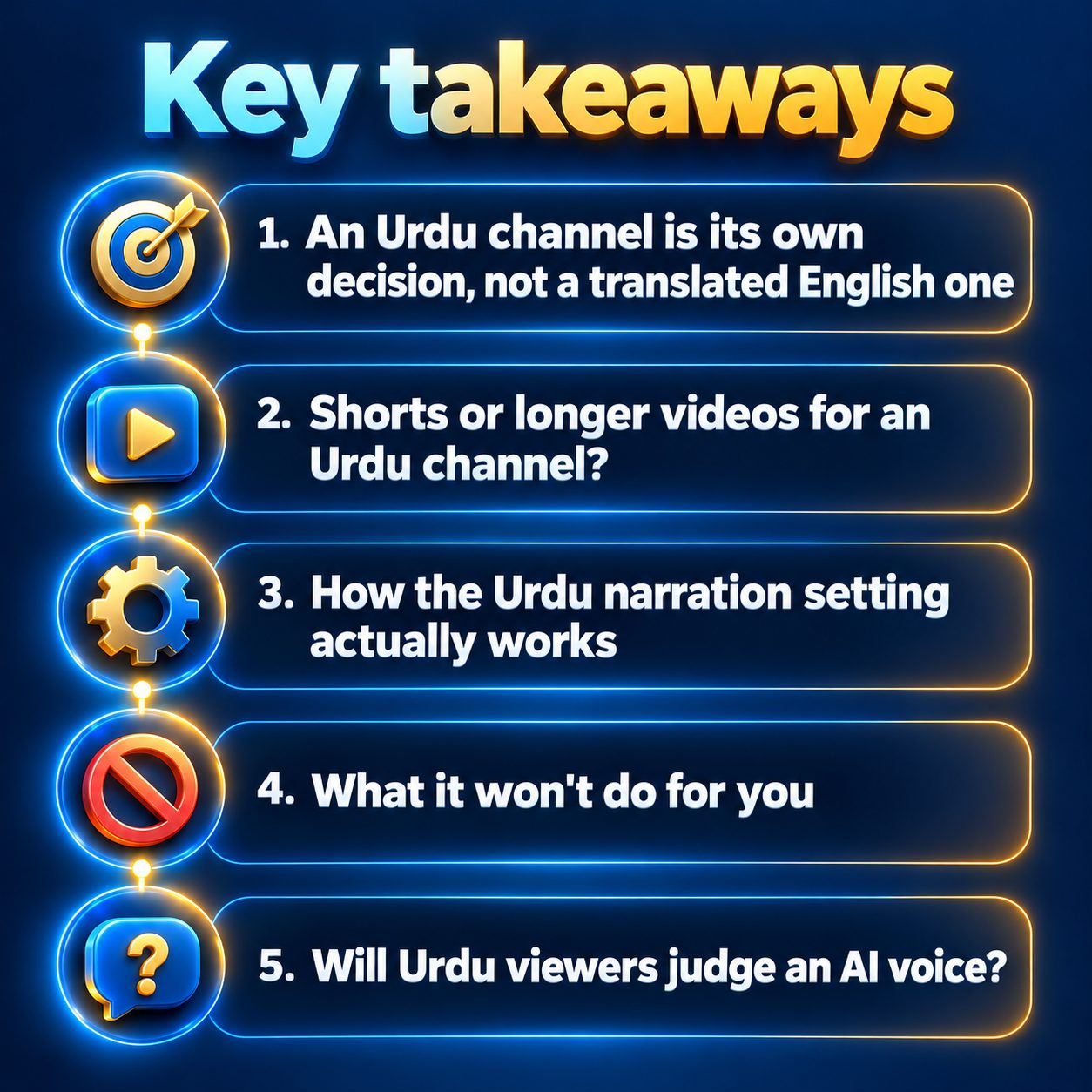
How the Urdu narration setting actually works
This is the short, mechanical part. On the Topic step there's a voiceover language picker. "Auto" narrates in whatever language you wrote the topic in. If you choose Urdu from the "More languages" dropdown, that choice controls the script, the narration and the captions together.
That means you can type your topic in English ("the story of the Shalimar Gardens") and still get the script and voice in Urdu. Set the language before you generate the script. If you change it afterward, regenerate so the new choice takes effect.
After that you're the editor. You can rewrite any line on the Scenes step, or paste in your own Urdu script, which is used word for word. Preview the narrators, pick one that suits your niche, and slow the speech down if the content is reflective. Captions show up in Urdu script in short chunks that follow the voice. Nothing is generated or charged until you press Launch, and a render typically takes about six minutes. The rest of the toolkit, including scheduling and auto-publishing, is covered on the features page.
What it won't do for you
Here's the honest part. The tool doesn't know which Urdu your audience speaks. Formal or conversational, Persian-leaning or everyday Karachi street Urdu: that's your call, and you'll only catch a misjudged word by reading every script out loud before it goes live. The optional per-word caption highlight isn't available for Urdu because it's a right-to-left script. Your captions still display normally and stay in sync with the voice. Nothing in MaqtAi tracks trends either. It can suggest topics from your niche, but it won't tell you what Pakistan is talking about this week. And it won't rescue a channel that pumps out near-identical videos, because YouTube's inauthentic-content policy demonetizes mass-produced, repetitive AI content. If you can't read Urdu at all, don't start this channel, since you'd have no way to check quality. If you'd rather use your own voice, Clone Studio has a voice-only mode on paid plans. It's still in beta, so record calmly in a quiet room.
Will Urdu viewers judge an AI voice?
This is the question people think but don't type. Honestly, some viewers will notice. What they won't forgive is the wrong word, an awkward phrase, or a ghazal read like a news bulletin. A clean voice that respects the language gets far more slack than a perfect voice reading a clumsy script.
No platform pushes a video down just because AI made it. YouTube ranks Shorts on viewer behavior: watch time, completion, likes and shares. What does hurt reach is a weak opening, copy-paste mass posting, or skipping a platform's disclosure rule for realistic synthetic media. Follow those rules and an AI narrator isn't what holds you back.
And no, you're not too late. Urdu faceless content is much less crowded than English, and every niche still has gaps. Your Urdu explainer on Iqbal can easily be the best one out there right now.
Your first two weeks, and what waiting costs
Week 1: pick one niche and make three Shorts. Read each script aloud, fix anything that sounds translated, and post them. Week 2: post 1/day or three times a week, and make one longer widescreen video from your strongest Short. Once the rhythm feels right, Autopilot on a paid plan can render from a topic queue on a daily, three-times-a-week or weekly schedule. By default, every video waits for your approval before it publishes.
Here's the honest cost of waiting. Every week you spend thinking about it is a week of watch data your channel isn't collecting. YouTube can't learn who your viewers are from videos you haven't posted. Meanwhile, someone else is posting the Urdu history video you were planning to make. So take one small step today: verify your email, use the free credits most new accounts get (no card needed, details on pricing), and make a single Urdu video. Free renders carry a watermark, but you'll hear the voice and see the captions for yourself. That answers the question better than any article can.
Doing this by hand is the part most people quit at. MaqtAi writes the script, narrates it, generates the visuals and captions, and assembles the faceless short for you. Verify your email and you get 450 free credits: about 3 videos on the still-frame tier, or one with AI motion. Free renders carry a watermark.
Try it on your niche freeFrequently asked questions
Can I write my topic in English and still get Urdu narration? Yes. Pick Urdu in the voiceover language picker on the Topic step, and the script, narration and captions all come out in Urdu even if your brief is in English.
Do Urdu captions highlight each word as it's spoken? No. The per-word highlight isn't available for right-to-left scripts like Urdu. Captions still display normally in short chunks that follow the voice.
Do I need to speak Urdu to run this channel? You need to read it well enough to catch a wrong word or an awkward phrase. The tool writes and narrates, but checking the language is still your job.
Can an Urdu channel get monetized? It can, under the same Partner Program rules as any other channel, as long as the videos are original and not repetitive. The watch-hours route through longer videos is usually the more reachable one.
Results vary, and nothing here is a guarantee of income.