The voice is a casting decision, not a settings toggle
Most people treat the voice step like picking a font. It is closer to casting an actor. The same script lands completely differently depending on who reads it, and viewers feel the mismatch before they can name it.
Rough guide by niche. Sleep and bedtime content wants a low, unhurried voice that never spikes in energy, because the goal is for people to stop watching and fall asleep. True crime and history want a steady, dry delivery that lets the facts do the work; drama in the voice reads as tabloid. Stoic motivation wants measured and calm, not shouty. Comic stories and curiosity content can take a brighter, faster narrator.
MaqtAi gives you a short list of narrator voices with a preview button on the Voice step, so run the same two lines of your actual script through several before you commit. Then keep the one you pick. A channel with one recognizable narrator feels like a show. A channel that changes voices every week feels like a content farm, and viewers do notice.
Pacing matters more than voice quality
Here is the thing nobody tells you: a slightly plain voice at the right pace beats a gorgeous voice at the wrong one.
Two controls do the heavy lifting. First, length. In the MaqtAi wizard you choose length and aspect ratio before the script gets written, on purpose, so the duration shapes how many words get written rather than the script being crammed into a slot afterwards. Pick a 30 second target and you get a script that breathes at 30 seconds.
Second, speech speed. You can slow the narration down or push it faster. Sleep content should be slower than feels natural to you. Motivation and quiz content usually want it a touch faster than default. Listen with the visuals, not on its own, because motion changes how fast speech feels.
And the first line carries everything. Vertical feeds autoplay, so your opening seconds are the whole audition. Write the hook as a spoken sentence, say it out loud yourself, and if you stumble, rewrite it.
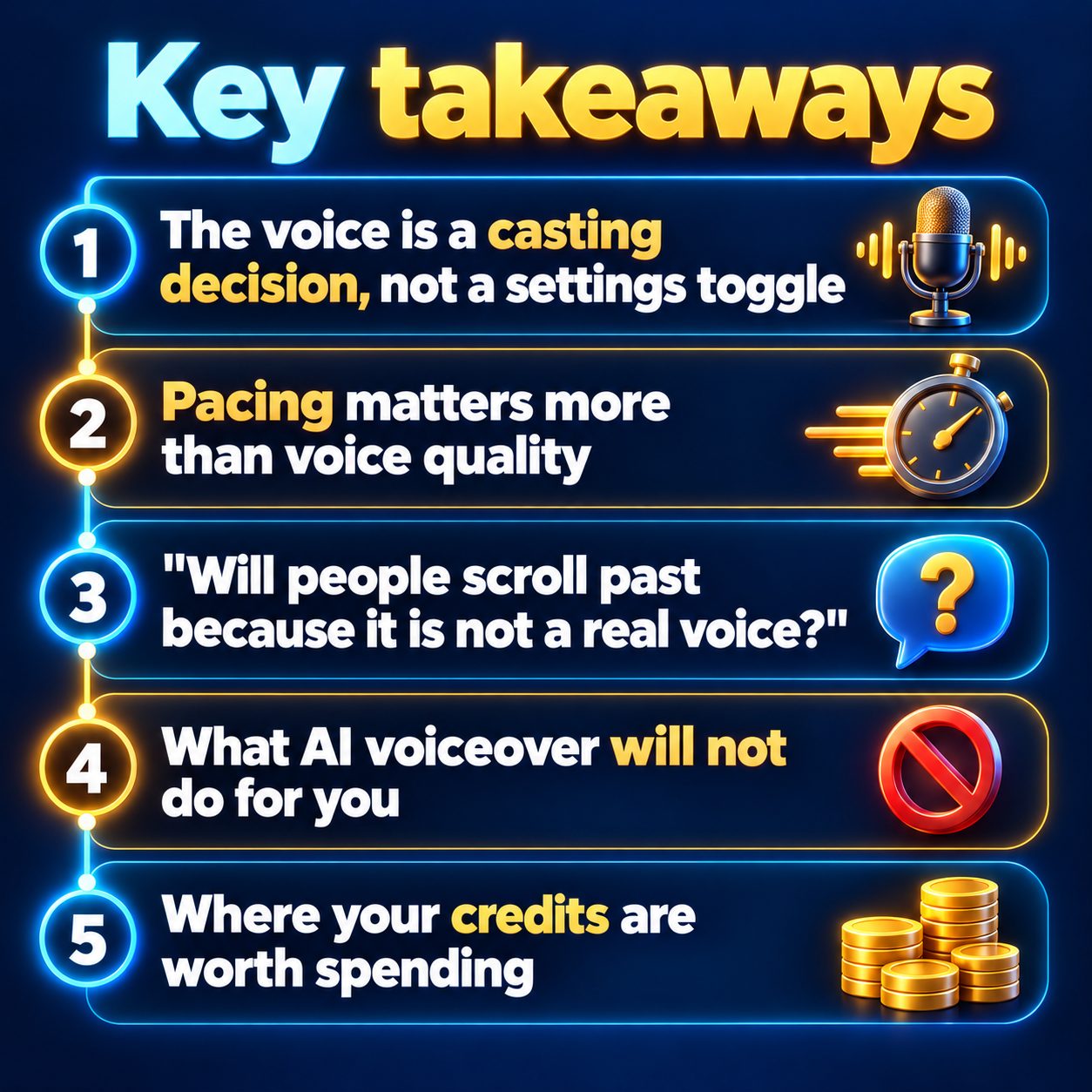
"Will people scroll past because it is not a real voice?"
The honest answer: no platform down-ranks a video for being AI-made. TikTok, Instagram, YouTube and Facebook rank short videos on viewer behavior, watch time, completion, likes, shares. Nobody at YouTube is checking whether a human held a microphone.
What actually hurts you is different. Near-duplicate files posted across a pile of accounts. A weak opening. And ignoring disclosure rules where they apply: YouTube asks creators to disclose realistic altered or synthetic content when they upload. The label itself does not shrink your distribution, but skipping it where it is required can get a video removed.
As for the unspoken version of the question, which is usually "will people judge me": some will, in comments, occasionally. Far more will simply watch, because they came for the story or the fact or the calm, not for proof that a human read it aloud.
What AI voiceover will not do for you
This is the part that makes the rest worth believing.
An AI voice will not make a boring script interesting. It cannot do comedic timing, a genuine emotional crack, or character acting across multiple personalities. If your channel's appeal is your own personality, your accent, your laugh, do not bother with this, record yourself instead.
A few specific limits worth knowing before you build around them. Clone Studio, which clones your own voice from a short guided reading, is labeled Beta in the app: it is close but not perfect, and your recording conditions matter, calm delivery, quiet room. Language versions of a finished video use the consistent preset narrator voice, never your cloned one. And presenter or talking-head videos cannot be localized yet, because the lips would not match the new words.
None of this causes growth either. Removing the recording step removes friction. Views still come from the niche, the hook and the cadence.
Where your credits are worth spending
A useful thing to internalize: voice quality does not change with the quality tier. The tiers (Express through Full Cinematic) decide how the per-scene motion is generated, and each tile shows its real credit cost with the total updating as you choose. Your narration sounds the same either way.
So spend up on motion only when the visuals are realistic and people-heavy, where the premium tiers genuinely show. If your niche runs on stylized art, anime, watercolor, comic, pixel, the higher tiers look close to identical, and Standard or Cinematic Opener is the smarter call. Put the saved credits into more videos instead. That trade is on the pricing page if you want the numbers in front of you.
One more: on a paid plan, a completed video's text, voice, music and caption edits cost no credits for 7 days after the render. If the narration reads wrong, fix it without paying again. Only regenerating a scene's visuals costs credits, and the cost is shown before you apply it.
Making it a channel, not three videos
The failure mode for narrated faceless channels is not quality. It is stopping after two weeks. So build for a cadence you can actually keep.
A workable rhythm: choose one niche and stay in it, write a running list of topics rather than deciding each morning, lock one voice and one caption style, and post daily or three times a week. In MaqtAi that turns into Autopilot, which renders from your topic queue on the cadence you set and, by default, holds every finished video for one-tap approval so nothing publishes without you. You can see how that fits together on the features page, and the use cases show which faceless niches this shape of video suits.
Publishing quirks worth knowing so you are not surprised: YouTube Shorts publishes directly, TikTok also publishes directly with a visibility level you pick before posting, and Instagram Reels needs a Business or Creator account linked to a Facebook Page.
The cost of thinking about it another month
Nothing dramatic happens if you wait. That is the problem. The channel just does not exist, so the algorithm never gets data on who your videos are for, and it needs a run of videos before it decides. Somebody in your niche is posting today and building that history instead.
The smallest useful step is not a plan. It is one narrated video: one topic, one voice, one hook you say out loud before you keep it. Verify your email on a new MaqtAi account and you get 450 free credits, three or four watermarked videos on the still-frame Express tier, no card. Make one this afternoon, watch it back with the sound on, and you will know more about whether this works for you than another month of reading will tell you.
Doing this by hand is the part most people quit at. MaqtAi writes the script, narrates it, generates the visuals and captions, and assembles the faceless short for you. Verify your email and you get 450 free credits: about 3 videos on the still-frame tier, or one with AI motion. Free renders carry a watermark.
Try it on your niche freeFrequently asked questions
Can I use my own voice without recording each video? Yes, on a paid plan. Clone Studio clones your voice from a short guided reading, with explicit consent, and there is a voice-only mode with no photo so the cloned voice narrates normal videos. It is Beta, so a calm recording in a quiet room makes a real difference.
Can I narrate in a language other than English? Yes. A language picker on the Topic step controls the script, narration and captions together, covering dozens of languages, and finished videos can also be regenerated with a new voiceover and captions in another language while keeping the same visuals.
Do narrated AI videos get monetized on YouTube? They can, but nothing is guaranteed. The long-form Partner Program path requires 1,000 subscribers and 4,000 valid public watch hours in 12 months, and YouTube demonetizes mass-produced repetitious content, so variety and effort per video matter.
Do I own the videos I make? Yes. Videos you generate are yours to post, monetize and use commercially on your own channels.
Results vary. Nothing here is a guarantee of income.