What a UGC ad actually needs (and what it doesn't)
Here's the thing people get wrong. A UGC ad doesn't need a famous face. It needs a believable one. The format works because it looks like a normal person holding a phone, talking about a product like they'd talk about it to a friend. Nobody clicks share because the presenter has a million followers. They keep watching because the hook is good, the script sounds human, and the pacing doesn't drag.
So strip away the word "influencer" and the job becomes clear. You need a hook in the first two seconds, a clear reason the product solves a real annoyance, and a face and voice delivering it without sounding like a script reader. None of that requires paying someone with an audience. It requires the ingredients, assembled well.
Your three realistic routes without hiring anyone
There are exactly three ways to do this, and they trade money against time in different ways.
Film it yourself. Free if you already own a phone and don't mind being on camera. The catch is you're now the talent. Every ad variation means setting up, reading, reshooting the takes you flubbed, and editing. If you want to test ten hooks, that's ten shoots.
Buy stock UGC clips or hire freelancers. Sites exist where creators film a generic testimonial for a flat fee. You skip being on camera, but you pay per clip, you wait for delivery, and you can't easily tweak the script after the fact. Testing many angles gets expensive fast.
Use an AI presenter. A tool generates a talking, lip-synced presenter that reads your script. No filming, no casting, no waiting on a freelancer. You write or generate the script, pick a presenter, and it renders. This is the route that scales when you want to test a dozen versions this week.
Most people who run product ads at volume end up mixing these. But if you're starting from zero and the reason you searched this is that influencers are expensive and slow, the AI route removes the exact bottleneck bothering you.
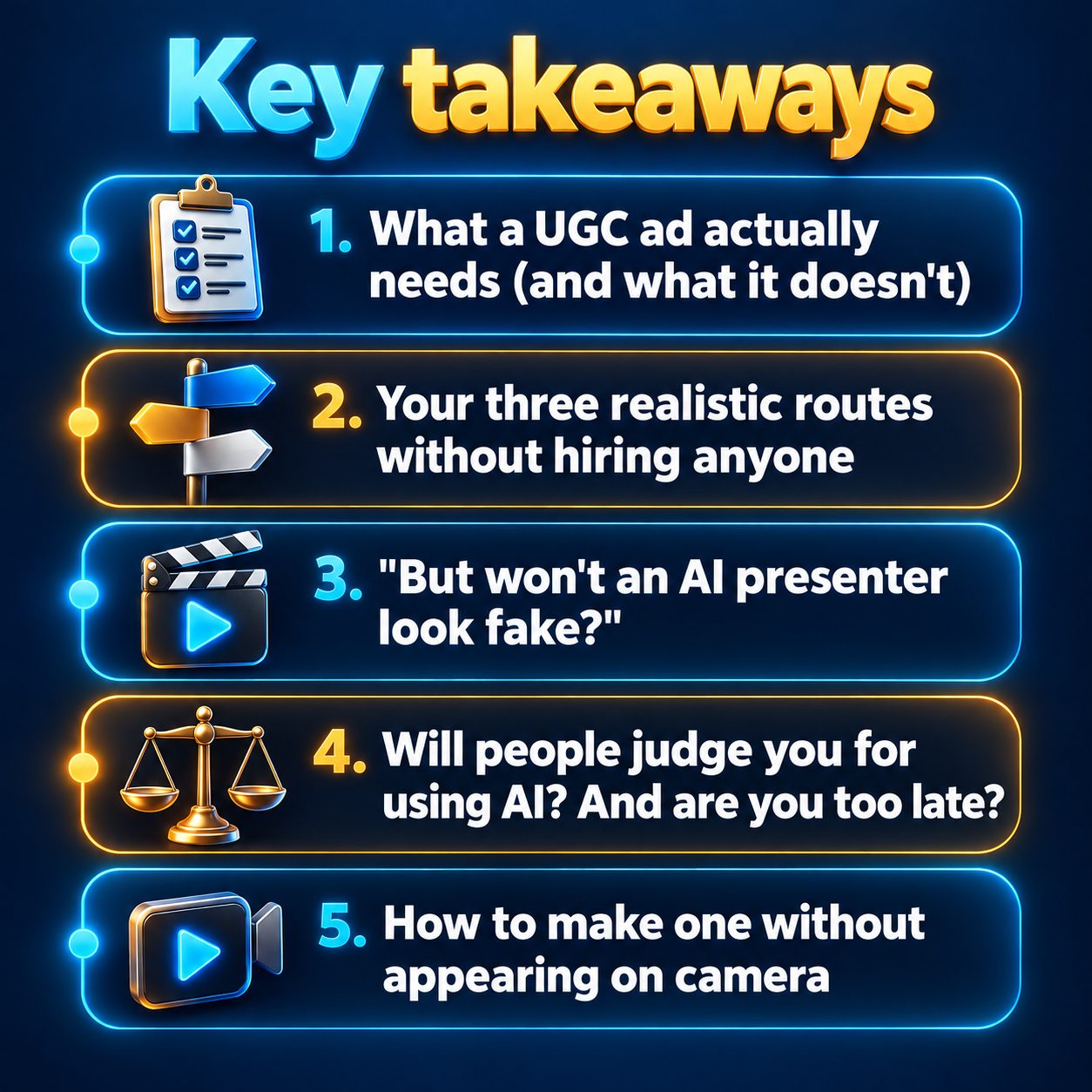
"But won't an AI presenter look fake?"
This is the honest worry, so let's not dodge it. Two years ago, yes, most AI avatars were uncanny. Today the good ones lip-sync cleanly and read with natural inflection, and viewers scrolling a feed are not studying frames. That said, AI presenters are strongest on tight, well-lit, head-and-shoulders delivery. They are weakest when you ask for big physical action or a product being physically handled in the same shot. Know that going in and you'll write scripts that play to the strength: someone talking to camera about the problem your product solves.
The other honest bit: the script matters more than the face. A perfect avatar reading a boring, salesy script converts nothing. A slightly-imperfect avatar reading a sharp, specific hook does fine. Spend your energy on the words.
Will people judge you for using AI? And are you too late?
The quiet questions. First, judgement: your customers care whether the product fixes their problem, not which software rendered the ad. Faceless and AI-fronted ads run across every platform right now and most viewers never think about it. Second, too late: no. Ad accounts reward testing volume, and testing volume is precisely what a manual, film-it-yourself approach can't give you. Being able to ship ten variants a week when your competitor ships one is the advantage, and that door is open today, not closed.
The real cost isn't judgement. It's the ad you didn't test because making it felt like a production.
How to make one without appearing on camera
Here's the concrete workflow. Whatever tool you use, the steps are: write a hook-first script, choose a presenter, generate the voice and video, review, publish.
Inside MaqtAi, this is a specific format called a presenter ad. You pick a stock presenter (there are Middle Eastern and hijabi options alongside the usual set) and it renders on the standard presenter engine with a fixed six-scene structure built for short product pitches. Because the structure is fixed, there's no scene-count fiddling to get wrong, though you do pick a length of 30, 60 or 120 seconds. You give it the topic and script, it handles the talking, lip-synced delivery, captions, and assembly into a vertical video.
If you'd rather the presenter be you without filming each ad, Clone Studio lets you record about 25 seconds of guided reading to clone your voice and upload one clear head-and-shoulders photo, with explicit consent. It needs an active subscription, and after that your clone can front ads without you setting up a camera again. There's also a voice-only mode if you want your cloned voice narrating but not a face on screen.
One honest note on cost: the talking presenter is off on free accounts, so a presenter ad needs a paid plan. Free-tier videos default to stills with pan-and-zoom motion and always carry a watermark, though you can switch AI motion on and pay its real price. So the fully-lip-synced presenter ad is a paid feature, while the free credits are enough to learn the wizard and build regular faceless product videos first.
Where these can post, and the limits worth knowing
Before you build a hundred, know where they land. Auto-publishing goes to TikTok, Instagram Reels, and YouTube Shorts, and publishing to any platform needs an active subscription. YouTube Shorts publishes directly. TikTok also publishes directly and publicly, with a visibility level you pick before posting; sending a draft to your TikTok inbox is an option rather than the normal route. Instagram Reels needs a Business or Creator account linked to a Facebook Page. One real limit: Autopilot can't post to TikTok automatically yet, so a TikTok destination waits in the approval queue. If you plan to run these as paid ads rather than organic posts, you'll download the video and upload it into your ad manager the normal way. You own every video you generate and can use it commercially.
Start with one, not a campaign
The expensive move here is staying stuck deciding. Every week you spend debating whether AI presenters are "good enough" is a week your ad account has no test data and your competitor is shipping. You don't need a plan or a budget to find out. You need one script and one afternoon.
So make one. Verify your email to get 450 free credits, which is about three to four videos on the still-frame Express tier, and build your first faceless product video to see how the script and voice land before you touch the paid presenter engine. Each render takes a few minutes, and if one ever fails, the credits come back automatically. One video today beats a perfect campaign you never start.
Winning ad creative is a volume game. MaqtAi turns a product photo or link into UGC-style presenter ads, with the script, presenter, and captions handled for you, ready for TikTok or Reels. Presenter ads use the talking presenter, which is on the paid plans. Verify your email for 450 free credits and start with faceless videos, no card needed.
Start freeFrequently asked questions
Do I need to be on camera at all? No. You can use a stock AI presenter that reads your script and lip-syncs, so no filming and no face of your own is required. If you want your own likeness later, Clone Studio can do that on a paid plan from one photo and a short voice recording, with consent.
Can I use these videos as paid ads, not just organic posts? Yes. You own the videos you generate and can use them commercially on your own channels. For paid campaigns you download the finished vertical video and upload it into your ad platform the usual way.
Why doesn't the price change when I switch quality on a presenter ad? Because presenter ads always render on the standard presenter engine with a fixed six-scene structure. There's no quality tier to change, only a length pick of 30, 60 or 120 seconds, so the cost stays fixed by design. Nothing is broken and you're not overcharged.
How much does one presenter ad cost to make? Every video draws from your credit balance, and the talking presenter is a paid feature off on free accounts. New accounts get free credits to build regular faceless videos first, so you can learn the workflow before spending on presenter renders.
Results vary, and nothing here is a guarantee of income or ad performance.