
You do not need crime scene footage
This is the first thing that stops people. True crime on YouTube and TikTok looks like it requires archival photos, courtroom sketches, police bodycam clips, and a narrator with a voice built for cable TV. Professional channels spend hours sourcing that material and clearing rights.
But the most-watched true crime shorts are not mini documentaries. They are atmosphere-driven storytelling. Dark visuals, a tense voiceover, animated captions pulling viewers through each line. The audience's imagination does the heavy lifting. That is exactly why faceless true crime works so well in short form: moody AI-generated visuals set the tone without you needing a single real photograph.
No face. No mic. No footage licensing headaches.
If you have ever retold a creepy unsolved case in a group chat, you already have the core skill. The rest is production, and production is the part you can hand off entirely.
Where to find stories that hook a viewer in three seconds
You are not breaking news. You are retelling public-record cases in a way that grabs someone mid-scroll. Good sources:
- Wikipedia's unsolved-death and cold-case lists. Hundreds of cases, fully public, with enough detail for a short script.
- Court records and press archives. Published news stories are fair game to retell in your own words.
- True crime subreddits and podcasts. Use these for inspiration on which cases resonate, then research the primary sources so your script is original.
- Historical crimes. Older cases are fascinating and carry less sensitivity around ongoing investigations.
The golden rule: never treat a victim's story as clickbait. Retell with respect, stick to verified facts, and add context. Audiences can tell the difference between a creator who cares about the case and one farming views.
One short equals one case, one angle, one unanswered question. "Who killed Jane Doe?" is a hook. "Here are five random unsolved murders" is not.
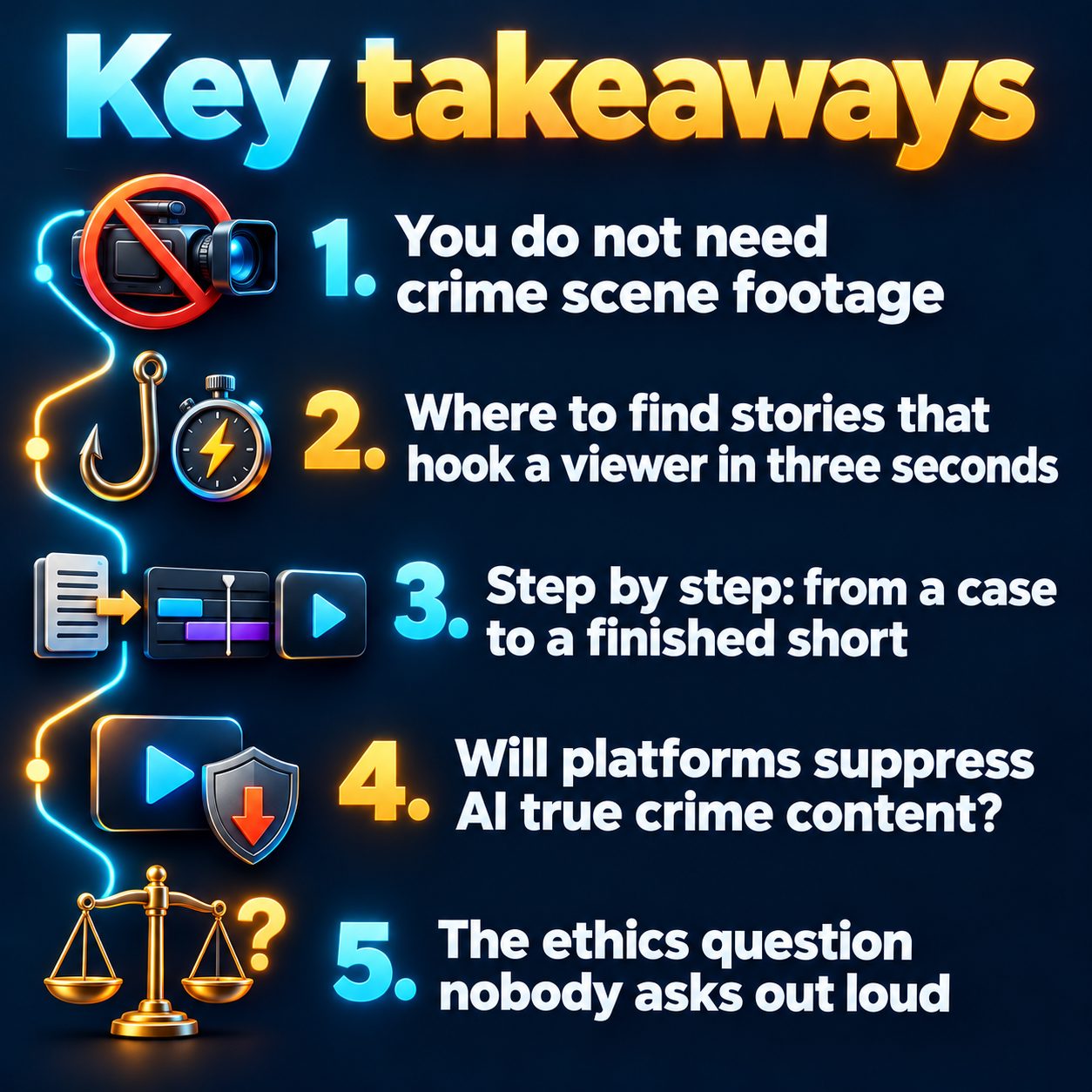
Step by step: from a case to a finished short
Here is the actual workflow:
- Pick a case. Choose one with a clear mystery, twist, or unresolved question.
- Write a hook-first script. Your opening line is everything. "In 1996, a locked hotel room held a body, a gun, and zero answers" beats "Today we are going to talk about a case from Norway." Keep the narration tight and cut anything that does not move the story forward.
- Set the visual tone. True crime works best with dark, cinematic imagery. Fog, empty hallways, rain on windows. You do not need real locations.
- Add a tense voiceover. A steady, slightly lower-pitched narrator sells the mood better than dramatic screaming.
- Layer captions. Animated captions keep viewers reading even with sound off, which is how most people first encounter shorts in their feed.
- Post consistently. One short a day gives the algorithm the most data to figure out who your audience is.
If doing all six steps yourself sounds like a full-time job, that is because it nearly is. The case selection and scripting are where your creative judgment matters. The voiceover recording, visual creation, caption syncing, and publishing are mechanical. Those are the parts worth automating.
Will platforms suppress AI true crime content?
Two concerns live here, and they deserve separate answers.
Does AI content get suppressed? No. TikTok, Instagram, YouTube, and Facebook rank shorts by watch time, completion rate, likes, and shares. They do not scan for AI production and penalize you. What does hurt reach: posting identical files across many accounts, weak opening hooks, or skipping a platform's AI-disclosure label for realistic synthetic media. The disclosure label itself does not reduce distribution; skipping it risks removal.
Does true crime content get restricted? Some platforms limit graphic or sensationalized violence in recommendations. The fix is straightforward: do not show gore, do not glorify criminals, do not exploit victims. Thoughtful true crime that focuses on the mystery rather than the violence performs extremely well in short form because it triggers curiosity. Curiosity drives completion rates. Completion rates drive reach.
Be honest about limits, too. If you mass-produce nearly identical videos with recycled scripts, viewers scroll past. The algorithm follows viewer behavior. Lazy content gets lazy results regardless of the niche.
The ethics question nobody asks out loud
"Is it okay to use AI to tell stories about real victims?"
Fair question. Here is my honest take: the ethics live in how you tell the story, not what tools produce it. A lazily written video that sensationalizes a murder for clicks is disrespectful whether a human or an AI read the narration. A carefully scripted short that brings attention to an unsolved case and treats the victim with dignity is valuable either way.
What matters: get the facts right. Do not invent details. Name your sources when possible. Never pretend you have inside information you do not have. That standard applies to every true crime creator.
And if you are wondering whether you are "too late," you are not. True crime is one of the most consistently searched niches across every short-form platform. New cases surface constantly. Old cases get rediscovered by new audiences. The channel that does not exist yet cannot compete with the one that starts posting this week.
Stop planning and post your first short
Here is what waiting actually costs you. Every day without a video is a day the algorithm has zero data about your channel. It does not know who likes your content because there is no content to like. Your future audience is watching someone else's true crime short right now. That creator is not more talented than you. They just started.
The smallest possible step: pick one unsolved case, write a hook, and make a single short. MaqtAi's true crime niche handles the voiceover, visuals, motion, and captions from your topic. You review it, tweak anything you want, and publish. The three-step workflow takes minutes, not hours. New accounts get free credits when you verify your email, enough to produce your first few videos with no card required. See what the free credits cover.
Your first video will not be perfect. Nobody's is. But it will be posted. And posted beats planned every single time.
Doing this by hand is the part most people quit at. MaqtAi writes the script, narrates it, generates the visuals and captions, and assembles the faceless short for you. Verify your email and you get 450 free credits: about 3 videos on the still-frame tier, or one with AI motion. Free renders carry a watermark.
Try it on your niche freeFrequently asked questions
Can I monetize a true crime shorts channel? Yes, you own the videos you create and can monetize them on your channels. Be aware that YouTube's policies warn against mass-produced repetitious AI content, so keep each video distinct and well-scripted.
How often should I post true crime shorts? Daily posting gives the algorithm the most signal to work with and builds your library fastest. If daily feels like too much, three times a week is a strong starting cadence. Consistency matters more than raw volume. MaqtAi's Autopilot and scheduling can hold that pace for you once you build a topic queue.
Do I need to credit sources in my shorts? Platforms do not require citations in short-form video. But mentioning "according to police records" or "as reported by" a named outlet adds credibility and signals to viewers that you did real research.
What if a victim's family asks me to remove a video? Take it down. No view count is worth causing additional pain. The creators who build lasting channels in true crime are the ones who treat every case like it involves real people, because it does.
Results vary. Nothing in this article is a guarantee of income or specific performance.