
"I'm not a storyteller" is the wrong worry
Most people who search this picture the classic story time creator: someone talking to the camera, reacting, doing voices. That's one format. The faceless version works differently, and honestly, it's more forgiving.
Nobody stays for your delivery in a narrated story that lasts under a minute. They stay because they need to know what happens next. That comes from structure. Talent has very little to do with it, and you can learn structure in an evening. You've probably told a friend about the weirdest thing that happened at your last job and heard them say "wait, then what?" If so, you already have the instinct. The rest is cutting.
Where your stories come from (and the Reddit trap)
Most guides skip this part. It's also where channels quietly get into trouble.
A lot of story time content is Reddit posts read aloud over gameplay footage. It's easy, and that's exactly the problem. Those posts belong to the people who wrote them. YouTube's channel monetization policies flag reused and repetitive content, and a channel built mostly on other people's text read by a voice is a likely target. You might get views. You might not get paid, and you're building on something you don't own.
Better sources:
- Your own life and your friends' lives, retold with names and details changed.
- Public domain folklore, myths and old ghost stories. Centuries of material, free to retell in your own words.
- Original fiction in a repeatable frame. "The babysitter finds a note" or "the customer who came back" can run as a series for a long time.
- Real events from history or true crime, sourced and told with care. The people in them were real. Don't turn them into a punchline.
Pick one lane. A channel that mixes horror, workplace drama and fairy tales confuses the viewer and the algorithm.
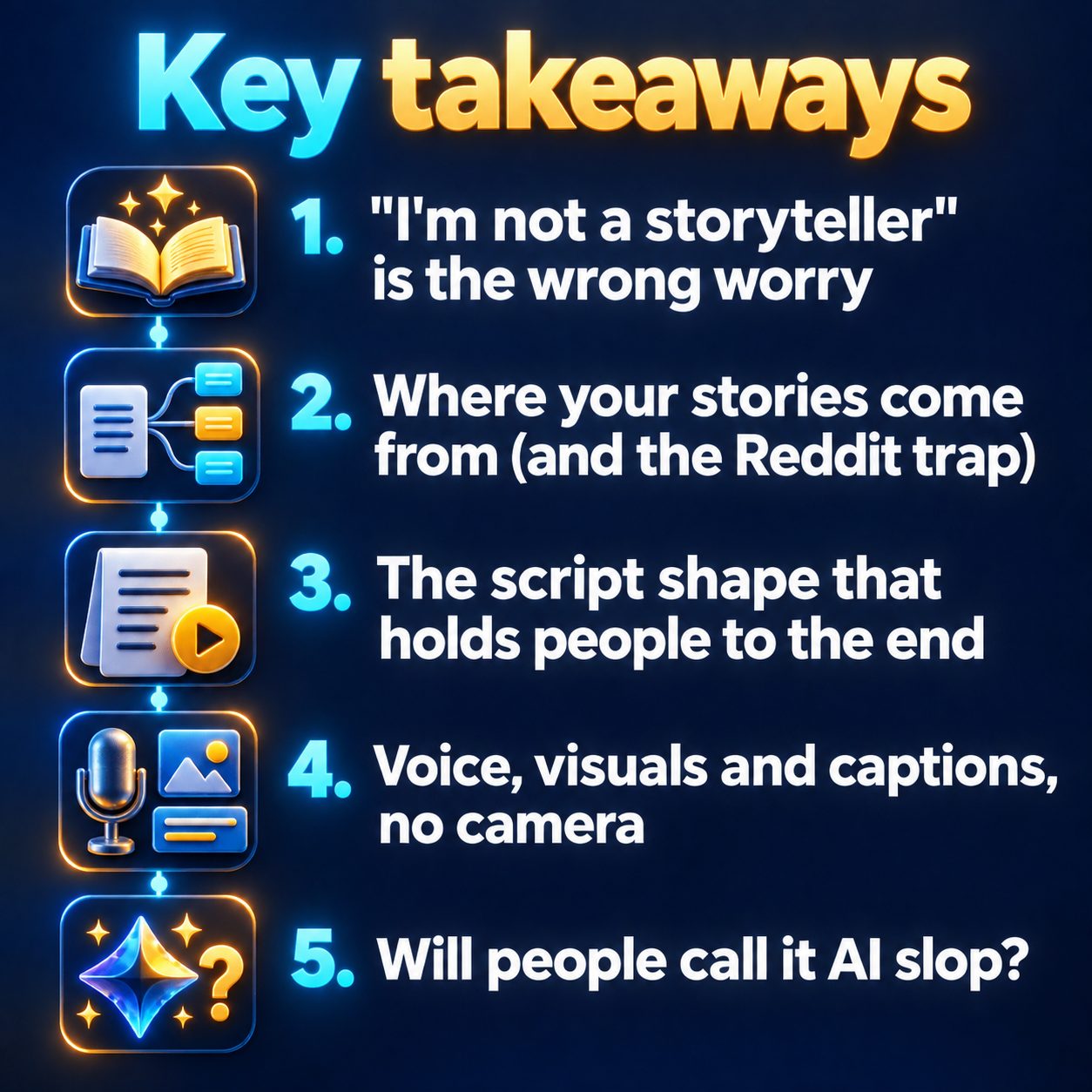
The script shape that holds people to the end
Short-form story time lives or dies in the first line. Don't start at the beginning of the story. Start at the moment that stops the scroll.
Weak: "So last summer I got a job at a hotel." Strong: "The guest in the corner room asked me never to clean under the bed."
Then follow this shape:
- The hook. The strangest, tensest or funniest moment, said plainly.
- The setup. Just enough context to care. A sentence or two, not a backstory.
- The turn. The thing that changes everything. This is where you earn the watch.
- The payoff. Resolve it, or end on the one line that makes people comment.
Aim for 30 to 60 seconds of narration. Read it out loud. If a sentence doesn't push toward the turn, cut it, even the ones you love. Comedy needs the biggest laugh last. Horror needs the quietest line right before the reveal.
Voice, visuals and captions, no camera
Here's how the faceless version comes together.
Voice. A calm AI narrator with a slightly low register suits most stories. Test a few. Horror wants slow and close. Comedy wants a little deadpan. Speed matters more than people expect. A narrator running a touch slower than default often sounds more like a person leaning in to tell you something.
Visuals. Stock gameplay loops are everywhere now, which is a good reason to skip them. Scenes that actually match the story (the hallway, the note, the face in the window) keep eyes on the screen and make your channel recognizable.
Captions. Non-negotiable. Plenty of people watch on mute, and short animated caption chunks let them read along. Keep them big, centered and readable.
Sound. Less than you'd think. A quiet ambience can help horror. A clean voice is usually better for comedy.
Will people call it AI slop?
Fair worry. Here's the honest picture.
No major platform pushes a video down just because AI made it. TikTok, Reels and Shorts rank videos on what viewers do with them: whether people watch to the end, rewatch, share or comment. What gets punished is the slop pattern. The same template gets mass-posted with weak openings, or near-identical videos go out with a few words swapped. Viewers notice that too.
The story is what separates a real channel from slop. You need a fresh idea, a hook that works and a payoff that lands. AI can speed up the making. It can't give you taste, and it can't decide which story is worth telling. That part stays yours.
Two practical rules. If your visuals look like realistic footage of real people, use the platform's AI disclosure setting. The label doesn't hurt reach, but skipping it can get the video removed. And if you present a story as true, make sure it is, or say it's fiction.
As for strangers judging you, the audience came for the story. Most viewers never think about how a video was made unless it gives them a reason to.
Running out of stories, losing steam, being "too late"
There are two questions people think but never type. What if I run out of stories? And what if I quit after two weeks?
You fix running out with a format. A recurring frame like "things guests left behind" or "my grandmother's village stories" turns one idea into a series, and series are what make people follow.
Quitting is the real channel killer. The algorithm doesn't punish you for it. The problem is that you need a stack of videos before you can learn which hooks work. Post 1/day if you can, three times a week if you can't, and only judge the channel after week 4.
Too late? Stories don't saturate the way a trend does, because people always want the next one. Only the lazy version is crowded.
This is the stage where a tool earns its place. With MaqtAi, you pick a niche and a topic. Scary stories, comic stories, true crime and bedtime stories are among the built-in niches. It writes a script that opens on a hook, narrates it, generates visuals with real motion, adds animated captions and assembles a vertical video, typically in about 6 minutes. If you wrote the story yourself, paste it and it's used word for word. A "Make it funny" switch retells any topic as comedy. On a paid plan, Autopilot can work through a topic queue on a schedule you choose. The honest limit: it won't find your stories, and nothing in it reads trends. Choosing the story is still your job.
What waiting actually costs
Every week you spend deciding is a week where nothing builds up. You have no videos, no data on which openings hold people, and no early followers telling you what they want next. Meanwhile, someone in your exact lane posted a story today and learned something from it.
So take one small step. Write a single hook tonight, then turn it into a video. MaqtAi gives most new accounts that verify their email free credits with no card, though not every account qualifies (details on pricing). That covers a few still-frame videos or one with AI motion. Free renders carry a watermark, so treat the first one as a test. Does your story hold you to the end?
Doing this by hand is the part most people quit at. MaqtAi writes the script, narrates it, generates the visuals and captions, and assembles the faceless short for you. Verify your email and you get 450 free credits: about 3 videos on the still-frame tier, or one with AI motion. Free renders carry a watermark.
Try it on your niche freeFrequently asked questions
How long should a story time video be? For TikTok, Reels and Shorts, 30 to 60 seconds of narration is a good target. YouTube allows Shorts up to 3 minutes, but tighter stories usually hold attention better.
Is it okay to read Reddit stories in my videos? Those posts belong to their authors, and channels built mostly on reused text risk demonetization. Retell your own experiences, public domain tales or original fiction instead.
Can story time videos be monetized? They can qualify, as long as the content is original and not mass-produced or repetitive, which YouTube's monetization policies look at closely. Views alone don't guarantee payment.
Do I need to show my face or record my voice? No. A faceless story time video works with an AI narrator, matched visuals and captions, and nobody needs to see or hear you.
Results vary, and nothing here is a guarantee of views or income.