
Where does the money in Facebook Reels come from?
Most people assume Facebook automatically pays you for every view. It doesn't. Reels income comes through several doors, and each one has its own requirements.
The first door is direct payment from Meta. Open your Page's Professional Dashboard and go to the monetization section. That's where you'll see which programs are available to your specific account. Facebook calculates earnings based on how your eligible content performs, not on how many videos you post.
The second door is viewer support, like Stars. This works well once you have an audience that actually likes you, not just people scrolling past.
The third door is sponsorships. An active Page in a clear niche attracts brands that want to reach the same audience you've built.
The fourth door is your own product. That could be a service, a course, or an affiliate link. Here, Reels become a way to bring in customers.
One important tip: Meta renames its programs and changes the requirements from time to time. So don't trust any post that gives you fixed numbers. The only reliable source is the dashboard on your own account.
"My country isn't eligible, so why bother?"
This is the objection we hear most, and it's a fair one. Eligibility for direct payouts varies by country and by account. Some people see the monetization section open, and some don't see it at all.
But keep two things in mind.
First: stay away from anyone selling you a "monetization activation service." These are usually scams, and they can get your Page banned.
Second: a Page with an engaged audience is valuable even without direct payouts. Sponsorships and your own product don't care whether your country is on Meta's list.
There's also something a lot of people miss. The same vertical video works on Instagram Reels and YouTube Shorts too. And YouTube publishes its requirements clearly. The YouTube Partner Program asks for 1,000 subscribers, plus either 4,000 public watch hours in the last 12 months or 10 million Shorts views in the last 90 days. So don't put all your chips on one platform.
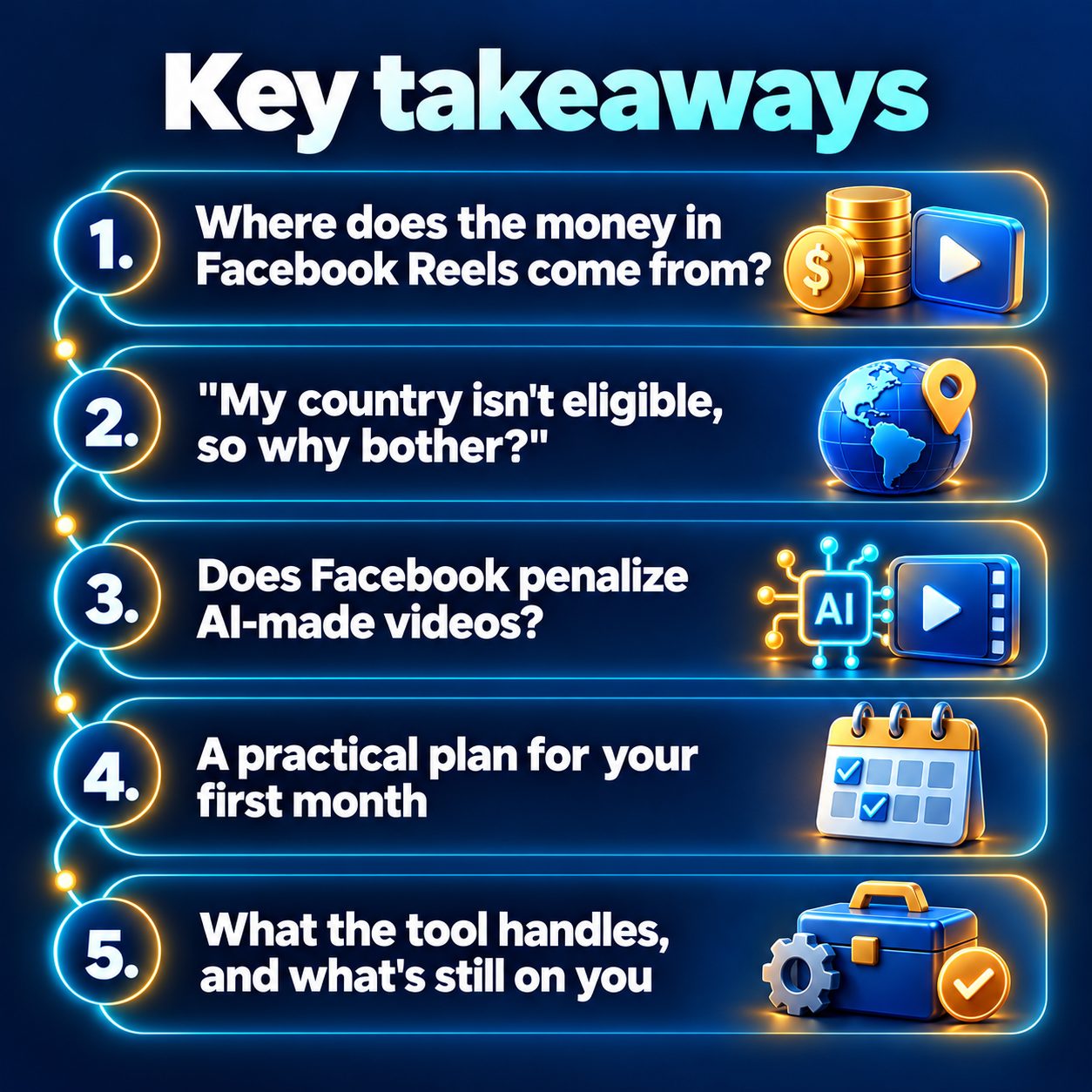
Does Facebook penalize AI-made videos?
No. No platform cuts a video's reach just because it was made with AI. Facebook ranks Reels based on viewer behavior: how many seconds people watched, whether they finished, and whether they engaged or shared.
What actually hurts your Page comes down to three things:
- Reposting clips someone else made. That's unoriginal content, and Meta clearly cracks down on it.
- Posting the same file across multiple Pages, or mass-posting near-identical videos.
- A weak opening that makes viewers swipe away in the first second.
There's one more rule. If your video shows realistic scenes generated with AI, add the AI-generated content label. The label doesn't reduce reach, but skipping it can get the video removed.
And what about the question nobody asks out loud: will people judge me? Viewers don't care about the tool. They care whether the story is fun and the information is useful. A boring video gets swiped whether a person or a program made it.
A practical plan for your first month
Step one: create a Page. Posting through third-party tools happens on a Facebook Page you manage, not on your personal profile. The Page is also where your Professional Dashboard lives.
Step two: pick one niche. Horror stories, history, Stoic motivation, and startup stories all work without showing your face. Pick a niche you can keep finding ideas for over several months. Browse niches that work for faceless channels if you're unsure.
Step three: write the first line before anything else. The first line decides whether the viewer stays. A history example: "This king lost an entire war because of one letter." Now the viewer wants to know what was in that letter.
Step four: keep the video short and complete. 30 to 60 seconds is a good length to start. Make a promise at the top, then deliver on it by the end.
Step five: choose a pace you can stick to. One video a day is ideal, but three a week, consistently, beats seven in one week followed by silence.
Weeks 1 to 4: Post at the same pace. Don't switch niches in the first two weeks. At the end of the month, open your insights. Look at completion rate, not just likes. The videos people finished tell you what they want.
What the tool handles, and what's still on you
For most people, the real problem isn't ideas. It's daily production: writing the script, recording, editing, then posting. Two weeks in, they burn out and stop.
This is exactly where MaqtAi helps. You give it a niche and a topic, and it writes the script with a strong opening line, adds an AI voiceover, generates animated scenes, and puts captions on screen. Once you connect your Page, it can post to Facebook Reels on a schedule you choose through the Autopilot feature. By default, every video waits for your approval before it goes live.
But be realistic about what the tool doesn't do:
- It doesn't read trends or pick your niche for you.
- It doesn't guarantee you'll be accepted into Facebook's monetization programs. That's Meta's call alone.
- It can't build an audience from a weak niche or a boring opening.
- Connecting accounts and auto-posting require a paid plan.
The tool only takes the production load off your plate. The views come from your niche, your first line, and your consistency.
Am I too late? And what if I quit after two weeks?
You're not too late. Reels need fresh content every day, and audiences are hungry for good original content in plenty of niches. A niche that looks crowded is usually crowded with reposted content, not original work.
The real risk isn't being late. It's stopping. So build your plan around what you can keep doing in a busy week, not a fired-up one.
And remember what waiting costs you. Every week you don't post is a week Facebook learns nothing about your audience. No data builds up, and the Page doesn't grow. Meanwhile, someone in your niche is posting every day.
Today's small step is simple: make one test video in the niche you picked. Most new accounts get free credits when they confirm their email, no card required, though not every account is eligible. Credit details are on the pricing page. Free videos carry a watermark, so treat it as a test to see the style and voice before you decide anything. There's no reason left to put off your first video.
Doing this by hand is the part most people quit at. MaqtAi writes the script, narrates it, generates the visuals and captions, and assembles the faceless short for you. Verify your email and you get 450 free credits: about 3 videos on the still-frame tier, or one with AI motion. Free renders carry a watermark.
Try it on your niche freeFrequently asked questions
Do I need a Facebook Page, or is my personal profile enough? For auto-posting through tools, you need a Page you manage. The Page is also the clearest place to track your insights and monetization tools.
Can I post the same video on Instagram and YouTube? Yes, vertical video works on Instagram Reels and YouTube Shorts. Just avoid posting the same file to multiple Pages on the same platform, because that looks like duplicate posting.
When will I start making money from Facebook Reels? There's no fixed timeline. It depends on your account and country eligibility, how consistently you post, and how strong the opening of each video is.
Do I have to disclose that a video was made with AI? If the video shows realistic AI-generated scenes, add the label Meta requires. The label doesn't reduce reach, but skipping it can get the video removed.
Results vary from person to person, and nothing in this article is a guarantee of any income.