
Why faith content works in short form, and who watches it
Islamic content suits short video better than most niches do. A single verse, one dua, or one moment from the seerah is a complete idea in 30 to 60 seconds. Viewers don't need an earlier episode for context. They need one thing to carry into their day.
So who's watching? Mostly Muslims who want a reminder in the gaps of the day: on the commute, after Fajr, while they wait in line. Reverts who want the basics without feeling judged. Young people who know the words of a dua but not what they mean. And curious non-Muslims trying to understand a neighbour. Pick one of these groups, because your choice changes your vocabulary and your pacing.
Worried you're too late? Look at what the big Islamic channels actually post. Most of it is broad reminders. There's still room for a channel that does one narrow thing well: the meanings behind daily duas, stories from Al-Andalus, or Quran reflections for reverts.
"Am I even qualified to do this?"
Most people never type this question, but it's the right one to ask. Honestly, you don't need to be a scholar. You do need to act like a careful student, not a mufti.
One rule covers it: you narrate, you don't rule. Telling the story of Yusuf from the Quran, explaining what "SubhanAllah" means word by word, or sharing a sahih hadith with its reference is narration. Answering "is this halal?" or settling a disagreement between schools of thought is a ruling, and rulings belong to people with the training. If a topic drifts that way, say so on screen: "ask a scholar you trust how this applies to you." Your audience will respect you more for it, not less.
Will some people judge you for using AI? A few might. What they're really checking is whether you're careless with the deen. Getting things right and knowing your limits answers that better than any disclaimer could.
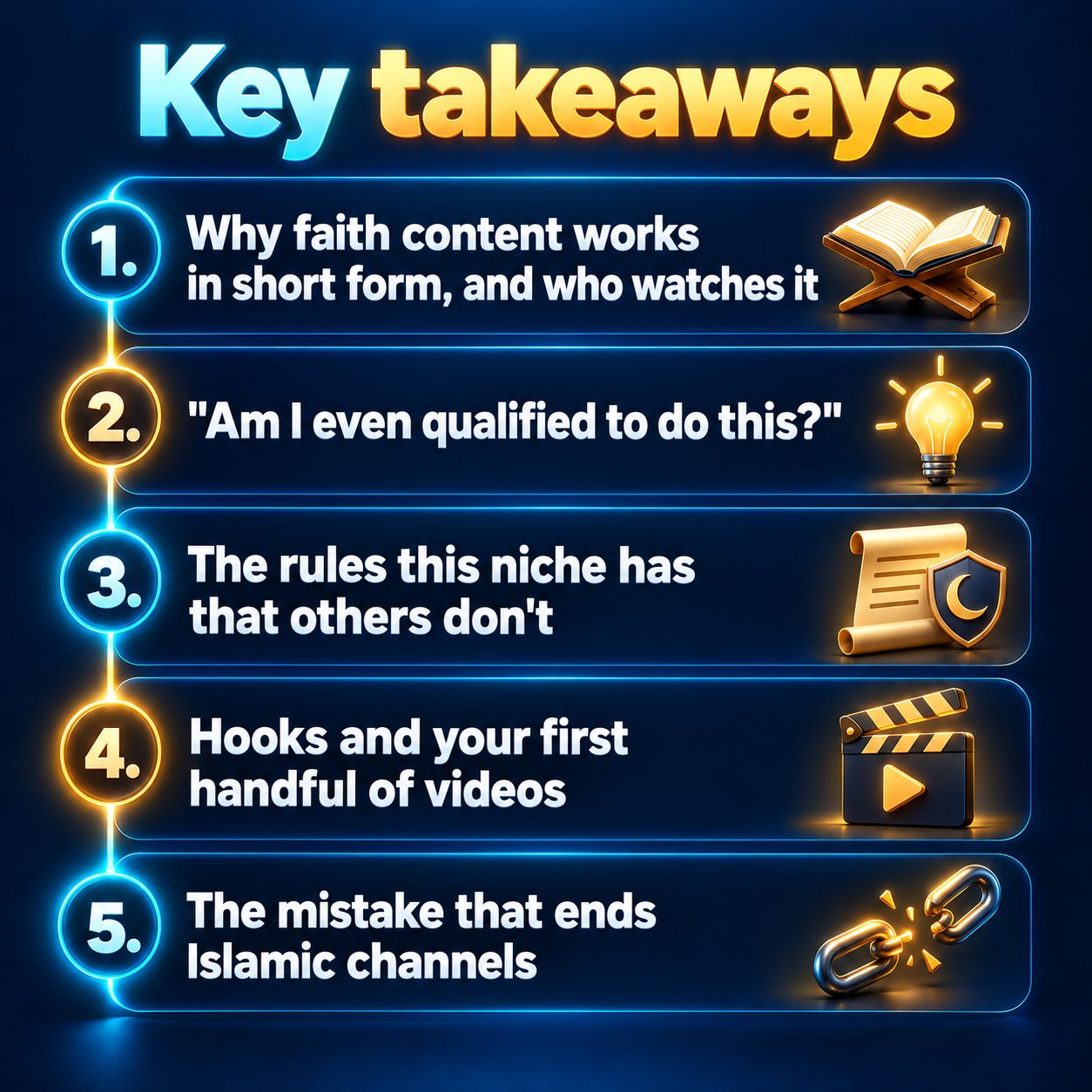
The rules this niche has that others don't
Generic channel advice will get you in trouble here. These constraints wouldn't matter for a startup stories channel. Here they're everything.
You check every verse and hadith yourself. AI script tools, good ones included, can misattribute a hadith, merge two narrations into one, or confidently quote something weak. Treat every generated script as a draft. Check verses on Quran.com and hadith on Sunnah.com, which shows the collection and the grading. If you can't find it, cut it. Then put the reference in the description.
Don't depict prophets. Most of your audience will expect no prophet to appear on screen as a face or figure, and for many viewers that goes for companions too. Tell prophet stories through scenery instead: desert at dawn, a ship on dark water, a well, lanterns, geometric patterns. Check every scene before you publish, because image generators will happily draw a robed figure if the prompt leaves them room.
Watch your audio. Many Muslim viewers avoid instrumental music. Put a trending beat under a Quran reflection and your comments fill up with an argument that has nothing to do with your video. A clean voice track keeps the focus where you want it.
Leave recitation to reciters. An AI voice explaining a verse in English is narration, but many viewers will object to AI reciting Quranic Arabic. Share the meaning, show the Arabic text if you like, and leave recitation to people.
Hooks and your first handful of videos
Fear hooks ("You commit this sin every day!") get clicks, but they cost you trust, and they bring in exactly the commenters you don't want. Faith content does better with hooks built on meaning and curiosity:
- The hidden meaning: "You say this word in every prayer. Here's what it actually means."
- The moment: "Yunus was in the dark, inside the whale, and these were his words."
- The question they already have: "Why do Muslims say Bismillah before eating?"
Use a calm voice and a slower pace than you'd hear on a motivation channel. The payoff should be a moment of reflection, not a twist.
For your first videos, choose topics that are easy to verify. That way, checking sources becomes a habit from day one:
- What "Alhamdulillah" means, word by word
- The dua of Yunus, and when people say it
- Why Muslims say Bismillah before eating
- Who was Fatima al-Fihri?
- The people of the cave, told from the Quran
- What Al-Fatiha asks for, line by line
Each of these is one idea from the Quran or a well-known sahih narration, and none of them is a ruling. Your comments will show you which lane people want more of.
The mistake that ends Islamic channels
That mistake isn't low views. It's one popular video with a fabricated or weak hadith in it. Someone knowledgeable posts a correction, likes push it to the top, and every new viewer reads it first. In most niches a factual slip is just embarrassing. Here it's a trust problem, and channels rarely recover from it.
The second thing that ends these channels is mass production. If you churn out near-identical reminders on the same template, YouTube's inauthentic content policy can demonetize you, and viewers see it as spam anyway. Mix your formats: a word meaning one day, a history story the next, then a dua.
Islamic channels join the YouTube Partner Program under the same rules as everyone else: 1,000 subscribers plus either 4,000 valid public watch hours in the last 12 months or 10 million valid public Shorts views in the last 90 days.
Keeping it going week after week
Faith channels come with a calendar built in. A Friday Al-Kahf reminder. A dua series in Ramadan. A Hajj series in Dhul Hijjah. These seasons give you planned topics before you've even sat down.
A week you can keep up looks like this: one sitting to pick topics, one to check sources and fix scripts, then the videos go out without you. Never skip the checking sitting.
This is where MaqtAi fits. It writes the script, narrates it with an AI voice, generates visuals with motion, and assembles the vertical video, so there's no filming or editing. By default the audio is voice only. If you want something underneath, there's a vocal bed with human voice only and no instruments. Narration works in 59 languages, Arabic and Urdu among them, and if you paste in a script you've already checked, it's used word for word. Autopilot can post daily, three times a week, or weekly, and by default nothing publishes until you approve it. For this niche, leave it that way.
So what does waiting cost you? Every week you don't post, someone else answers the question your viewers are typing, sometimes with a weak hadith and a scary hook. Your channel isn't collecting watch history, and you aren't learning which lane your audience wants. Here's the small step: write your first script tonight, check its sources, and turn it into a video. Most new accounts get free credits when they verify their email, with no card needed. That's enough to see your first one before you commit to anything.
Doing this by hand is the part most people quit at. MaqtAi writes the script, narrates it, generates the visuals and captions, and assembles the faceless short for you. Verify your email and you get 450 free credits: about 3 videos on the still-frame tier, or one with AI motion. Free renders carry a watermark.
Try it on your niche freeFrequently asked questions
Can I make an Islamic channel without showing my face? Yes. Faith content works well faceless because the words matter more than the presenter. Scenery, text, and a calm voice carry it.
Is it okay to use an AI voice for Islamic content? Most viewers accept AI narration that explains meanings and tells stories. Many object to AI reciting the Quran itself, so leave recitation to human reciters and ask a scholar you trust if you're unsure.
Do I need Islamic knowledge to start? Careful habits matter more than credentials. Narrate verified sources, cite them in the description, and never give rulings.
Will YouTube monetize an Islamic channel? It follows the same Partner Program rules as any other channel. Repetitive, mass-produced uploads are what get channels demonetized, not the topic.
Results vary, and nothing here is a guarantee of income.