Pick a niche you will not abandon in two weeks
This is where most people stall. They Google "best faceless YouTube niches," find a list, pick whichever one claims the highest RPM, and start making videos about a topic they do not care about.
That approach falls apart fast. Faceless channels grow on volume and consistency. You need a topic area deep enough that you can brainstorm new ideas month after month without forcing it. Scary stories, true crime, history, stoic motivation, dark psychology, startup breakdowns, sleep and relaxation content... these all work because the well of material never runs dry. You can browse common faceless niches to get a feel for what people are actually building.
Ask yourself one honest question: could you scroll through this topic for fun on a Saturday? If yes, you have a niche. If you picked it only because someone on Twitter said it pays well, you will burn out before the algorithm even learns who to show your videos to.
You do not need a camera, a mic, or editing software
The word "video" makes people assume they need a ring light, a decent microphone, and a weekend learning Premiere Pro. For faceless content, none of that applies.
A faceless video is four things combined: a script, a voiceover, visuals that move, and captions. That is it. You never record yourself. You never film anything.
Today, AI handles every layer. You can generate a script from a topic, narrate it with a realistic AI voice, create matching visuals with actual motion (not just static images with a slow zoom), and add animated captions automatically. The technical barrier that existed a couple of years ago is mostly gone.
Your job becomes creative direction. Choose the topic, review the output, decide if it hits, and publish. Think of yourself as the editor-in-chief, not the camera operator.
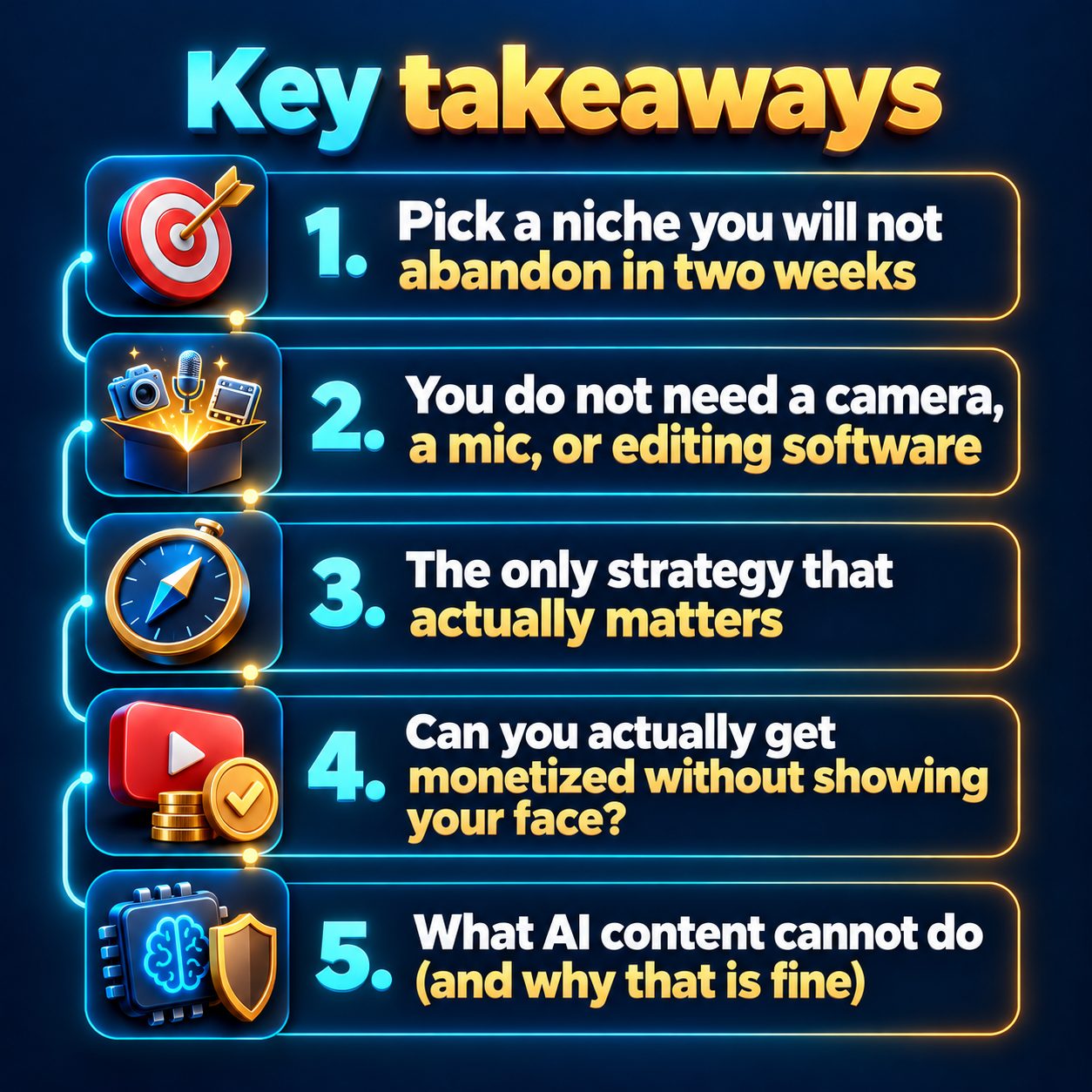
The only strategy that actually matters
Here is the part nobody wants to hear: the strategy is consistency.
Not a special hashtag trick. Not a secret posting time. Not a viral hook formula. Consistency.
Short-form platforms like YouTube Shorts, TikTok, and Instagram Reels are recommendation engines. They need data about your content to figure out who wants to see it. Every video you post gives the algorithm more signal. The more signal, the better it gets at matching your videos with the right viewers.
Creators who post a handful of videos, check their analytics, see low view counts, and decide "it does not work" are quitting before the system had a chance to learn. The ones who grow are the ones who kept publishing through those early quiet weeks.
This is also why faceless channels have a structural advantage. Because you are not filming, not editing manually, and not building up the courage to get on camera, you can publish far more often. Daily posting becomes realistic when each video takes minutes to produce instead of hours.
Can you actually get monetized without showing your face?
Yes. YouTube does not care whether your face is in the video. It cares whether viewers watch, engage, and come back.
To join the YouTube Partner Program, you need either 1,000 subscribers plus 4,000 public watch hours in the past 12 months, or 1,000 subscribers plus 10 million public Shorts views in 90 days. Faceless channels meet these thresholds regularly. Entire genres like Reddit story channels, history compilations, and motivation reels are built without a single face on screen.
Beyond ad revenue, faceless channels can earn through affiliate links in descriptions, digital product sales, and sponsorships. Nobody offering you a brand deal cares that you used AI visuals. They care about your audience size and engagement.
One honest note: reaching monetization takes real time. Do not expect to earn anything meaningful in your first few months. Treat the early period as skill-building and audience-building. Revenue follows consistency, not the other way around.
What AI content cannot do (and why that is fine)
You might worry that AI-generated videos will feel generic or get flagged. That concern is fair, and being honest about limits actually helps you make better content.
AI is excellent at production. It generates clean scripts, natural-sounding voiceovers, visually interesting scenes, and properly timed captions. What it cannot do on its own is bring your unique perspective. Two creators using the same AI tool on the same topic will get different results only if they bring different angles, opinions, or niche knowledge.
Your edge is curation and taste. Which topics do you pick? What angle do you take? Which videos do you choose not to publish? The creators who treat AI as a production assistant and themselves as the creative brain are the ones making content that stands out.
YouTube has publicly stated that AI-generated content is allowed as long as it follows community guidelines. You are not breaking any rules. You are using modern tools.
Your first video could be done this afternoon
If you have read this far, you already know enough to start. The remaining gap between you and a published video is just doing it.
Tools like MaqtAi exist specifically for this workflow. You pick a niche and a topic, and the AI generates the script, voiceover, visuals with real motion, and animated captions, then assembles everything into a vertical video ready for YouTube Shorts, TikTok, or Instagram Reels. You can review and tweak every scene before it goes live, or set it to auto-publish on a schedule.
New users get free credits just for verifying their email, enough for a few videos, no card required. That means you can go from "thinking about it" to "my first Short is live" in a single sitting.
The most expensive thing you can do right now is keep researching. Every day without a published video is a day the algorithm has zero data about your channel. People are starting faceless channels in your niche right now. You do not need the perfect topic, the perfect script, or the perfect thumbnail. You need a first video. Make it free today, learn from what happens, and make the next one better.
Doing this by hand is the part most people quit at. MaqtAi writes the script, narrates it, generates the visuals and captions, and assembles the faceless short for you. Verify your email and you get 450 free credits: about 3 videos on the still-frame tier, or one with AI motion. Free renders carry a watermark.
Try it on your niche freeFrequently asked questions
Is it too late to start a faceless YouTube channel? No. Short-form video consumption is still growing, and YouTube Shorts continues to expand its recommendation reach. New channels surface every day because the algorithm rewards content quality and viewer engagement, not account age.
Do I need to post every single day? Daily posting helps, but it is not mandatory. What matters is a cadence you can actually sustain. Three times a week, consistently, beats seven days of posting followed by three weeks of silence. AI production tools make higher frequency realistic without burnout.
Will YouTube penalize AI-generated content? No. YouTube's guidelines on AI content allow it as long as it follows community standards. You do need to disclose altered or synthetic content in certain cases (like realistic depictions of real events), but standard faceless videos using AI voiceover and visuals are completely within the rules.
Do I own the videos I make with AI tools? With MaqtAi, yes. Videos you generate are yours to post, monetize, and use commercially on your own channels. Always check the terms of any tool you use, but ownership of your output is standard.
Results vary. Nothing in this article is a guarantee of income.