Why most AI story videos get scrolled past
Here's the fear, and it's fair: you've seen plenty of AI story videos that feel flat, and you figure yours will be one more. But the AI usually isn't the problem. The problem is that the story starts too slowly.
"Once upon a time, in a small village..." is where viewers swipe. Short-form rewards stories that start in the middle of the action. Compare these two openings:
- "There was a woman who lived alone in an old house."
- "She lived alone, so she didn't understand why the baby monitor was still picking up breathing."
The second one opens a question the viewer needs answered. That's the whole trick. Platforms rank shorts on how people behave while they watch: how long they stay, whether they finish, whether they share. None of them push a video down just because AI made it. A story that holds attention gets shown to more people. A story that wanders doesn't, whether a human or a model wrote it.
So the structure that works is simple. The hook comes in the first sentence. The middle builds tension and pays it off. The ending lands in a single line, ideally one that makes people want to watch again or scroll to your next one.
Pick a story lane you could fill for months
"Storytelling" isn't a niche. It's a whole shelf of genres, and each one has its own rules.
- Scary stories live on dread. Slow narration, a quiet build, one sharp turn at the end.
- History stories live on the surprising detail. They also need accuracy, because history viewers will correct you in the comments, and they'll be right.
- True crime needs sourcing and taste. These are real people, sometimes real victims. Skip the gore, stick to documented facts, and never make up details to make a case juicier.
- Comic stories need timing. The punchline has to land in the last beat, not somewhere in the middle.
- Bedtime and sleep stories flip every rule above. No loud hooks and no cliffhangers. You want calm pacing and a soft voice, because the point is that people drift off.
- Startup and business stories work best when they focus on one decision: the moment a founder chose something odd, and what came of it.
Here's a quick test before you commit. Can you list a couple dozen story ideas in this lane right now, off the top of your head? If yes, you've got a channel. If you run dry after five, pick a different lane. You can browse more story niches on the use cases page.
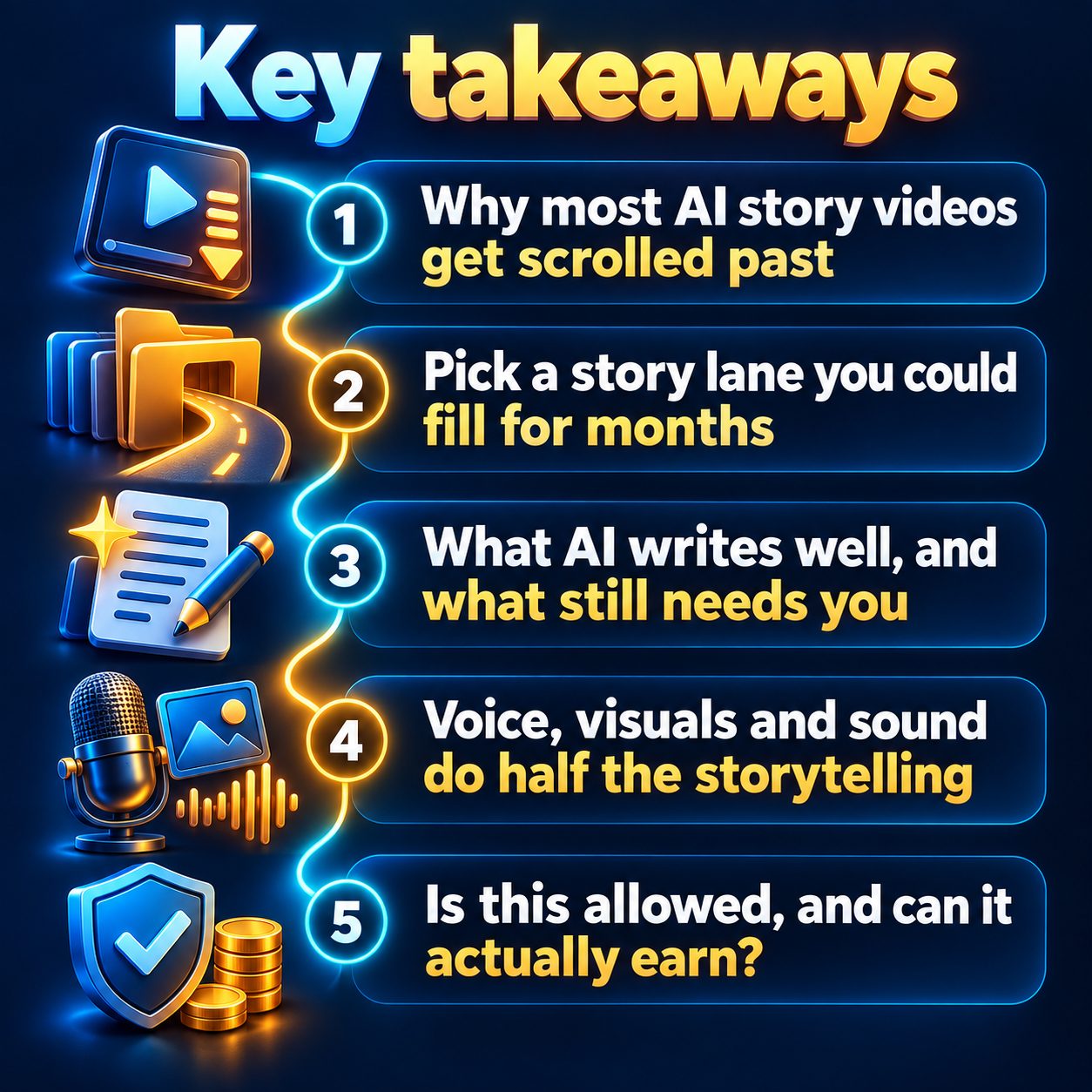
What AI writes well, and what still needs you
Here's the honest version, because I'm not selling you magic. AI is great at drafting fast, keeping a consistent structure and never getting tired. It struggles in three places:
- Twists. It likes to play it safe. If the ending feels predictable, rewrite that last line yourself.
- Facts. For history and true crime, check names, dates and places against a real source. A model can say something false with total confidence.
- Sameness. Make a lot of videos and the phrasing starts repeating. Read your scripts side by side now and then, and cut the phrases that keep coming back.
If you already have a story you love, write it yourself and let the tool handle the production. That's often where the best channels end up: a human picks the stories and AI does the grind.
Voice, visuals and sound do half the storytelling
The same script can feel gripping or dead depending on how it sounds and moves.
Voice: match it to the genre. A deeper, slower narrator for horror. Something warm and even for sleep content. A bit of energy for comic stories. Slow the speed down for dread and nudge it up for comedy.
Visuals: use real motion. A slideshow of still images reads as low effort, and viewers feel it within seconds. Scenes that move keep the eye busy while the voice carries the plot.
Captions: animated captions matter because plenty of people scroll with the sound off. Captions let those viewers follow the story anyway.
Sound: a quiet ambient bed adds more than you'd expect. Wind and creaking floors for scary stories, a room tone for history. Keep it low enough that it never fights the narrator.
Is this allowed, and can it actually earn?
Yes, it's allowed. TikTok, Instagram, YouTube and Facebook all host AI-narrated story channels. The one rule to respect is disclosure. If your visuals are realistic enough to pass as real footage, use the platform's AI label. The label itself doesn't reduce reach, but skipping it can get a video removed.
On money, be realistic. The YouTube Partner Program requires 1,000 subscribers, plus either 4,000 valid public watch hours in the last 12 months or 10 million valid public Shorts views in the last 90 days. YouTube also demonetizes content that's mass-produced and repetitive. The fix is to make each story genuinely different: a new plot, a new twist, a new angle. Don't post the same template over and over with the names swapped. Shorts need to be vertical or square and up to 3 minutes long, which leaves plenty of room for a full story arc.
The questions you're not typing
"Will people judge me for using AI?" Viewers judge boring. They rarely care how a good story got made, and on a faceless channel nobody's even looking at you.
"Am I too late?" Stories never run out, and new viewers show up every day looking for them. A channel that starts today with better hooks beats one that started years ago and stopped trying.
"What if I quit after two weeks?" Most people do, and not from lack of talent. Producing every video by hand wears them out. So set it up so your consistency doesn't rely on motivation: write a batch of topics at once, then let the schedule carry you through the weeks when you don't feel like it.
This is where a tool like MaqtAi fits in. You give it a niche and a topic. It writes the script with a hook-first structure, narrates it with an AI voice, generates and animates the visuals, adds animated captions and assembles a vertical video, typically in about six minutes. You can edit any line or paste your own story word for word. If you want the schedule to run itself, Autopilot and auto-publishing work from a topic queue, and by default nothing goes out until you approve it.
Here's what waiting actually costs. Every week you don't post is a week without data on which hooks work for your audience, while someone in your lane is posting daily and learning faster. You don't need a full plan to start. You need one story. Pick the one you'd tell a friend tonight, turn it into your first video, and see how it feels. Verifying your email gets you free credits, and there's no card involved, so the first one costs you an afternoon and nothing else.
Doing this by hand is the part most people quit at. MaqtAi writes the script, narrates it, generates the visuals and captions, and assembles the faceless short for you. Verify your email and you get 450 free credits: about 3 videos on the still-frame tier, or one with AI motion. Free renders carry a watermark.
Try it on your niche freeFrequently asked questions
How long should an AI storytelling video be? For most story channels, 30 to 60 seconds is the sweet spot for a single tight arc. Shorts can run up to 3 minutes, but only go longer if the story truly needs the room.
Can I use my own story instead of an AI-written one? Yes. You can paste your own script and it's used word for word, so the AI only handles the voice, visuals and captions.
Do AI story videos get less reach? No platform down-ranks a video just for being AI-made. Reach depends on watch time and completion, so the hook and pacing matter far more than how the video was produced.
Which story niche is easiest for beginners? Scary stories and comic stories are forgiving because they don't need fact-checking. History and true crime can do well too, but they need accurate sourcing.
Results vary, and nothing here is a guarantee of views or income.