
A series is a promise, not a playlist
Random uploads make the viewer re-decide every time whether you are worth watching. A series makes one promise and keeps it, so the second video is an easier yes than the first.
Three things to lock before you make anything:
The spine. The one question every episode answers. "What happened to this town's missing person?" "What did this founder get wrong?" "One Stoic idea, in plain words." If you cannot write the question in a single line, you do not have a series yet, you have a topic.
The shape. Length, aspect ratio, how you open, how you close. Same every time. YouTube classifies uploads automatically: vertical or square up to 3 minutes becomes a Short, 16:9 or anything longer becomes a regular video (YouTube's own explainer). Pick one and stay there for the whole run. Mixing shapes mid-series confuses both the audience and your own sense of whether it is working.
The tell. A recurring element viewers can recognize in a feed: a title pattern, an opening line, a numbered episode tag. It costs nothing and it is what turns a scroll into "oh, this channel again."
One format note worth knowing before you commit. Regular 16:9 videos typically earn far more ad revenue per view than Shorts, and the long-form Partner Program path (1,000 subscribers plus 4,000 valid public watch hours in 12 months) is documented here. Shorts are faster to make and easier to test. Many people run the vertical series first, then rebuild the best episodes as longer videos once they know which spine holds attention.
"My niche is too narrow for a whole series"
Usually the opposite is true. Narrow spines produce more episodes, not fewer, because the constraint does the thinking for you.
Test it like this: sit down and write episode titles until you run dry. If a spine gives you fewer than about twenty before you stall, it is a video idea, not a series. If it gives you more than you can count, you have your channel.
Broad spine: "history facts." Where do you even start on a Tuesday? Narrow spine: "objects found in shipwrecks, one per episode." Every episode writes its own brief. Same for "scams that ran for years before anyone noticed" or "one psychology bias, one real situation." You can browse the way different faceless niches tend to structure themselves if your spine is not landing.
And narrow does not mean small. The audience for a specific thing is easier for the algorithm to find than the audience for everything.
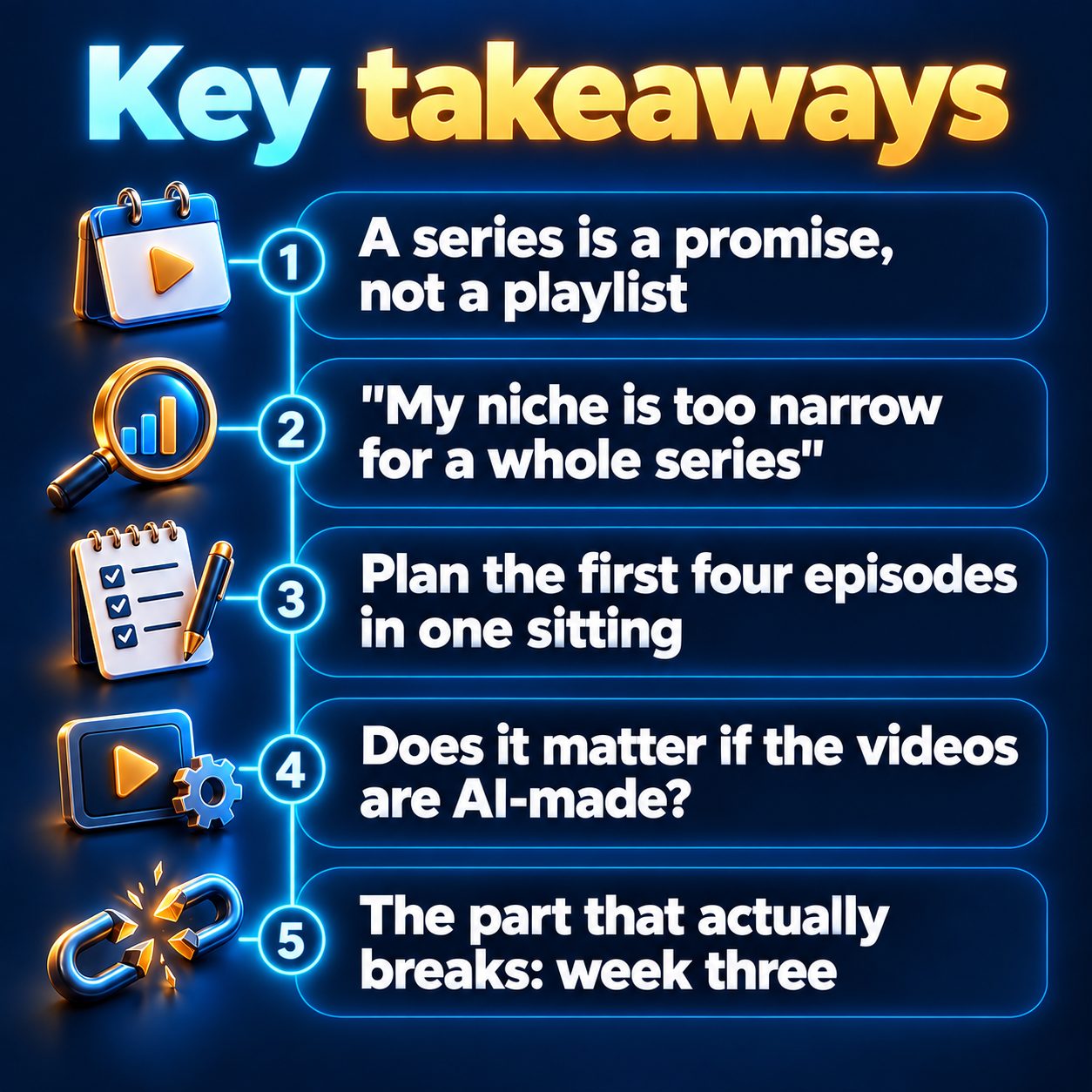
Plan the first four episodes in one sitting
Do not plan a whole season. Plan four, then judge.
- Write four titles that are clearly the same series. If a stranger read them in a list, they should see the pattern instantly.
- Write only the first eight seconds of each. The hook carries a short video more than the rest of the script does. Say the promise or the surprise immediately. No "in this video we will explore."
- Decide the cadence you can actually hold. Daily is not automatically better. Three times a week on fixed days, held for a month, beats a daily burst that dies on day nine.
- Batch. Make all four in one session while your head is in the format. Publishing is a separate job from making.
- Judge on retention, not views. Views on a new channel are noise. The graph that matters is how far people get before they leave. If everyone drops at the same second across four episodes, that second is your problem, not the niche.
After the first four, keep the spine and change one variable at a time: the hook style, or the length, or the thumbnail line. Change everything at once and you learn nothing.
Does it matter if the videos are AI-made?
Honest answer: no platform down-ranks a video simply for being AI-made. TikTok, Instagram, YouTube and Facebook rank short video by viewer behavior, watch time, completion, shares. Production method is not an input.
What does hurt you is real, so know it:
- Spam patterns. Near-identical files posted across many accounts, or mass duplicate uploads, get treated as spam because they are.
- Weak opening seconds. This kills more channels than anything on this list.
- Skipping the AI disclosure where a platform requires it for realistic synthetic media. The label itself does not reduce reach; not applying it can get the video removed.
- YouTube's inauthentic-content policy demonetizes mass-produced repetitious content. A series with a real spine, real research and varied episodes is not that. A hundred reskins of the same script is.
And the question nobody types: will people judge you for not being on camera? Faceless series have been normal on YouTube for years. Viewers care whether the story is good. Nobody has ever left a comment asking to see the narrator's face on a shipwreck channel.
The part that actually breaks: week three
Week one you are excited. Week two you are fine. Week three something comes up, you miss a day, then the streak is gone and the channel quietly ends. That is the real failure mode, not talent and not the niche.
So build for week three now. Keep a running topic list so you never start from a blank page. Batch on one day, publish across the week. Keep the format boring enough that making an episode is a filling-in job, not a creative crisis.
This is where a tool earns its place, and only here. MaqtAi makes the whole vertical episode from a niche and a topic: script, AI voiceover, moving visuals, animated captions, assembled in a few minutes, with no filming and no editing. Autopilot takes your topic queue, or suggests a batch of topics from your niche, and renders on the cadence you set, daily, three times a week or weekly, and every finished video waits for your one-tap approval unless you explicitly turn auto-publishing on. The friction it removes is the one that kills series: production effort on the day you do not feel like it.
It does not pick your spine, write your hook strategy, or make a boring format interesting. That part stays yours.
Start episode one before you feel ready
Waiting has a price and it is not dramatic, it is just quiet. The channel does not accumulate the watch data the algorithm needs to learn who to show you to. Your format stays untested, so month three looks exactly like month one. Somebody with a worse idea and a worse hook is publishing on a schedule and getting the feedback you are not getting.
You do not need a season plan. You need episode one, today, in the shape you intend to repeat.
Verify your email and you get 450 free credits, no card, which is three or four watermarked still-frame episodes, or one with AI motion, enough to see the format on screen instead of in your head. Full credit costs and plans are public. Make it, watch it back, decide whether the spine holds. That is the whole first step.
Doing this by hand is the part most people quit at. MaqtAi writes the script, narrates it, generates the visuals and captions, and assembles the faceless short for you. Verify your email and you get 450 free credits: about 3 videos on the still-frame tier, or one with AI motion. Free renders carry a watermark.
Try it on your niche freeFrequently asked questions
How many episodes before I know if the series works? Give it a month at a steady cadence, then read retention rather than views. If watch-through is climbing across episodes, the format works even if the numbers are still small.
Should my series be Shorts or long-form? Shorts are faster to test and cheaper to make, so most people start there. Long-form typically earns more per view and has the more reachable Partner Program path, so many creators rebuild the strongest episodes as 16:9 videos later.
Do I have to label my videos as AI? Where a platform requires disclosure for realistic synthetic media, yes, and it is worth doing. The label does not reduce distribution; skipping it where it is required risks removal.
Can I run more than one series at once? Yes, but not on day one. Get one spine to a steady cadence first, because two half-run series is the same problem as no series at all.
Results vary. Nothing here is a guarantee of views, monetization, or income.