
Start with the niche, not the profile
Most faceless accounts stall because someone picked a name, made a profile picture, then sat there wondering what to post. Flip the order.
Choose one subject you could talk about every day for a month without getting bored, then narrow it until it sounds almost too specific. "Motivation" is not a niche. "Stoic answers for bad days at work" is. "History" is not a niche. "How ordinary people survived famous disasters" is.
Narrow helps you three ways. Ideas get easier, because a tight topic suggests its own next video. Your comments fill with people who want more of exactly that, and comments are the cheapest research you will ever get. And the For You page gets a clean signal about who to show you to, instead of guessing from an account that jumps between finance, horror and gym tips.
If you cannot decide, look at what you already watch late at night. That is usually your niche. Scary stories, unsolved cases, dark psychology, comic-style retellings and stoic motivation all work faceless, because the story carries the video instead of a person. Have a look at how different niches play out if you want a shortlist to react to.
The twenty minutes of setup, done once
- Make a fresh account with its own email. Keep your personal scrolling account separate.
- Handle: put the niche in it. Readable beats clever. Skip long runs of numbers and underscores.
- Bio: one line about what the viewer gets. "Two minutes of history you were never taught" beats "Welcome to my page".
- Profile picture: one shape or one word, legible at thumbnail size.
- Switch to a Creator account in settings. It is free and it turns on the analytics you will need by week two.
- Spend two or three evenings watching only your niche from that account. Save every video whose first line made you stop scrolling. That saved folder is your hook library.
That is the entire account setup. Everything after this is content, which is the part people skip before blaming the algorithm.
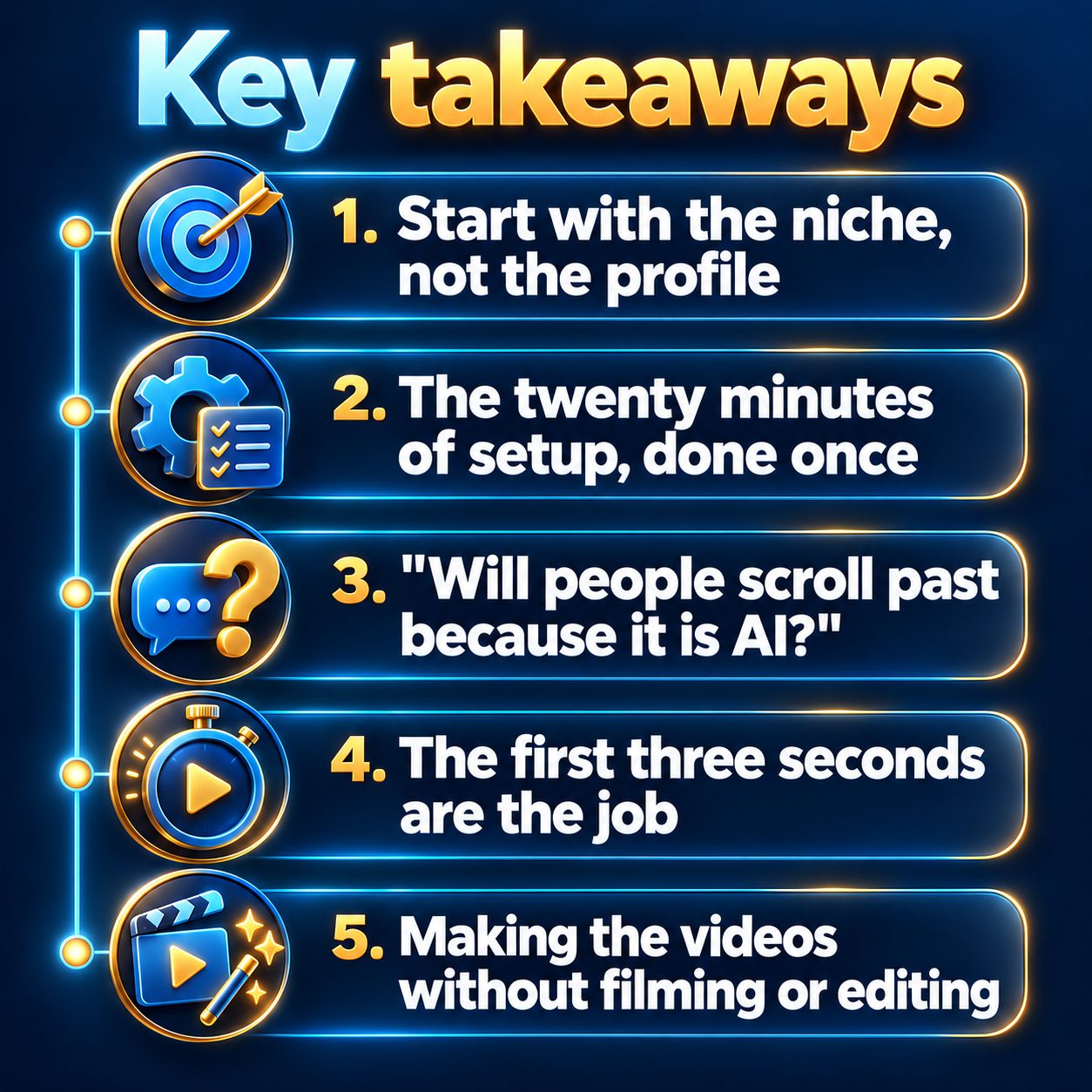
"Will people scroll past because it is AI?"
No platform demotes a video for being AI-made. TikTok, Instagram and YouTube rank short video on viewer behaviour: watch time, completion, replays, shares. Nobody in your comments runs a forensic check before deciding to watch to the end.
What genuinely does hurt you is worth knowing.
- Weak opening seconds. This kills more videos than everything else combined.
- Spam patterns. The same file posted from several accounts, near-duplicate uploads pushed out in bulk, comment bait.
- Skipping disclosure. When a video contains realistic synthetic media, TikTok expects the AI-generated label. The label itself does not shrink your reach; leaving it off when it applies risks removal.
The question under the question is usually different, though: "will people I know think this is embarrassing". Most of them will never see it, and the whole point of faceless is that your name is not on it. Viewers judge boring. They do not judge anonymous.
The first three seconds are the job
On a feed that autoplays, your opening frame and opening sentence are your thumbnail and your title. Everything else is downstream.
A structure that holds up for almost any faceless niche: open with the hook, spend the middle setting up a problem and paying it off, and end with one clear next step, whether that is a question for the comments or a promise of part two. No introductions. No "in this video we will". Start mid-thought.
Hooks that work in short form tend to be one of a few shapes. A claim that sounds wrong until you explain it. A specific detail with no context yet. A question the viewer already has a bad answer to. Write a batch of them in one sitting before you record anything, then use your best one and keep the rest for later.
Keep videos short at the start. Under a minute is plenty while you learn whether people finish them.
Making the videos without filming or editing
This is where beginners actually quit. Not at setup, not at ideas. At video four, when the process turns out to take an evening each.
So cut the process down before you start. Batch: write several hooks at once, generate several videos in one sitting, post them across the week. Reuse the same voice, the same caption style, the same visual look, so your account looks like an account instead of a test folder.
This is the friction MaqtAi was built to remove: you give it a niche and a topic, and it writes the script, narrates it with an AI voice, generates moving visuals, adds animated captions and assembles a vertical video, usually in a few minutes. You can edit any line before it renders, or paste your own script and have it used word for word. Once you have posted to a platform manually, scheduling and Autopilot can keep the cadence running from a topic queue you control, with a "Suggest topics" button that drafts a batch from your niche when you would rather not fill it yourself.
Honest limits, because they matter more than the feature list. It will not pick your niche and it will not rescue a topic nobody cares about. A generated hook is a starting point, not a guarantee. And for TikTok specifically, you pick a visibility level and publish straight to your account, but Autopilot cannot post there automatically yet, so a TikTok destination waits in the approval queue for you to confirm. If that extra tap would break your routine, know it now rather than on day one.
Your first two weeks
Week 1: post one video a day, same niche, same voice, same caption style. Do not redesign the profile. Do not change topic. You are collecting data, not chasing a hit.
Week 2: open your analytics and look only at watch time and completion. Find the videos people finished, then read their first lines back to back. That pattern is your account's hook formula. Keep making that. Rewrite the openings of the ideas that flopped and try them again, because a good idea with a bad first line usually just needs a better first line.
After that, keep going. Two weeks tells you very little. A couple of dozen videos start telling you something real.
What waiting a month actually costs
Nothing dramatic happens if you wait. That is the problem. The account you have not made is not accumulating any signal about who to show your videos to, you are not learning which hooks work in your niche, and the person who started today is doing both. There is no deadline here, just compounding you either start or do not.
So make the smallest possible commitment: one video, tonight, on the narrowest topic you can think of. Verify your email for 450 free credits and you can render your first one without a card, three or four on the still-frame Express tier, watermarked and without a presenter, which removes the last excuse that was doing any work.
Doing this by hand is the part most people quit at. MaqtAi writes the script, narrates it, generates the visuals and captions, and assembles the faceless short for you. Verify your email and you get 450 free credits: about 3 videos on the still-frame tier, or one with AI motion. Free renders carry a watermark.
Try it on your niche freeFrequently asked questions
Do I need to show my face to grow on TikTok? No. Faceless accounts run on stories, voiceover and visuals, and the ranking systems look at how people watch, not at whether a human appears on screen.
How long should a faceless TikTok be? Start short, under a minute, and let completion rate tell you whether you have earned the right to go longer. A finished 40-second video beats an abandoned two-minute one.
Do I have to label AI content on TikTok? If your video contains realistic synthetic media, yes, label it as AI-generated. The label does not reduce your distribution, and skipping it when it applies can get the video removed.
Can I post the same video to Reels and Shorts too? Yes, and it is a sensible way to get more from each video. Just avoid posting identical files from multiple accounts on the same platform, which is the spam pattern that does get penalised.
Results vary. Nothing here is a guarantee of views, monetization or income.