
Why long-form is the easier monetization path
YouTube runs two routes into the Partner Program. The long-form path requires 1,000 subscribers and 4,000 watch hours over 12 months. The Shorts path demands 1,000 subscribers and 10 million Shorts views in 90 days. Read those side by side. One asks you to accumulate hours gradually over a year. The other needs a viral avalanche in three months.
Every minute someone watches a regular video adds to your watch-hour total. A two-minute video watched to the end by a steady audience each day builds that number quietly. Shorts contribute almost nothing to watch hours and lean entirely on massive view volume. If you have been posting only Shorts, you have been playing the harder game.
Regular videos also typically earn far more ad revenue per view once you are monetized. The long-form path is easier to reach and more valuable once you get there.
Picking a niche that holds viewers for minutes
Not every topic works at two or five minutes. The niches that thrive in long-form faceless video share a trait: they reward curiosity. History deep dives, startup origin stories, true crime cases, dark psychology explainers, bedtime stories, and stoic philosophy all give viewers a reason to stay through sections. A list of fun facts does not.
Before you produce anything, ask yourself: would someone sit through this on a bus ride? If the answer is only "maybe for fifteen seconds," it belongs in a Short. If the story has a buildup and a payoff, it belongs in 16:9. Check use cases for niche ideas that naturally fit longer formats.
One smart move is pairing both formats. Publish the full story as a regular video, then create a companion Short on the same topic to pull new viewers toward your channel. MaqtAi builds this into the workflow: every finished 16:9 video has a "Make a companion Short" button that generates a separate standalone vertical video on the same subject, with its own payoff rather than a teaser.
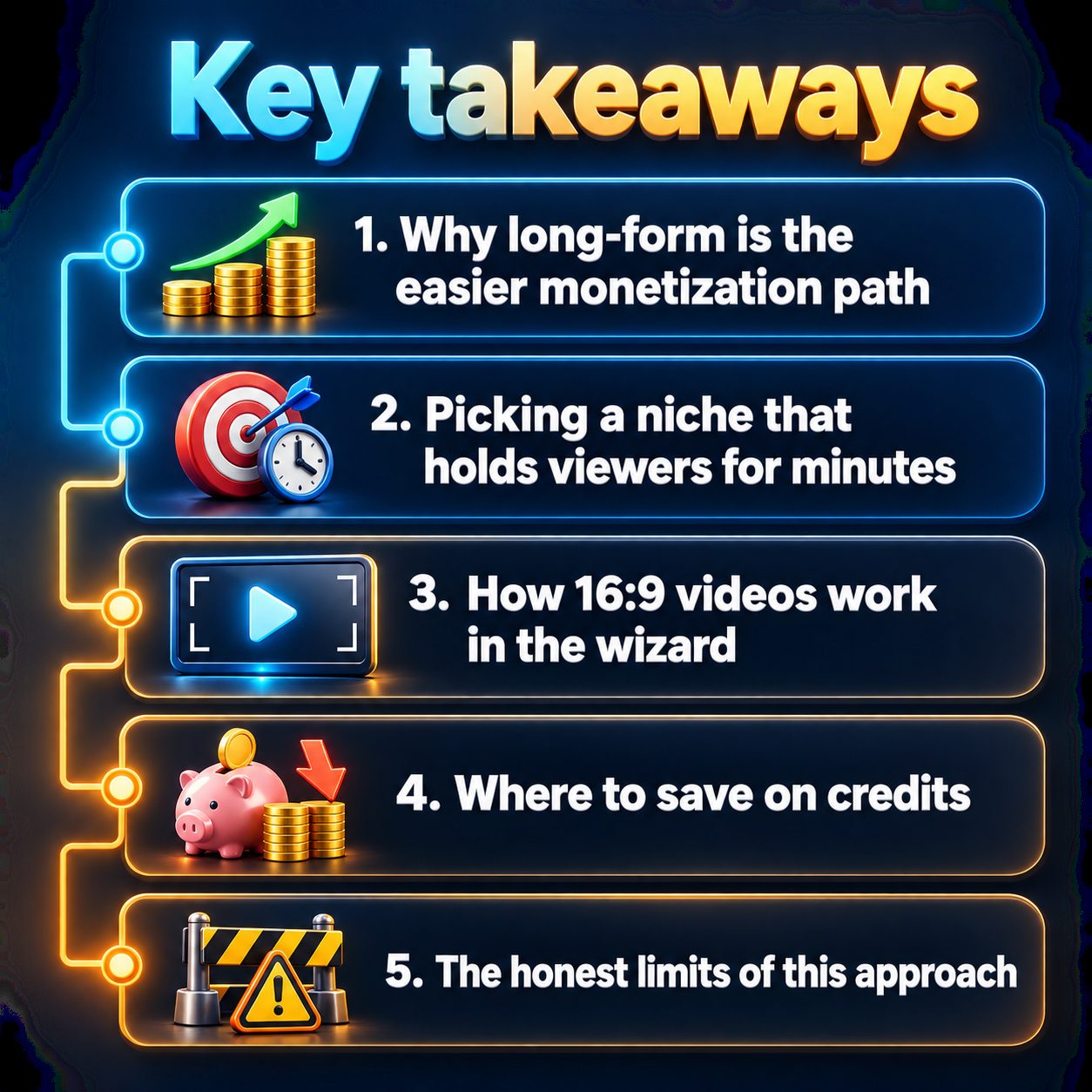
How 16:9 videos work in the wizard
When you open the video wizard, the Length and Aspect step comes before the script is written. That matters. Choosing 16:9 at a longer duration tells the AI how much ground to cover, and it generates a long-form script structure automatically: a hook, themed sections, and a recap. You are not stretching a short script to fill time. The script is built for the format from the start.
From there, the wizard walks through visual style, scenes, voice, music, and captions. You choose from multiple narrator voices and adjust speech speed to match your niche's pacing. A stoic motivation channel might want something slower and deliberate. A startup story channel might want something punchy. Preview and pick what fits.
Nothing is generated or charged until you press Launch on the Review step, so you can experiment freely.
Where to save on credits
Every video costs credits, and long-form videos have more scenes, so they naturally cost more than a quick Short. The quality tier you pick controls how much motion each scene gets. Here is honest guidance: Premium and Full Cinematic tiers mainly benefit realistic, people-heavy footage. If your visual style is stylized art like anime, watercolor, comic, or pixel art, Standard looks nearly identical and costs meaningfully less. Save the higher tiers for videos where realism matters.
Being deliberate about your tier choice on each video is how you keep a daily or near-daily cadence affordable over months.
New users who verify their email get free credits to start, enough to test whether your niche works in long-form before entering any payment details.
The honest limits of this approach
This capability removes the friction of producing long-form video without a camera, a microphone, or an editing timeline. It does not remove the need for good judgment.
YouTube's inauthentic-content policy can demonetize channels that mass-produce repetitious AI content. Posting the same recycled script angles with interchangeable visuals is exactly the pattern that triggers review. Your topic selection, your hooks, and the variety in your scripts are still your job. The tool builds what you describe; it cannot decide what is worth describing.
Long-form AI video also has a visual ceiling. The generated scenes look good and have real motion, but they are not hand-filmed documentary footage. Viewers of faceless channels expect and accept this style. Viewers who want vlog-quality presence will look elsewhere. Know your audience.
And a practical note: completed videos stay editable for seven days after rendering. After that, you can re-create with the same settings, but you cannot tweak the original. Plan your review window accordingly.
Building watch hours week by week
Here is what a realistic first month looks like. Week one, publish a few 16:9 videos in your chosen niche. Watch the retention graphs in YouTube Studio. See where viewers drop off. That data tells you whether your hooks and pacing work better than any advice article can.
Week two, adjust. If viewers leave at the midpoint, your sections might be too long or too similar. Tighten the structure. If they leave in the first few seconds, your hook needs work. The brand signal and topic development tools on MaqtAi's My Brand page can help you shape stronger angles and opening hooks before you generate a script.
Weeks three and four, increase your cadence. If you can sustain a video every day or every other day, your watch hours compound. This is where Autopilot matters: load your topic queue, set your cadence, and let the system handle rendering and publishing while you focus on finding better topics.
The expensive choice is not the credits. It is the weeks spent not posting while a competitor builds watch hours daily. Your first video costs nothing but an email signup and an afternoon.
Doing this by hand is the part most people quit at. MaqtAi writes the script, narrates it, generates the visuals and captions, and assembles the faceless short for you. Verify your email and you get 450 free credits: about 3 videos on the still-frame tier, or one with AI motion. Free renders carry a watermark.
Try it on your niche freeFrequently asked questions
Does YouTube penalize AI-generated long-form videos? No platform down-ranks videos just for being AI-made. YouTube ranks by viewer behavior: watch time, likes, shares, and completion rate. What does get flagged is mass-produced, repetitious content with no real value. Unique topics and genuine scripting effort keep you in the clear.
Can I post both Shorts and long-form from the same channel? Yes, and many creators do. MaqtAi's companion Short feature lets you generate a standalone vertical video from any finished 16:9 video, so you can feed both formats from the same topic without doubling your work.
How many long-form videos would I need to reach 4,000 watch hours? It depends entirely on your average view duration and audience size. There is no fixed number. Focus on making videos people actually finish, then let consistent posting do the math over months.
Results vary. Nothing in this article is a guarantee of income or monetization.