
What "hard" actually means on Shorts
Shorts distribution is not gated by your subscriber count. Upload something and the feed shows it to a small batch of people who have never heard of you. That part is free. What happens next is the whole game: if most of that batch swipes away in the first second or two, the video stops there. If they watch to the end, or loop it, or send it to someone, the feed widens the test.
So "hard" does not mean invisible. It means your video gets one audition and most auditions fail. That is a very different problem from the one people imagine when they say Shorts are impossible. You are not waiting to be discovered. You are being tested, constantly, and the test is honest.
The practical upside: your bad videos cost you almost nothing except the time you spent making them. Nobody sees them. That is why the people who grow tend to be the people who could afford to be wrong a lot.
The three things that decide whether a Short travels
The first two seconds. Not the first ten. Viewers decide before your intro finishes, which is why your intro should not exist. Open on the most interesting sentence in the whole script. If the payoff is "this castle was built on a mass grave," that is your opening line, not your closing one.
No dead air in the middle. Every second that does not add information or tension is a second where someone leaves. Short-form is unforgiving about pacing in a way that long-form is not. 30 seconds of tight script beats 60 seconds of comfortable script every time.
One recognizable lane. The feed learns what your channel is by watching who finishes your videos. If your uploads are a scary story, then a stoic quote, then a finance explainer, you are resetting that learning every day. Pick one thing. Stay boringly consistent about it for a while.
That is the actual difficulty. It is not technical, and it is not luck. It is craft plus repetition.
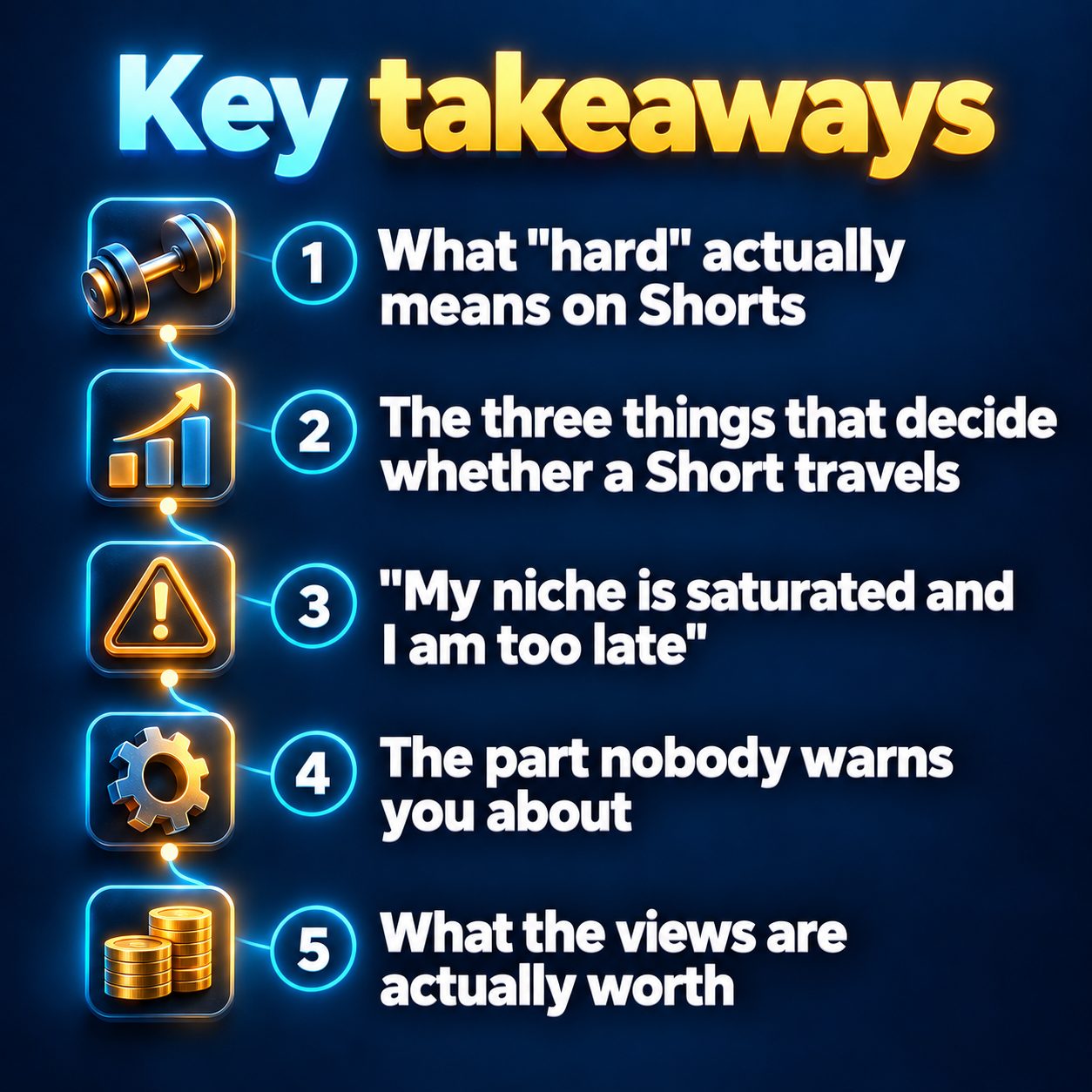
"My niche is saturated and I am too late"
This is the objection almost everyone brings, and it deserves a real answer rather than a pep talk.
Saturation is real for generic content. If your video is a rewrite of the same ten facts everyone else posts about the Roman Empire, in the same voice, with the same stock clip, you are competing on nothing. That version of the niche is genuinely full.
But the Shorts feed is topic-driven, not follower-driven. It does not care that a channel started last week. It cares whether this specific video held attention better than the alternatives it could have shown instead. A new channel with a sharper angle beats an old channel coasting. That is why brand-new channels still surface in crowded niches every day.
The honest reframe: you are not too late to the niche. You might be too late to the laziest version of it. Narrow down. Not "history," but forgotten disasters. Not "motivation," but stoicism for people who hate their job.
The part nobody warns you about
Here is the thing that actually kills channels, and it is not the algorithm.
Most people post for two weeks. They get a handful of videos that flop, one that does okay, and then life happens. They come back three weeks later, post twice, and conclude that Shorts do not work.
But the algorithm needs data. It needs a body of videos to figure out who your viewers are and when they show up. A channel with a couple dozen videos in one lane gives it something to work with. A channel with six videos over two months gives it nothing.
This is why cadence matters more than any individual video. Post 1/day if you can. If you cannot, post 3 times a week, but pick a rhythm and hold it for a month before you judge anything. Judge the channel after a couple of dozen videos, not after five.
The uncomfortable part is that consistency is a production problem, not a motivation problem. Writing, recording, editing, uploading, and captioning a video every day is a real job. Almost nobody quits because they stopped believing. They quit because the work stopped fitting into their evening.
What the views are actually worth
Worth knowing before you commit, because it changes what you build.
YouTube's monetization thresholds are public: the standard path is 1,000 subscribers plus 4,000 valid public watch hours in 12 months, or 1,000 subscribers plus 10 million Shorts views in 90 days. The long-form path is far more reachable for most people, and long-form ad revenue per view is much higher than Shorts revenue.
So the smart structure for a lot of creators is Shorts as the discovery engine and longer videos as the thing that actually earns. Shorts get you in front of strangers. Longer videos build the watch hours.
Also worth reading plainly: YouTube's monetization policies treat mass-produced, repetitious content as inauthentic. Volume with no point of view is a dead end. Volume with a clear angle and a real script is not.
Where a tool helps, and where it does not
If the bottleneck is production rather than ideas, that is solvable. This is exactly what MaqtAi does: you give it a niche and a topic, and it writes the hook-first script, narrates it with an AI voice, generates moving visuals, adds animated captions, and assembles a vertical video, usually in a few minutes. Autopilot runs the whole thing from a topic queue on a schedule, and by default every finished video waits for your one-tap approval before anything publishes.
Honest limits, because they matter more than the pitch. It will not pick a good niche for you. It will not tell you your angle is boring. It cannot make a topic nobody cares about interesting, and no tool can. Nothing about being AI-made gets you down-ranked, but nothing about it gets you views either. The hook, the niche, and the cadence still do all the work, and those are yours.
Also: TikTok publishing posts directly and publicly with a visibility level you pick, though Autopilot cannot post to TikTok automatically yet, so a TikTok destination waits in the approval queue, and Instagram Reels needs a Business or Creator account. Worth knowing before you plan around it.
What another month of deciding costs
Nothing dramatic happens if you wait. That is the problem. The channel just does not exist, the algorithm collects no data about it, and the person in your niche who started this week has a month of videos and a rough idea of which hooks land.
The cheapest way out of the loop is to make one video and post it. Not a strategy, not a content calendar. One. New accounts get 450 free credits after verifying their email, no card needed, enough for three or four still-frame Express videos, or a single one with AI motion, so the first one costs you an afternoon and nothing else. Check the credit costs if you want to know what a run of videos looks like before committing to anything. Free renders carry a watermark and have no talking presenter, and publishing to any platform needs a paid plan.
You will learn more from posting one bad Short than from another week of reading about whether Shorts are worth it.
Doing this by hand is the part most people quit at. MaqtAi writes the script, narrates it, generates the visuals and captions, and assembles the faceless short for you. Verify your email and you get 450 free credits: about 3 videos on the still-frame tier, or one with AI motion. Free renders carry a watermark.
Try it on your niche freeFrequently asked questions
How many Shorts should I post before deciding it is not working? Give it a month of consistent posting in one niche, ideally daily, before judging anything. Fewer than a couple dozen videos does not give the feed enough to learn from, and it does not give you enough hook attempts to spot a pattern.
Do AI-made Shorts get fewer views? No platform down-ranks a video for being AI-made. Shorts are ranked on viewer behavior: watch time, completion, rewatches, shares. What does hurt you is near-duplicate mass posting, weak opening seconds, or skipping a platform's AI-disclosure rule for realistic synthetic media.
Is it easier to get views on Shorts or on TikTok? Both push new videos to a test audience regardless of follower count, so the mechanics are similar. Shorts tends to be easier to convert into money later because of the long-form path on the same channel.
Do I need a big subscriber count before Shorts start performing? No. Shorts distribution is driven by how each video performs with a cold test audience, not by your subscriber count. Subscribers are a result of good Shorts, not a prerequisite for them.
Results vary. Nothing here is a guarantee of views, growth, or income.