
Stories beat tip lists in a short-form feed
Business content on short-form video has a sameness problem. Text on screen, stock footage of someone walking into an office, a voiceover listing tips. Viewers scroll past because they have seen it all before.
A story stops the thumb differently. When someone sees a character facing a real situation, they feel curiosity. They want to know what happens next. That pull earns watch time, and watch time is the signal every platform uses to push your video further.
Comic-book illustration adds another advantage. It looks nothing like a typical business reel, so it registers as something new in the feed. That visual contrast buys you an extra beat of attention, and in short-form, every beat counts.
What the illustrated story format gives you
MaqtAi's Business Parable format is built for exactly this kind of content. Here is what it includes:
- Exactly 7 scenes, always in comic-book illustration style.
- Smooth zoom animation instead of AI-generated motion, keeping the look consistent and avoiding uncanny visual artifacts.
- A fixed structure. No quality tier picker, no scene count slider, no duration setting. The wizard shows a single "Illustrated format" card with one credit price. If you try switching tiers, nothing changes, because there is nothing to switch.
- Clean voiceover by default. No background music plays unless you explicitly pick an ambience on the Music step.
- Editable lines and image prompts on the Scenes step, even though scenes cannot be added or removed. You control what gets said and what each panel shows.
The step-by-step walkthrough covers the full flow from topic to published video.
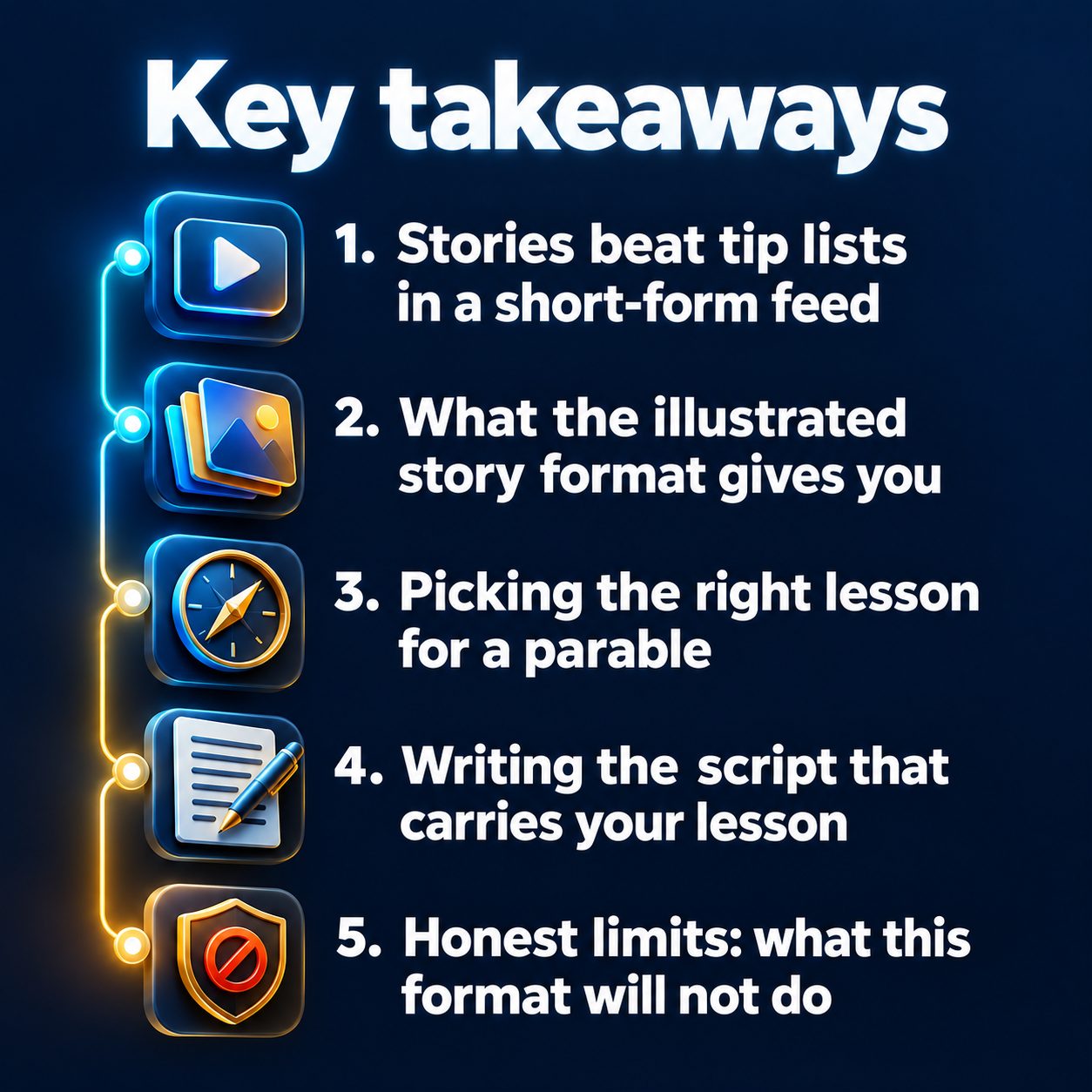
Picking the right lesson for a parable
Not every business insight works as a story. The format shines when your lesson has a character, a tension, and a resolution.
Good fits:
- A founder who made a pricing mistake and learned from the fallout
- A freelancer who said yes to every client until burnout forced a boundary
- A small business that grew too fast and had to choose between quality and scale
Bad fits:
- A list of productivity apps (no narrative arc)
- A comparison of tax strategies (too abstract for visual storytelling)
- Step-by-step software tutorials (better as screen recordings)
The test is simple: if you can say "someone did X, and here is what happened," you have a parable. If you can only say "here are five things you should know," a different format will serve you better.
Writing the script that carries your lesson
You have two paths on the Script step.
Let MaqtAi generate it. Type your topic ("a startup founder who ignored customer feedback and pivoted too late") and the AI writes a hook-first script shaped for the 7-scene structure.
Paste your own. If you already have the story written, paste it into the Script step without pressing Generate. Your words are used word-for-word. At launch, the script splits across the 7 scenes exactly as you wrote them. This matters when your lesson comes from personal experience and specific phrasing counts.
One detail to know: once scenes exist, edits typed back into the script text box will not update them. Edit individual lines on the Scenes step instead.
If you have saved a brand signal on the My brand page, the "Tailor to my brand" checkbox shapes the generated script for your specific audience. For business educators, that means the vocabulary, the stakes, and the takeaway match who you are actually talking to.
Honest limits: what this format will not do
- The scene count is locked at seven. If your story needs more room, create a standard video with a longer duration instead.
- Comic-book is the only visual style. If your brand calls for photorealistic footage or minimalist motion graphics, this format is not the right fit.
- Quality tiers have no effect. Stylized art looks nearly identical across tiers, so fixed pricing saves you from overspending. But you cannot push visual fidelity higher by paying more.
- Music is silent unless you choose otherwise. Some creators prefer clean narration; others want subtle background texture. Neither is wrong, but the choice is yours to make.
- The format does not cause views. Your niche, your hook, and your posting cadence determine whether the algorithm picks the video up. A beautifully illustrated parable with a weak opening line will still underperform.
This format removes the friction of production. It does not remove the need for a good story.
One parable a week builds a real library
The trap with business storytelling is treating every video like a masterpiece. You refine one lesson for days, post it, then go quiet for two weeks. The algorithm forgets you existed.
A better rhythm: one illustrated business parable per week. One topic, one script reviewed, one video launched every seven days. Manageable on a busy schedule, because you are not filming or editing anything. You can batch topics on a Sunday and schedule them through Autopilot to publish on your chosen days.
Over a couple of months, you build a library of visual business stories on your channel. Each teaches a standalone lesson, but together they signal depth and expertise to anyone who lands on your profile.
Your first parable takes an afternoon
Every week without a video is a week the algorithm has no data about your content. It cannot learn who your audience is, because there is nothing to test. Other creators in the business education space are posting regularly while you plan.
You do not need to match their pace today. You need one video. One story. One lesson you have already learned.
MaqtAi gives you free credits when you verify your email, enough to make your first illustrated business parable without paying or entering a card. Pick a lesson, write or generate the script, review the scenes, and hit publish.
The costly choice is not trying a tool. It is sitting on a lesson worth teaching and never showing it to the people who need it.
Doing this by hand is the part most people quit at. MaqtAi writes the script, narrates it, generates the visuals and captions, and assembles the faceless short for you. Verify your email and you get 450 free credits: about 3 videos on the still-frame tier, or one with AI motion. Free renders carry a watermark.
Try it on your niche freeFrequently asked questions
Does the comic-book style look unprofessional for business content? The opposite, usually. Illustrated stories stand out in feeds full of talking heads and text overlays. The visual novelty earns attention, and the storytelling format earns watch time.
Can I use my own script instead of the AI-generated one? Yes. Paste your script into the Script step without pressing Generate, and your words are used verbatim. At launch they split across the 7 scenes. Edit individual lines on the Scenes step after that.
Why can I not change the quality tier or scene count? The Business Parable is a fixed format: 7 scenes, comic-book illustration, smooth zoom animation. Since stylized art looks nearly identical across tiers, a single price keeps things simple and prevents overspending.
How do I see the credit cost before committing? The wizard shows the exact price on the "Illustrated format" card. Nothing is charged until you press Launch on the Review step, so you always know the cost first.