
The five jobs, and which ones AI can actually take
Every short is five jobs stacked on top of each other: a script, a voice reading it, visuals that move, captions on screen, and the act of getting the file onto a platform. Filming used to be job three. It does not have to be anymore.
AI handles all five today. A script generator writes the hook and the payoff. A synthetic voice reads it in a tone you choose. Image and video models produce niche-matched footage that moves instead of sitting there as a slideshow. Captions get timed to the voice automatically. Publishing tools push the finished vertical file straight to your connected accounts.
What none of that touches is the decision layer. Which niche. Which topic this week. Whether the opening line is interesting to a stranger scrolling in bed at midnight. Treat AI as the production crew and yourself as the person who decides what gets made. That framing is the difference between a channel and a folder of files nobody watched.
Pick the niche before you touch a tool
This is the step people skip, and it is the step that decides whether anything works.
A faceless short lives or dies on whether the topic is inherently watchable without a face. Some categories are built for it: scary stories, unsolved history, dark psychology, stoic motivation, bedtime and sleep content, startup postmortems, comic-style parables. Others need a person on camera to carry them, and no amount of good generation fixes that.
Pick one, and stay in it long enough for the algorithm to learn who to show you to. A channel that posts a horror story, then a productivity tip, then a history fact is three channels with no audience each. If you are stuck choosing, look at the niches that already work in short form and pick the one you would happily read about for months, because you are going to be writing topics for it every week.
Then write the hook first. Not the script, the hook. One sentence that creates a question the viewer needs answered. "There is a room in this building nobody has opened since 1974." Everything after that is just keeping the promise. AI will write you a serviceable hook, but you are the one who knows whether it lands, so read it out loud before you generate anything.
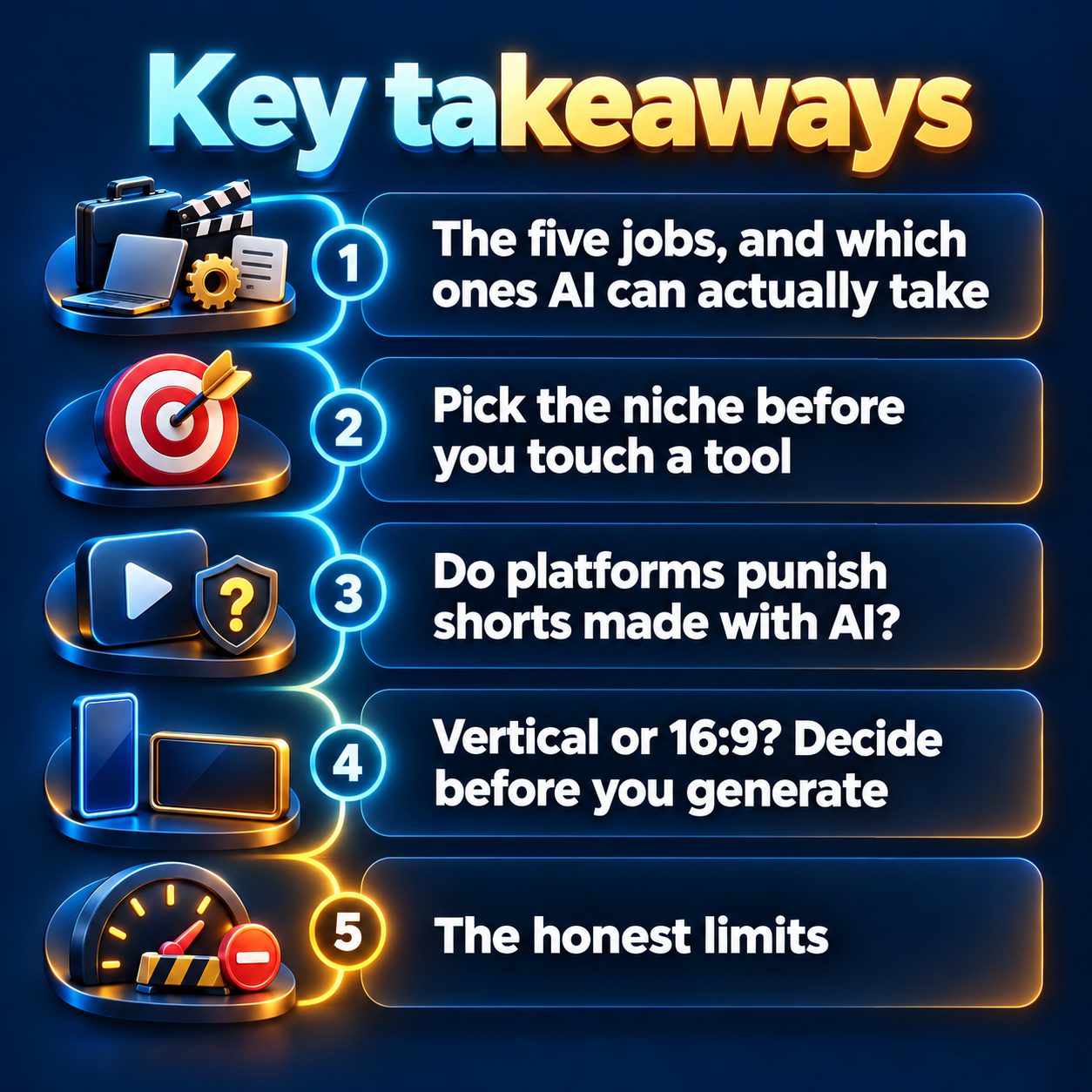
Do platforms punish shorts made with AI?
No. TikTok, Instagram, YouTube, and Facebook rank short videos by what viewers do with them: how long they watch, whether they finish, whether they like and share. None of them has a mechanism that demotes a video for being generated rather than filmed. Creators run AI-presenter channels at serious scale.
What does hurt you is a set of specific behaviors, and they are worth knowing precisely:
- Spam patterns. Identical files across multiple accounts, or near-duplicate videos posted in bulk, get treated as spam. That is a real risk with automated production, and it is avoidable.
- Weak openings. A short that loses people in two seconds gets buried, whether a camera or a model made it.
- Skipping AI disclosure. Platforms ask you to label realistic synthetic media. The label itself does not reduce distribution. Failing to apply it when required can get the video removed.
Monetization is a separate question from reach. YouTube's inauthentic-content policy targets mass-produced, repetitious content, so "generate a hundred near-identical videos" is not a monetization strategy. Make things a person would actually choose to watch, and you are inside the rules.
Vertical or 16:9? Decide before you generate
This one catches people out. YouTube classifies automatically: vertical or square, up to 3 minutes, is a Short, and 9:16 at 1080 x 1920 is the standard. Anything 16:9, or longer than 3 minutes, becomes a regular video.
That classification matters more than it sounds, because the two formats have different monetization doors. YouTube Partner Program entry needs 1,000 subscribers plus either 4,000 valid public watch hours in the last 12 months or 10 million valid public Shorts views in the last 90 days. The watch-hours path is far more reachable than the Shorts-views path, and Shorts ad revenue runs on its own policy anyway.
Practical read: if TikTok and Reels are your main game, go vertical and stay there. If YouTube is your main game, consider producing longer 16:9 pieces and letting shorts do the discovery work. You can run both, and the same topic can carry a long version and a separate standalone short with its own payoff.
The honest limits
Here is what AI production will not do, said plainly, because you will find out anyway.
It will not make a boring topic interesting. It will not tell you your hook is weak. It will not build an audience while you sleep for the first few weeks, because there is no audience yet and no data for the algorithm to work with. Generated visuals are good and getting better, but on realistic people-heavy footage you will still spot the occasional strange hand or odd blink. Voice cloning is close but not perfect; mouth movement is the hardest part.
And it will not save a channel with no point of view. If you would not watch your own videos, nobody else will either. AI removes the filming and the editing. It does not remove the taste.
The production loop that actually holds up
Here is the whole workflow, start to finish.
- Write 20 topics in one sitting. Not one. Twenty. This is your queue, and it is what prevents the week-three collapse when you cannot think of anything.
- Turn each topic into a hook first, then let the script get generated around it. Edit the first line by hand every single time.
- Set the length before the script. 30 to 60 seconds forces a tight structure. Longer needs a real reason.
- Keep the voice and visual style constant across the channel. Consistency is what makes a stranger recognize your second video.
- Post on a fixed cadence. Daily if you can, three times a week if you cannot. Cadence beats polish, every time.
That is the loop. The bottleneck is never the ideas, it is the hour per video that production eats. Tools like MaqtAi collapse the middle of that loop: you give it a niche and a topic, it writes, narrates, generates visuals with motion, adds animated captions, and assembles a vertical video, typically in a few minutes. You review or you do not. Autopilot and scheduling will then run the queue on your chosen cadence and publish to your connected accounts on a paid plan, with an approval step on by default so nothing goes out without your tap.
What waiting actually costs
Nothing dramatic happens if you start next month. That is exactly the problem. Your channel does not grow, the algorithm collects no data about who to show you to, and someone in your niche posts every day in the meantime and builds the head start.
The first video is always the hardest and always the worst. Make it anyway, badly, today. Verifying your email on MaqtAi gets you 450 free credits, no card, which is enough for three or four watermarked still-frame shorts and lets you see your niche in a finished vertical file instead of imagining it.
Doing this by hand is the part most people quit at. MaqtAi writes the script, narrates it, generates the visuals and captions, and assembles the faceless short for you. Verify your email and you get 450 free credits: about 3 videos on the still-frame tier, or one with AI motion. Free renders carry a watermark.
Try it on your niche freeFrequently asked questions
How long does it take to make one short with AI? The generation itself typically finishes in a few minutes. Realistically, budget 10 to 15 minutes for your first one including picking a topic, tightening the hook, and reviewing the result.
Do I have to disclose that my shorts are AI-generated? Platforms ask you to label realistic synthetic media. The label does not reduce your distribution, and skipping it when it applies risks removal, so apply it.
Can I post the same video to TikTok, Reels, and Shorts? Yes, posting one video across your own accounts is normal cross-posting. What gets flagged as spam is identical files spread across many different accounts, or near-duplicate videos posted in bulk.
Do I own videos made with an AI tool? With MaqtAi, yes. Videos you generate are yours to post, monetize, and use commercially on your own channels.
Results vary. Nothing here is a guarantee of income.