
The short answer, and the honest catch
Most short-form platforms reward consistency because every post gives their algorithm more chances to test your content against real viewers. More at-bats, more learning, faster feedback. So daily is the ceiling worth aiming for on TikTok, Reels, and YouTube Shorts.
Here is the catch nobody says out loud: the best cadence is the one you will still be doing in four months. A channel that posts daily for eleven days and then goes quiet trains the algorithm to expect nothing from you. Frequency only compounds if it is sustained.
Does posting more actually help, or is that a myth?
It is not a myth, but it is often misunderstood. Posting more does not magically boost each individual video. What it does is give the platform a bigger sample to figure out who your content is for. Ten videos tell an algorithm far more than two. Your hooks get tested more, your thumbnails get more impressions, and your winners surface faster.
The part people get wrong: volume does not rescue weak content. If your hook is dead in the first two seconds, posting ten of those a week just teaches the algorithm faster that people swipe away. So the honest rule is quality first, then as much frequency as you can hold at that quality. More bad videos is not a strategy. More good-enough videos, consistently, is.
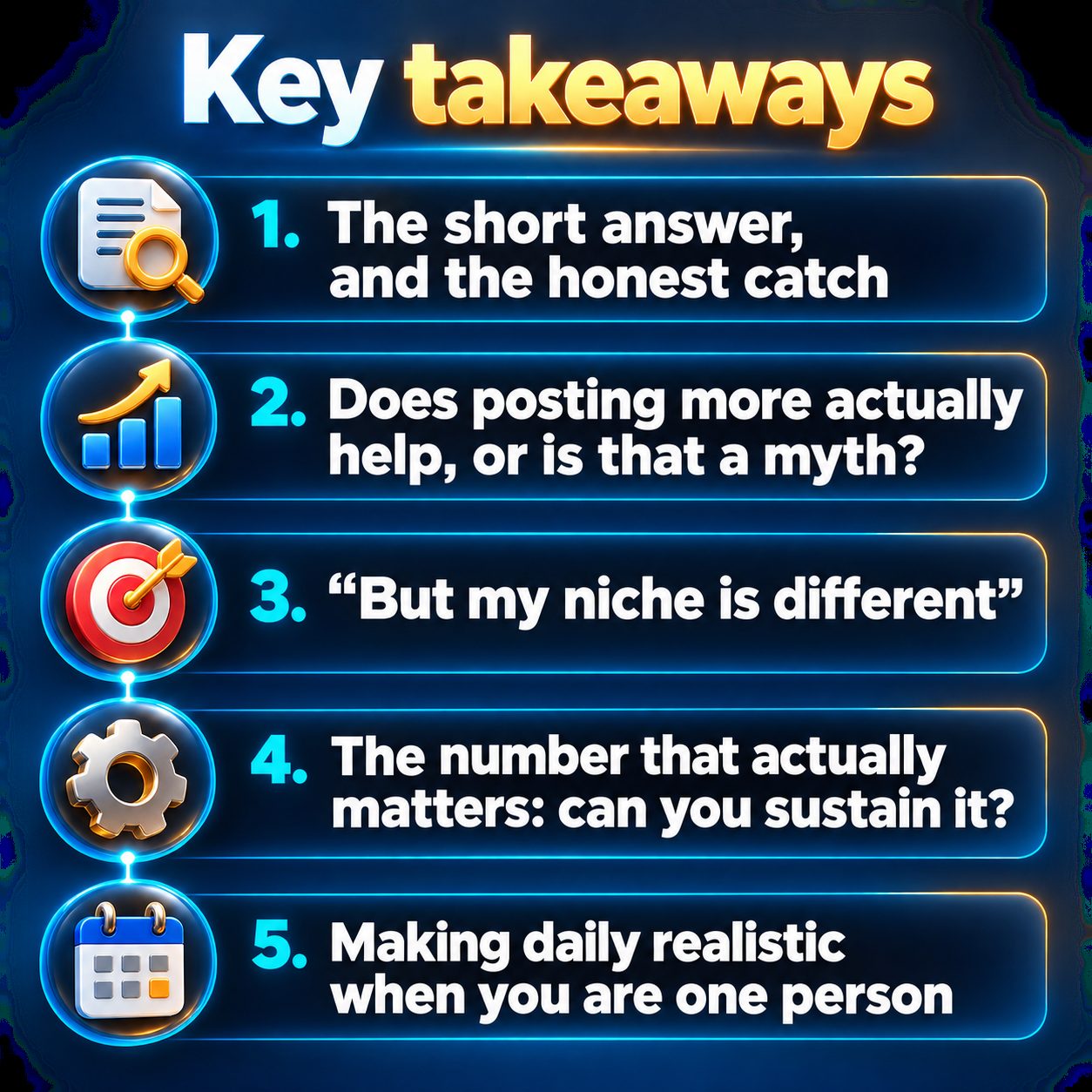
"But my niche is different"
Sometimes true, mostly not. Cadence does shift a little by format:
- Fast, trend-driven niches (comic stories, dark psychology, stoic motivation, reaction-style content) tolerate and often reward daily posting. The audience appetite is bottomless and the shelf life is short.
- Story-heavy niches (scary stories, true crime, history) can post daily too, but each video carries more weight, so many operators land at 4 to 5 a week and put the extra care into the narrative.
- Slow-burn or evergreen niches (bedtime and sleep content, longer explainers) do fine at 3 to 4 a week because viewers come back to a library, not a feed.
Notice none of these say "once a week is enough." Below roughly three posts a week, the algorithm barely has data to work with and your channel reads as inactive. If you are testing a brand-new niche, lean higher at the start so you learn which topics land, then settle into a rhythm you can defend.
The number that actually matters: can you sustain it?
Here is the trap most faceless operators fall into. They pick daily because a video said to, sprint for two weeks, burn out on scripting and editing, and quit. The algorithm then sees a dead channel. That is worse than never having started the daily push.
So work backwards from your real capacity. Ask yourself honestly: how many videos can you produce, at a quality you are not embarrassed by, every single week, for the next three months, on your worst week? That number is your cadence. If it is three, post three. If it is seven, post seven. Then protect it like a bill you have to pay.
Consistency also gives you something frequency alone cannot: a clean read on what works. When you post on a steady schedule, you can actually tell whether Tuesday's history video outperformed Thursday's because of the topic or the hook. Erratic posting muddies every signal you would use to improve.
Making daily realistic when you are one person
This is where most people's honest answer to "how many can you sustain" is low, because scripting, voicing, sourcing visuals, and editing each video by hand is hours of work. Daily is easy to recommend and brutal to do solo.
That is the exact gap faceless-video tools close. MaqtAi takes a niche and a topic and produces a finished vertical video: it writes a hook-first script, narrates it with an AI voice, generates and animates niche-matched visuals, and burns in animated captions, usually in a few minutes. You never film and you never record your voice. So the ceiling on your cadence stops being your editing stamina and starts being your topic ideas.
And you do not have to babysit it. With Autopilot and scheduling, available on a paid plan, you load a queue of topics, pick a cadence of daily, three times a week, or weekly, and it renders on that schedule. By default every finished video waits for your one-tap approval before anything goes out, so consistency does not mean losing control. Across 19 faceless niches, the same rhythm applies whether you run scary stories or startup breakdowns, and you can run several channels in parallel from one place.
Doing this by hand is the part most people quit at. MaqtAi writes the script, narrates it, generates the visuals and captions, and assembles the faceless short for you. Verify your email and you get 450 free credits: about 3 videos on the still-frame tier, or one with AI motion. Free renders carry a watermark.
Try it on your niche freeWhat waiting actually costs
Every week you spend deciding on the perfect cadence is a week your channel is not accumulating the algorithm data that makes the next video land better. The operators pulling ahead are not smarter about frequency. They just started posting and let the platform learn while you were still planning.
You do not need to commit to daily forever today. You need one video published so the learning starts. Verifying your email gives you 450 free credits, about 3 to 4 videos on the still-frame Express tier and watermarked, no card required. Make one this afternoon, post it, and let the feedback begin. Pick your real cadence once you have watched a few land, not before.
Frequently asked questions
Is posting daily better than posting three times a week? Daily gives the algorithm more data and usually grows faster, but only if you hold the quality and actually sustain it. A steady three a week you keep for months beats a daily pace you abandon after two.
Will posting more hurt my quality or my reach? It hurts reach only if the extra videos are weaker. Volume amplifies whatever you already make, so fix the hook and the first two seconds first, then scale the count.
What is the minimum cadence for a faceless channel to grow? Around three posts a week is a sensible floor. Below that the algorithm has little to learn from and your channel reads as inactive, which slows everything down.
How do I keep a daily schedule without burning out? Separate the creative decision from the labor. Batch your topics, then let a tool render and schedule them so the daily commitment is approving videos, not building each one from scratch.
Results vary and nothing here is a guarantee of income or growth.