
What the clock is actually counting
The timeline everyone quotes is wrong because they are measuring the wrong thing. Nobody gets paid for the day they created a channel. What moves you toward money is the number of watchable videos sitting in front of the algorithm, and the specific threshold you are walking toward.
So two creators can both say "I started in January" and be in completely different places by spring. One posted daily and has a real body of work the algorithm has tested against dozens of audiences. The other posted five times, got quiet numbers, and stopped. The calendar treated them the same. YouTube did not.
That is the good news buried in the boring answer. The timeline is mostly a cadence problem, and cadence is the one variable you fully control.
Two doors to YouTube money, and one is much closer
This is where a lot of faceless creators lose a year without realizing it. There are two entry paths to YouTube's Partner Program, and they are not equally hard: you need 1,000 subscribers, plus either 4,000 valid public watch hours in the last 12 months or 10 million valid public Shorts views in the last 90 days.
Read those two options again. Watch hours accumulate from long-form videos and they carry over across a full year. Shorts views reset on a rolling 90-day window, which means you have to hit that ceiling in a burst, not gradually. For most people starting from nothing, the watch-hours door is the realistic one.
Regular videos also typically earn far more ad revenue per view than Shorts do, since Shorts revenue follows its own separate policy. Shorts are still worth making. They are the cheapest discovery you will ever get. Just treat them as the top of the funnel that sends people to your longer videos, not as the revenue engine themselves.
And ads are not the only door. Affiliate links in the description and eventually sponsor deals tend to arrive before a channel is anywhere near ad-monetized, especially in niches where the audience buys things.
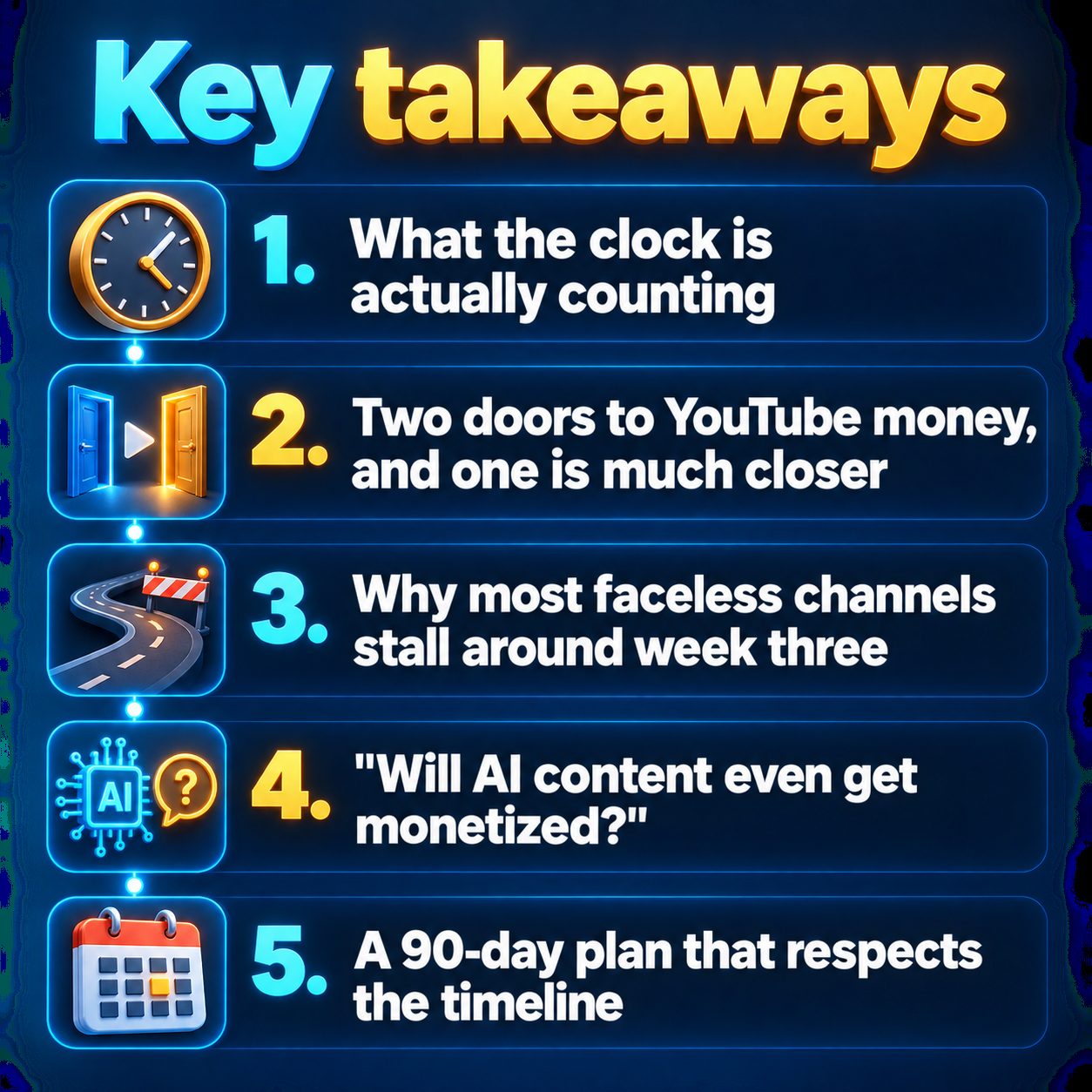
Why most faceless channels stall around week three
Here is the pattern I have watched a hundred times, and it has nothing to do with the niche.
Week one is exciting. Week two is fine. Week three the numbers are still flat, and posting starts feeling like shouting into a room where nobody looked up. So the cadence slips to every few days, then weekly, then the channel quietly ends. The channel did not fail. It stopped before it had produced enough data for the algorithm to figure out who to show it to.
The fix is unglamorous: decide your cadence based on what you can sustain on a bad week, not a good one. Daily is powerful, but three times a week held for months beats daily held for eleven days. Pick the one you will still be doing when you are bored of it.
The second stall is niche drift. Scary stories on Monday, finance on Wednesday, motivation on Friday. Each video has to find its audience from scratch because the channel never taught the algorithm what it is. Pick one lane and stay in it long enough to be recognizable.
"Will AI content even get monetized?"
This is the question you are actually carrying, so let me be blunt about it.
No platform down-ranks a video for being AI-made. TikTok, Instagram, and YouTube rank short video by viewer behavior: watch time, completion, shares. Production method is not an input. Faceless AI-presenter channels are running at serious scale right now and nobody is confused about it.
What does get punished is mass-produced repetitious content. YouTube's inauthentic-content policy exists precisely for channels churning identical templates with a swapped-out topic. If every video is the same voice reading the same structure over the same stock loop, that is the risk, and it is a real one. The defense is not avoiding AI. It is making each video actually worth watching: a specific hook, a real payoff, visuals that match the words. Same standard a human editor would be held to.
Also worth knowing before you plan around it: platforms want realistic synthetic media disclosed. The label itself does not hurt distribution. Skipping it can get the video removed.
Honest limit while we are here: no tool, AI or otherwise, makes people watch a boring topic. If your niche has no audience, faster production just gets you to the wrong answer sooner.
A 90-day plan that respects the timeline
Weeks 1 and 2: pick one niche and commit. Publish short vertical videos on a fixed cadence, daily if you can. Do not judge anything yet. You are gathering data, not results.
Weeks 3 and 4: look only at the first three seconds of your best and worst performers. Rewrite your hook pattern based on what you find. Keep the cadence identical.
Month 2: add long-form. This is the move most faceless creators delay too long. A 16:9 video over the 3-minute mark counts as a regular video, and watch hours only accumulate from these. Two per week alongside your shorts is plenty.
Month 3: double down on whatever topic cluster worked and stop making the others. By now you should have a rough sense of your channel's shape.
The friction in that plan is production volume, which is exactly where a tool like MaqtAi's scheduling and Autopilot earns its place: on a paid plan you queue topics, it renders and posts on your cadence so week three does not kill you. It does not choose your niche or write a hook that beats yours. That part stays your job.
What waiting actually costs
Nothing dramatic happens if you start next month instead of today. That is what makes it dangerous. The cost is invisible: the watch hours not accumulating, the algorithm not learning who your videos are for, the person in your niche posting daily while you decide.
Every day you delay does not just push the finish line back one day. It pushes back the day you start learning what works, which is the part that actually takes time.
So make the smallest possible move. One video, in one niche, today. Verifying your email on MaqtAi gives you 450 free credits, no card, which is enough for three or four watermarked still-frame videos on the Express tier, so you can see your first faceless video finished and decide whether this is a thing you want to do for the next three months. That is the whole decision. Not the business plan, just the first video.
Doing this by hand is the part most people quit at. MaqtAi writes the script, narrates it, generates the visuals and captions, and assembles the faceless short for you. Verify your email and you get 450 free credits: about 3 videos on the still-frame tier, or one with AI motion. Free renders carry a watermark.
Try it on your niche freeFrequently asked questions
Can I make money faster on TikTok or Instagram than YouTube? Often yes, but usually not from platform ad revenue. Brand deals and affiliate links can arrive on those platforms well before you hit any monetization threshold, especially in niches where the audience buys products.
Does using an AI voiceover block monetization? No. An AI voice is not disqualifying on its own. What gets flagged is repetitious mass-produced content with no original value, so vary your topics, structures and visuals, and make sure each video actually says something.
Should I start with Shorts or long-form videos? Start with shorts for discovery, then add long-form by month two. Watch hours only come from regular videos, and that path to the Partner Program is far more reachable than the Shorts views path.
How many videos before I know if my niche works? Not a fixed number, but far more than most people make before quitting. Give any niche a couple of months of consistent posting before you judge it, since early videos are tested against a tiny audience.
Results vary. Nothing here is a guarantee of income.