
Why history quietly dominates short form
History gives you something most niches cannot: a built-in story arc. Every topic already has conflict, a turning point, and a resolution. That structure maps perfectly onto the shape a short video needs to hold attention for 30 to 60 seconds.
The audience is wider than you think. History shorts pull viewers who would never search "history" deliberately. They watch because the hook promised something strange or counterintuitive, and the video delivered. These viewers tend to comment, share, and rewatch more when the content earns their attention.
Your real competition is not polished documentary channels with research teams. It is the flood of history accounts posting Wikipedia paragraphs over still images. Clear narration, visuals with actual motion, and a script that respects the viewer's time will separate you from that crowd fast.
The hook pattern that stops the skip
Most history hooks sound like textbook introductions. "In 1347, the Black Death arrived in Europe." That is a fact, not a hook. Nobody pauses their scroll for a date.
Hooks that drive completion do one thing: open a gap the viewer needs closed. Name something they thought they understood, then reveal it is stranger than they assumed.
Compare two openings for the same topic:
- "The Great Wall of China was built over many centuries."
- "The Great Wall was never meant to keep invaders out."
The second works because it contradicts a belief. The viewer has to stay.
Three hook shapes that work specifically for history:
The correction. "You were taught X. The real story is weirder." This works because most people learned simplified history in school and enjoy discovering the fuller version.
The absurd detail. "A Roman emperor once declared war on the ocean." Lead with the strangest true fact, then explain why it happened.
The consequence chain. "One forged document changed European borders for centuries." Promise a domino effect, then trace it.
These are not clickbait. Every one is a true claim you pay off inside the video. History hands you material this wild. You never need to exaggerate.
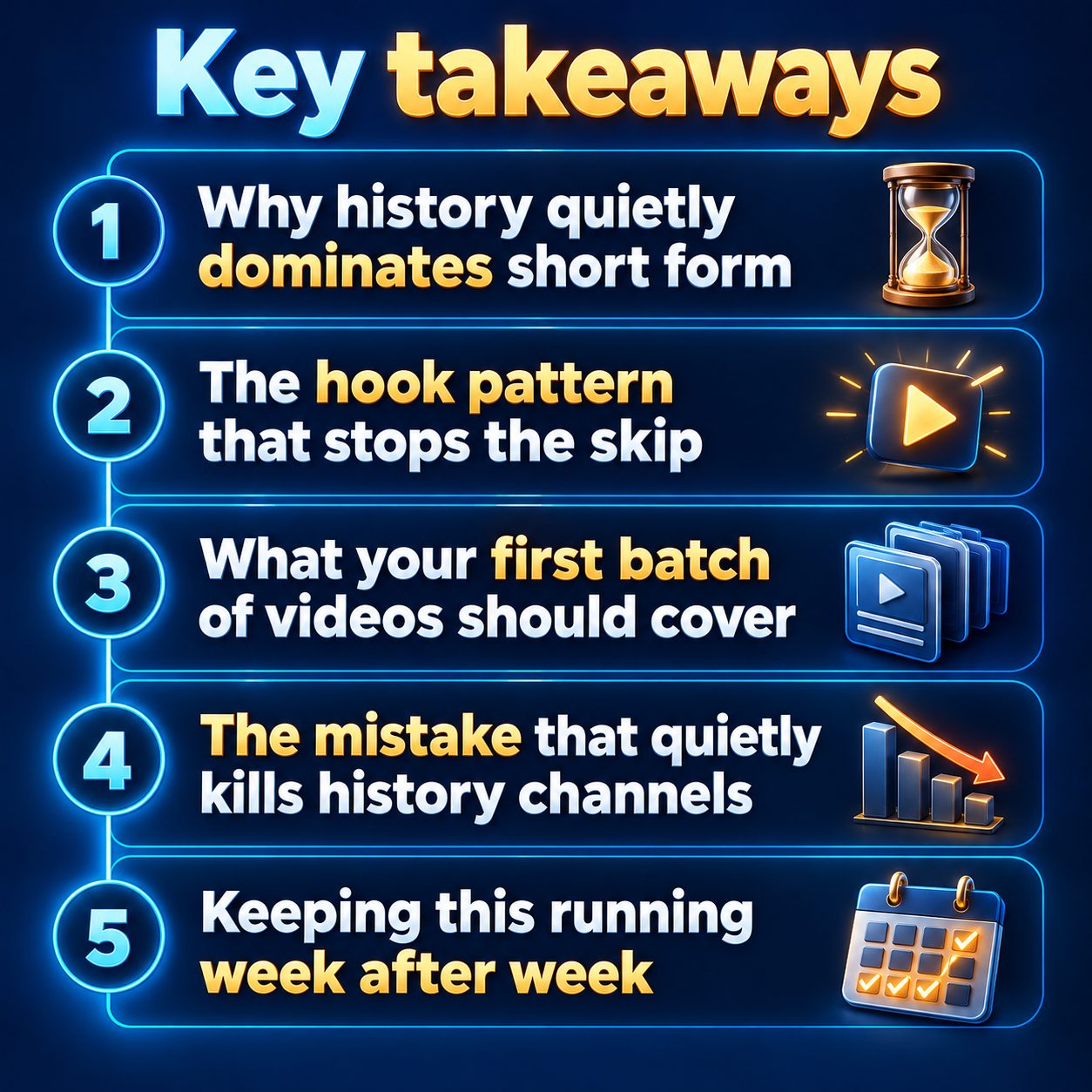
What your first batch of videos should cover
Start tight. Do not open with a broad overview of a world war. Pick the strangest, most specific slice of a topic you can find.
"The pope who put a dead body on trial" (the Cadaver Synod). Bizarre, documented, and visually striking.
"Why Roman soldiers were paid in salt" (the origin of "salary"). Familiar enough to hook, surprising enough to hold.
"The woman who survived three sister ships" (Violet Jessop). A character-driven story with three natural acts.
"Napoleon was not actually short" (the myth and the British propaganda behind it). A correction hook with a satisfying explanation.
"The city that disappeared overnight" (Pompeii, or the Roanoke colony). Mystery hooks perform well because the viewer needs the resolution.
Each one follows the same template: one thread, one surprise, one payoff. If your script needs more than one "but actually" turn, it probably belongs in two separate videos.
The mistake that quietly kills history channels
Inaccuracy. Not because algorithms penalize it, but because history viewers will fact-check you in the comments. Get a date wrong, oversimplify a cause, or repeat a debunked myth, and your comment section becomes a correction thread. That hurts engagement and makes new viewers distrust everything you post next.
You do not need a PhD. You need to verify your core claim before scripting. A quick cross-reference between two reputable sources is enough for a short. If you cannot verify the central claim, skip the topic. Plenty of others exist.
Be upfront about simplification too. A 45-second video cannot capture every nuance behind the fall of Rome. But if your script says "Rome fell because of X," adding "that was one of many reasons" sounds more authoritative than false certainty. Viewers respect the honesty.
One more constraint worth naming: when history overlaps with tragedy, colonialism, or cultural sensitivity, a flippant tone will cost you more than views. Treat the weight of the material seriously, even in a casual format.
Keeping this running week after week
The biggest threat to a history channel is not running out of topics. It is the research bottleneck. Finding a topic, verifying it, writing a script, sourcing visuals, recording narration, editing, and posting is a long chain that breaks the moment life gets busy.
Batch your research separately from production. One session a week collecting topics and saving a one-line note for each will keep you from staring at a blank page when it is time to produce.
For production, faceless history shorts do not require a camera. The visuals are illustrations, maps, paintings, and generated imagery. The narration is a voiceover. This is where MaqtAi fits naturally: you bring the topic and the angle, which is the part that actually matters for history, and it handles the script, AI voiceover, visuals with real motion, animated captions, and publishing to TikTok, Instagram, and YouTube. Set a cadence through Autopilot and the posting schedule runs while you focus on finding your next batch of strange, true stories.
You can test this with the free credits you get just for verifying your email. That is enough to try a few videos before spending anything.
The honest cost of putting this off
Every week without posting is a week the algorithm collects zero data about your channel. It cannot learn who your audience is, which hooks spread, or which topics stick. That learning starts only when you publish. Your first videos will not be your best, and that is fine. They are the price of the data that makes your later videos better.
Pick one topic from the list above. Make it today. See if a stranger finishes watching it.
Doing this by hand is the part most people quit at. MaqtAi writes the script, narrates it, generates the visuals and captions, and assembles the faceless short for you. Verify your email and you get 450 free credits: about 3 videos on the still-frame tier, or one with AI motion. Free renders carry a watermark.
Try it on your niche freeFrequently asked questions
Do AI-generated visuals work for history content? Yes. History shorts rarely use original footage. Paintings, maps, stylized illustrations, and generated scenes all fit the genre naturally. Motion and pacing matter far more than photorealism.
Will platforms reduce my reach because the videos are AI-made? No platform down-ranks a video for being AI-produced. Reach depends on watch time, completion, and engagement. A well-hooked history short performs the same regardless of how it was made.
How often should I post history shorts? Daily builds momentum fastest, but three times a week still gives the algorithm enough data to learn your audience. Consistency matters more than raw volume.
Can I cover sensitive historical topics without getting flagged? You can, but tone and accuracy matter. Avoid graphic descriptions, treat tragedies with appropriate weight, and follow each platform's community guidelines. Factual, respectful coverage is almost never penalized.