Most creators leave entire language markets untouched
Your best video already has a hook that works, visuals that hold attention, and a script that keeps people watching. The only thing stopping it from reaching viewers in Spanish, Arabic, Hindi, or Portuguese is the narration language. That used to be a dealbreaker. You do not speak it, so you cannot narrate in it.
Faceless channels changed this completely. There is no face to match, no lips to sync, and AI voiceover now sounds natural in dozens of languages. The barrier is gone. The real question is not whether you can do this. It is which language to choose and how to do it well enough that viewers never feel like they are watching a lazy translation.
Picking the right language for your specific niche
The temptation is to pick Spanish or Hindi because the speaker populations are enormous. That matters, but niche supply matters more.
Stoic motivation content in English is crowded. In Arabic or Portuguese, competition thins while viewer interest stays strong. True crime in Spanish is growing. History content in French or German draws audiences that tend to watch longer.
Search your niche keywords on YouTube or TikTok with the language filter set to your target. Look at how many creators are making content at your quality level. If you find only a handful posting consistently, you have found a gap worth filling.
Pick one language. Learn what works there before you expand to a second.
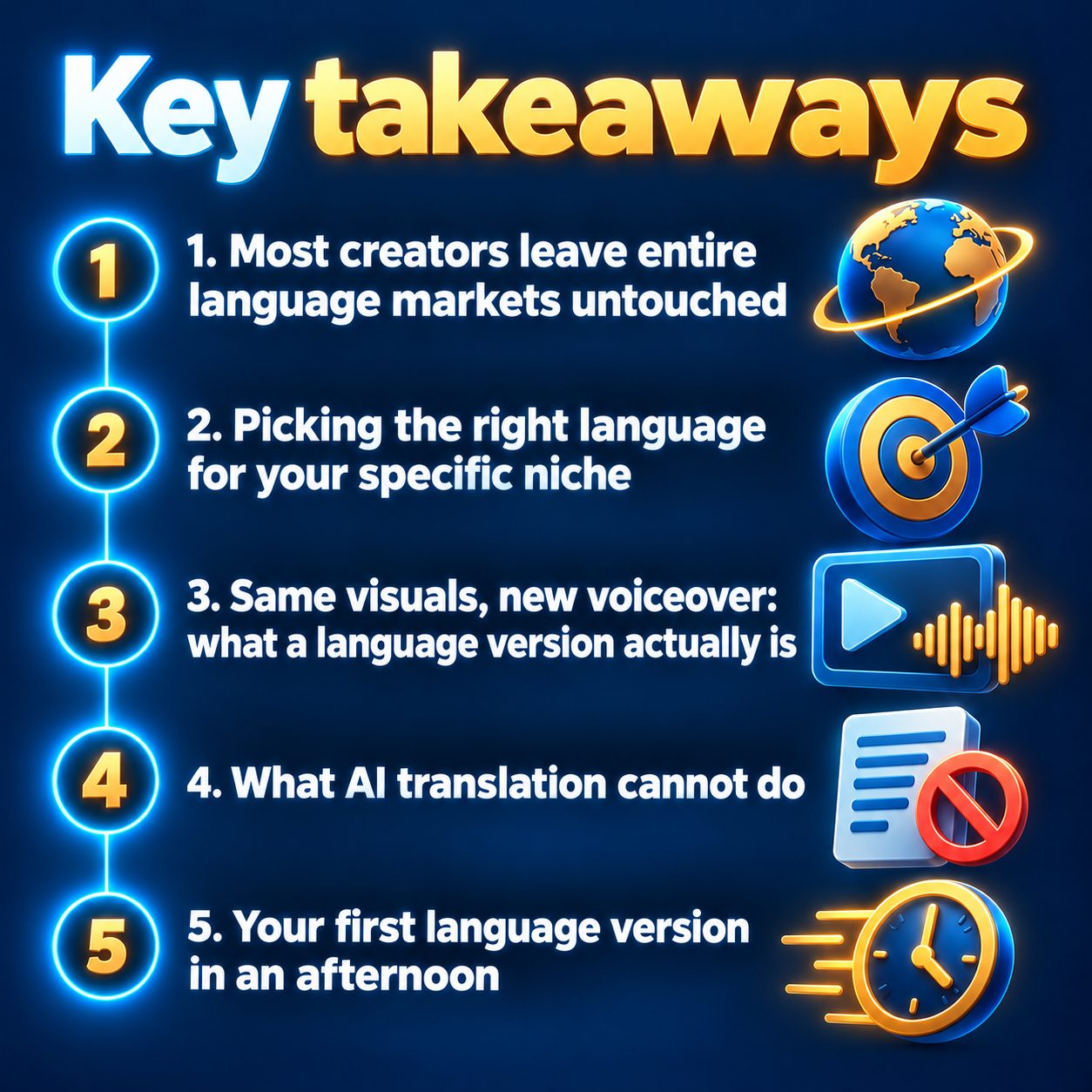
Same visuals, new voiceover: what a language version actually is
A language version keeps everything about your video intact: the scenes, the motion, the music, the ambient sound. Only the voiceover and the captions change. The narration is translated, re-recorded in a natural AI voice, and paired with new animated captions in the target language.
This means your visual storytelling carries over completely, which is both a strength and a constraint. Your visuals need to work without language-specific assumptions baked in. A video explaining a fascinating concept translates gracefully. A video with English text burned into every scene does not. If you know you will create language versions, plan your visuals to be language-neutral from the start.
In MaqtAi, completed videos have a Language Versions panel covering 57 languages, from Spanish and French to Hindi, Arabic, Japanese, Thai, and Filipino. You pay one all-in price per language (translation plus voiceover), shown on the button before anything is charged. Regenerating a language you already generated costs roughly a quarter of the original price. You can edit the translated script before regenerating, so if a bilingual friend flags an awkward phrase, you fix it at no cost.
The bigger strategic question: should these versions go on your main channel or a separate one? A dedicated channel per language builds a much cleaner audience signal. The algorithm knows exactly who to show your content to. MaqtAi lets you connect multiple channels on the same platform, so managing a Spanish YouTube channel alongside your English one happens from a single workspace. If you are serious about the second language, a separate channel almost always wins.
What AI translation cannot do
This is the section you need before you commit.
Language versions change voiceover and captions. They do not localize your content culturally. A joke that lands in English may mean nothing in Korean. A reference to a specific celebrity or holiday falls flat in markets that do not share that context. Educational, motivational, storytelling, and curiosity content crosses borders most easily. Comedy and commentary are the hardest to translate.
The translated script is AI-generated. It is natural and often surprisingly good, but it is not the same as a native speaker writing from scratch. Idioms sometimes flatten. Nuance sometimes shifts. For your first few videos in a new language, having a bilingual person review the script is worth the small effort.
Presenter and talking-head videos cannot be localized yet because the presenter's lip movements would not match new audio. This feature works with picture-and-motion faceless videos only.
Language versions also rely on stored scene files kept for seven days after rendering. Translate promptly, or use the re-create option for older videos.
And a practical note you are probably wondering about: you will get comments you cannot read. Browser translation tools and YouTube Studio's built-in translation handle most moderation. Pin a comment in the target language introducing your channel so new viewers feel welcomed.
Your first language version in an afternoon
Start with your best-performing video. You already know the hook works. Generate one language version and publish it to a dedicated test channel.
Watch completion rate, not view count. A translated video that holds viewers to the end tells you the niche travels well. A video that gets clicks but drops people halfway suggests the content does not cross the cultural gap as cleanly.
One version of one video is your entire test. The three-step workflow gets you from a topic to a finished video quickly, and generating a language version from it takes minutes. If you do not have a finished video yet, MaqtAi's free credits (yours just for verifying your email, no card needed) cover creating your first video and a language version of it.
The expensive choice here is not trying a second language. It is spending weeks deciding while another creator fills the gap you spotted. Every day without a video in that language is a day your future audience is watching someone else, or watching nothing at all because nobody has shown up yet.
Doing this by hand is the part most people quit at. MaqtAi writes the script, narrates it, generates the visuals and captions, and assembles the faceless short for you. Verify your email and you get 450 free credits: about 3 videos on the still-frame tier, or one with AI motion. Free renders carry a watermark.
Try it on your niche freeFrequently asked questions
Do platforms penalize content posted in multiple languages? No. TikTok, YouTube, and Instagram rank videos by viewer behavior (watch time, completion, shares), not by production method or language. A Spanish version of your English video competes on its own merits with other Spanish-language content.
Can I use my cloned voice for language versions? Language versions use MaqtAi's preset narrator voices, not cloned voices. If your brand identity depends on a specific voice, this is a limitation to keep in mind. The preset voices sound natural and stay consistent across regenerations.
What if the translated narration sounds unnatural? Edit the translated script in the Language Versions panel before regenerating. Even small adjustments to phrasing improve how natural the voiceover sounds. For your first few videos in a new language, having a bilingual person review the script is a small effort that pays off quickly.
Should I disclose that my content uses AI voiceover? Platform rules require disclosure for realistic synthetic media. Adding a brief note in your channel description or video caption is straightforward, and the disclosure label itself does not reduce distribution.