
First, define what "fast" can actually mean
Fast is not overnight. Fast is a channel that has a clear identity, a repeatable format, and a month of daily uploads behind it by the time most people are still designing a logo.
Here is the mechanic underneath it. Short-form feeds do not care that you are new. Every upload gets shown to a small test audience, and how those viewers behave decides whether it goes wider. That means each video is a fresh roll of the dice, and the only way to grow fast is to roll often while getting slightly better each time.
So the goal for your first month is not views. It is data. You want enough uploads that you can look back and say "these three worked, those seven did not, and here is what the three had in common." You cannot do that with four videos.
Narrow beats broad, and crowded is not the problem
The objection I hear most is either "my niche is too small" or "my niche is saturated." Neither kills a channel. What kills channels is variety.
If your feed has a history video, then a motivation video, then a tech explainer, the algorithm has no idea who to show you to, and neither does a new viewer deciding whether to follow. One narrow lane fixes both problems at once. Not "history" but "strange deaths of Roman emperors." Not "motivation" but "stoic answers to a specific modern problem." Not "psychology" but "manipulation tactics people use at work."
Saturation is actually a signal that demand exists. You are not competing with the whole niche, you are competing with the videos in front of the same viewer today. Pick a lane you could make videos about for months without getting bored, because you will be making a lot of them. If you want to see the kind of formats that repeat well without filming, the use cases page is a decent starting map.
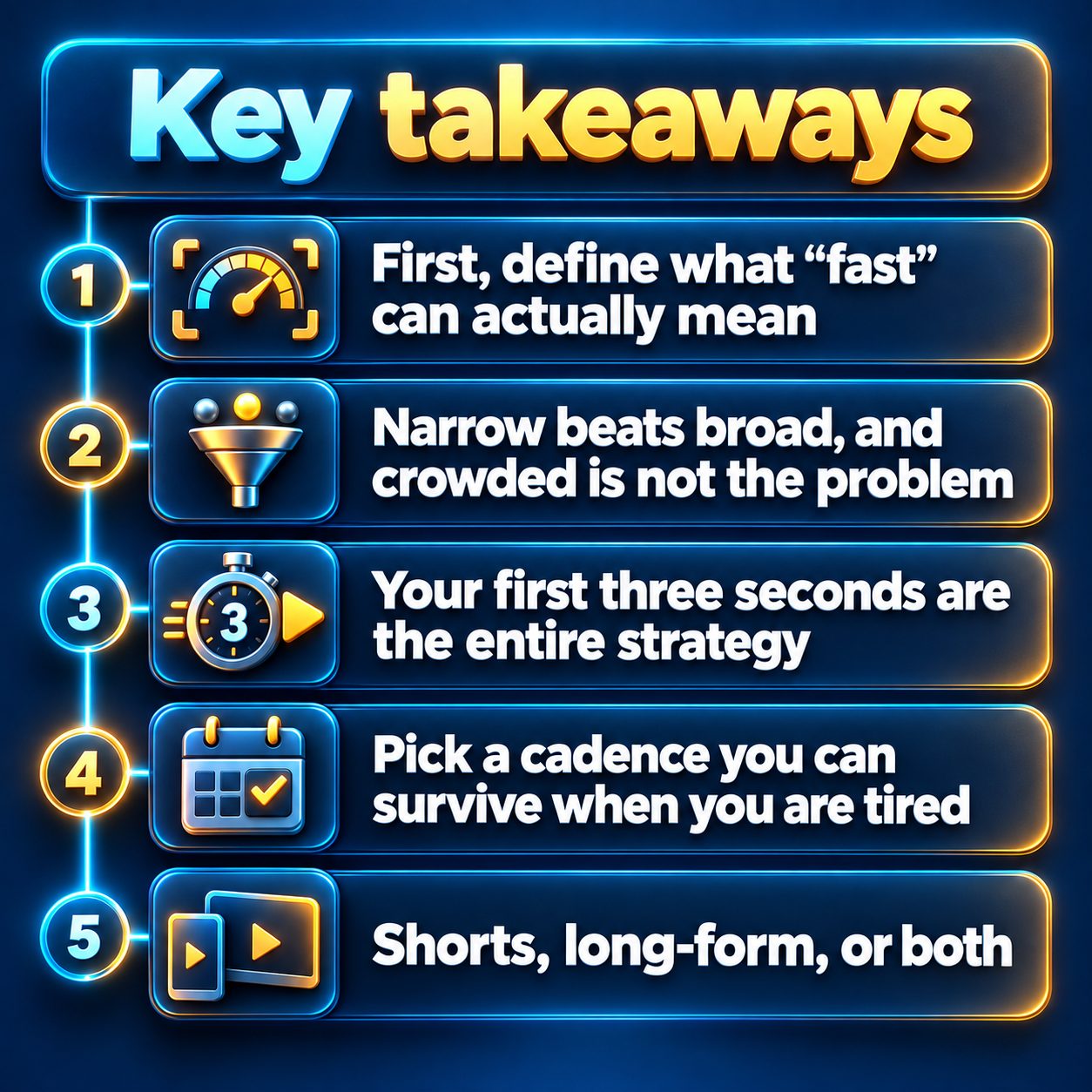
Your first three seconds are the entire strategy
New creators spend hours on the middle of the video. The middle almost never matters if the opening does not hold.
A hook that works usually does one of four things: states something that sounds wrong, opens a loop, names the exact viewer, or drops the viewer mid-scene. "Roman emperors kept dying in the bathroom, and there is a reason" beats "Today we're going to talk about Roman history." "If your boss does this in meetings, it is deliberate" beats "Here are some workplace psychology tips."
Three rules that hold across niches:
- No intro. No channel name, no "welcome back." Start on the sharpest sentence in the script.
- The first visual should already be the subject. A title card is a scroll trigger.
- Say the payoff exists, but not what it is. That is the loop that keeps someone to the end.
Write the hook first, then write the rest of the script to justify it. If you cannot write a hook for a topic, the topic is weak.
Pick a cadence you can survive when you are tired
The unspoken fear here is real: what if you post enthusiastically for two weeks and then stop? Most new channels die exactly there, not from bad content.
So design for the tired version of you. Daily is ideal because it produces data fastest, but a cadence you actually keep beats an ambitious one you abandon. Three a week, forever, wins.
The practical fix is batching. Sit down once a week, write out a list of topics in your niche, and produce the whole week in one session. Keep the format fixed: same length, same caption style, same voice, same visual treatment. Boring and identical is a feature. It cuts your decision-making to almost nothing, and it teaches returning viewers what your channel is.
Then review once a week, not daily. Look at which openings held attention and which did not, and write next week's hooks in that shape.
Shorts, long-form, or both
This is the part people get wrong on money. YouTube classifies vertical or square videos up to three minutes as Shorts, and anything 16:9 or longer as a regular video.
Shorts grow a new channel faster because the feed pushes them to people who have never heard of you. But the monetization paths are very different. The long-form route into the Partner Program asks for 1,000 subscribers plus 4,000 valid public watch hours in 12 months, while the Shorts route asks for 10 million valid Shorts views in 90 days, per YouTube's own requirements. The long-form bar is far more reachable for a small channel.
The sane play: use Shorts to get discovered, and publish longer videos on the same topics so the audience you attract has somewhere to spend watch time. Same niche, two shapes.
Also worth knowing before you build: YouTube demonetizes mass-produced, repetitious content. Reusing one template with the words swapped is the pattern to avoid, whether or not AI is involved.
"Is AI video allowed, and will people judge me?"
No platform down-ranks a video for being AI-made. TikTok, Instagram, and YouTube rank short-form by viewer behavior: watch time, completion, likes, shares. Production method is not an input.
What does hurt: spam patterns like posting near-identical files across several accounts, weak opening seconds, and ignoring a platform's disclosure rule for realistic synthetic media. The disclosure label itself does not reduce reach; skipping it when it is required can get the video removed.
As for judgment, viewers scrolling a feed care whether the story is good. Faceless channels have been normal for years. What people do notice is thin content, and no tool fixes that. AI writes and renders faster than you can, but it cannot pick your niche, and it cannot tell you whether your hook is interesting. That judgment stays yours.
What it can remove is the friction that makes daily posting impossible. A tool like MaqtAi turns a niche and a topic into a finished vertical video with script, voiceover, animated visuals, and animated captions, and its Autopilot and scheduling run a topic queue on a set cadence with an approval step before anything publishes. That is the bottleneck it solves: consistency, not creativity.
What another week of deciding actually costs
Nothing dramatic happens if you wait. That is the problem. The channel just sits at zero, the algorithm gathers no data about who your videos suit, and whoever is in your niche posts seven more times while you pick a name.
The first video is always the worst one. Make it badly, today, and start the clock. New accounts that verify their email get free credits to make the first few videos with no card, so you can see your niche as a finished video before you commit a month to it. Details are on the pricing page.
Doing this by hand is the part most people quit at. MaqtAi writes the script, narrates it, generates the visuals and captions, and assembles the faceless short for you. Verify your email and you get 450 free credits: about 3 videos on the still-frame tier, or one with AI motion. Free renders carry a watermark.
Try it on your niche freeFrequently asked questions
How many videos before a new channel starts moving? Think in months of consistent posting rather than a specific count. Most channels find their working format after a stretch of uploads where they can compare hooks side by side, which is why cadence matters more than polish.
Should I post to TikTok and Instagram too? Yes, but publish the same idea rather than the identical file everywhere with the same caption. Cross-posting multiplies your chances of one video catching, and each platform tests you independently.
Do I need to disclose that a video is AI-generated? If it contains realistic synthetic media that could be mistaken for real, yes, follow the platform's disclosure setting. The label does not reduce distribution, and skipping it when required risks removal.
Is it too late to start a faceless channel? No. Feeds are recommendation-driven, so new accounts get tested on their content rather than their history. Being late only matters if you keep postponing the first upload.
Results vary. Nothing here is a guarantee of views, subscribers, or income.