
First, pick which door you're aiming for
The entry rules are public, and it helps to read them once instead of guessing. YouTube's Partner Program page asks for 1,000 subscribers plus either 4,000 valid public watch hours in the last 12 months or 10 million valid public Shorts views in the last 90 days. So there are two doors, and they're very different sizes.
The Shorts door looks easier because Shorts are quick to make. The catch is that all those views have to land inside a rolling 90-day window, so older views keep dropping out. The watch-hours door is slower at first, but it's much easier to get through. Every minute someone spends on a longer video counts toward it. Once you're in, regular videos also tend to earn a lot more per view than Shorts, which have their own revenue rules.
Here's my honest take after running faceless channels. Use Shorts so people find you, and use regular horizontal videos to build the hours.
"Will a faceless or AI channel even get approved?"
People rarely type this question, but almost everyone has it. The short answer is that how you make the videos isn't what gets channels rejected. Sameness is. YouTube reviews the whole channel, not one video. Its inauthentic content policy targets channels that pump out mass-produced, repetitive videos. Faceless channels aren't shut out of the program, but content farms are.
Here's what a reviewer wants to see when they open your channel:
- Each video says something the others don't. A different topic or angle, and a real payoff at the end.
- A recognizable format and voice, so it looks like a channel someone runs on purpose.
- Nothing lifted. No clips you didn't make and can't explain why you're using.
Worried viewers will judge you for using AI? Mostly they judge boring videos. Platforms rank Shorts on viewer behavior like watch time and completion. How the video was made doesn't factor in. If you use realistic synthetic footage, turn on the platform's AI disclosure. The label doesn't cut your reach, but skipping it can get a video removed.
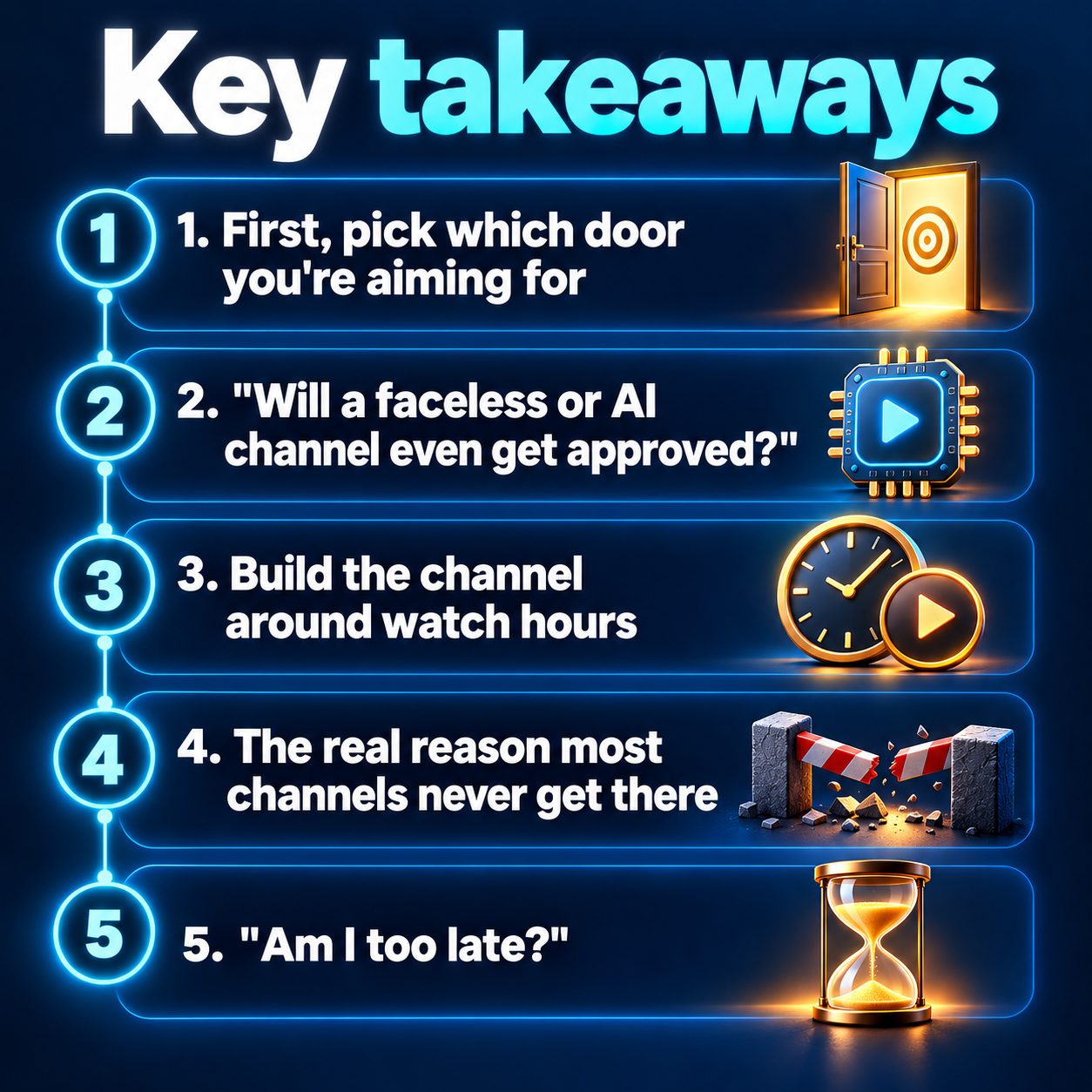
Build the channel around watch hours
This is the part that actually moves you toward the threshold:
- Choose a niche you can talk about for months. History, true crime, stoic ideas and startup stories all have deep topic lists. The niche guide can help if you're torn.
- Pick one structure and repeat it. Put a hook in the first sentence. Then set up a problem, pay it off and end on one next step. When every video follows the same shape, viewers learn to trust it.
- Make regular videos in 16:9, a few minutes long. Anything vertical or square up to 3 minutes gets classified as a Short (YouTube's Shorts spec), so shape your long videos horizontally on purpose.
- Pair each long video with a standalone Short on the same topic. Give it its own payoff. Don't make it a teaser clip. Links in Shorts can't be tapped, so end by inviting viewers to the full video on your channel.
- Read retention, not just views. The spot where people drop off shows you which hook or setup to rewrite next.
The real reason most channels never get there
It's rarely the niche. It's week three. The first videos feel exciting. By the third week, editing is a chore, the numbers are quiet and one missed day turns into a missed month.
So choose a posting rhythm you can keep up even in a bad week. Posting three times a week and sticking to it beats a daily plan you drop. Batch the work into one sitting so posting day is just pressing publish. Decide ahead of time what counts as a fair test. After a couple of dozen videos, judge the channel on retention and which topics held people, not on subscribers.
And if you stop after two weeks? That's fine, as long as you learned something. What really costs you is quitting quietly and starting a brand-new channel from zero every few months.
"Am I too late?"
No. Every niche has established channels, but the recommendation system serves viewers, not seniority. New questions come up every day, and a specific angle on a crowded topic still finds its audience. What's actually late is waiting for the perfect plan while your first ten videos stay unmade.
Where a tool helps, and where it doesn't
Production is usually what breaks the cadence, and that's the friction MaqtAi removes. You give it a niche and a topic. It writes the script, narrates it with an AI voice, animates the visuals, adds captions and assembles the video, and you never go on camera. Pick 16:9 at 2 or 5 minutes and the script automatically follows a long-form structure: a hook, themed sections, then a recap. A finished horizontal video also has a "Make a companion Short" button. It creates a separate vertical video on the same topic with its own payoff. Autopilot can render from your topic queue on a daily, three-times-a-week or weekly schedule. By default, each video waits for your approval before it posts.
Now the honest limits. It won't pick a niche with an audience for you, and it doesn't read trends. It can't make YouTube approve your channel. If you feed it twenty nearly identical topics, you'll get exactly the repetitive channel the policy is built to catch. Choosing topics and angles is still your job, and it's the job that matters most.
What waiting actually costs
Every week you don't post, you collect no retention data. You don't learn which hook works, and your watch-hours clock doesn't move. Meanwhile, someone in your niche is posting today and learning from it. The threshold doesn't get closer on its own.
So take one small step this afternoon. Pick a niche, write down five topics and make one video. MaqtAi gives new accounts 450 free credits when they verify their email, with no card needed. That covers roughly 3 to 4 videos in the default still-frame style, or one with AI motion (see pricing). Free renders carry a watermark, so treat them as a test of the format rather than your first upload. That test is how you find out whether this channel is one you'll keep making.
Doing this by hand is the part most people quit at. MaqtAi writes the script, narrates it, generates the visuals and captions, and assembles the faceless short for you. Verify your email and you get 450 free credits: about 3 videos on the still-frame tier, or one with AI motion. Free renders carry a watermark.
Try it on your niche freeFrequently asked questions
How long does it take to get monetized on YouTube? There's no fixed timeline. It depends on your niche, how consistently you post and how well your videos hold viewers. Plan in months, not weeks, and measure progress by retention before subscribers.
Do Shorts views count toward watch hours? No. Views from the Shorts feed count toward the separate Shorts path, not the watch-hours path. That's why regular horizontal videos matter for most new channels.
Can a faceless AI channel be monetized? Yes, if the videos are original and varied. YouTube's inauthentic content policy demonetizes mass-produced, repetitive content, so every video needs its own angle and payoff.
Should I buy views or subscribers to get there faster? No. The requirements count only valid public activity, and fake engagement puts the whole channel at risk. It also ruins the retention data you need to improve.
Results vary, and nothing here is a guarantee of income or of acceptance into the YouTube Partner Program.